
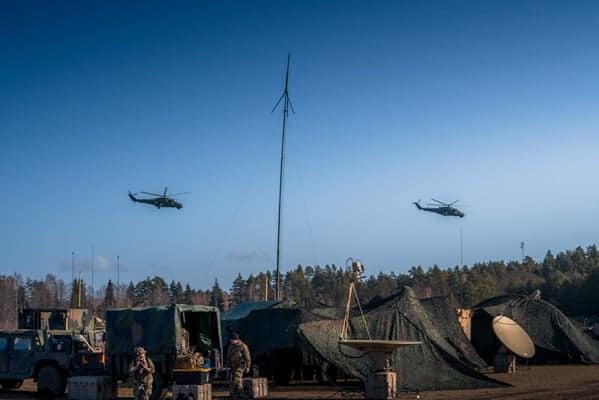
NATO is rapidly strengthening its defences across the Baltic Sea as fears grow that Russia could test the alliance’s resolve in one of Europe’s most vulnerable regions.
From newly built military ramps on Latvia’s coastline to explosive training exercises and reinforcements along the eastern flank, Western forces are preparing for a potential crisis that officials warn could become the biggest test of NATO’s collective defence since the Cold War.
At the centre of the preparations is the Baltic Sea — a strategic corridor bordered by eight NATO members and Russia, and a vital route for trade, military movement and Moscow’s naval ambitions.
During the latest Baltops exercise, US Navy Seabees have been constructing boat ramps on Latvia’s western coast designed to allow troops, vehicles and equipment to move rapidly into the region if conflict breaks out.
The message from commanders is clear: NATO wants Russia to know it is ready.
Capt Allen Willey, commander of the US Navy construction battalion, inspected one of the ramps built specifically for rapid military deployment.
The Seabees, famous for their “Can Do” motto dating back to 1942, are expected to play a crucial role in keeping NATO forces supplied and operational during any potential confrontation.
Read more related news:
Explosions rock Crimea leaving Russians in the dark
Putin expected Ukraine to fall, but instead they built a weapons revolution
Putin’s riviera has no fuel, no tourists, bridges burning and soldiers fleeing
Putin stages nuclear war drill north of Britain as top Kremlin ally ‘backs atomic strike’
Military officials increasingly describe the Baltic region as a possible flashpoint.
Swedish officials have warned that Russia could consider attempting to seize Gotland Island — a strategically important location in the Baltic Sea — as a way of testing NATO’s response.
Analysts have also raised concerns about hybrid attacks, including sabotage targeting critical infrastructure such as undersea cables.
Western officials fear Moscow could attempt to exploit perceived weaknesses in the alliance, creating a major test of NATO’s Article 5 commitment that an attack on one member is treated as an attack on all.
Lt-Cdr Cody Robertson said the exercises were designed to ensure forces were ready.
“This exercise will make us better prepared, if defence is required,” he said.
The arrival of Finland and Sweden into NATO has significantly changed the strategic balance in northern Europe, bringing two militarily capable nations into the alliance’s defensive planning.
Concerns have intensified after satellite imagery reportedly showed Russia clearing areas near its western borders for new military infrastructure, including barracks, vehicles and combat formations.
Security officials have also pointed to suspected Russian sabotage activity targeting undersea infrastructure in the Baltic region.
Former Latvian intelligence chief Janis Kazocins warned that the Baltic states remain particularly exposed.
“As tiny countries with limited resources, we need to be absolutely sure that our deterrence is strong enough,” he said.
Latvia, which has direct experience of Soviet occupation, has responded by dramatically increasing defence spending, allocating almost 5 per cent of GDP towards security.
The UK has been contributing forces and support to NATO exercises and deterrence operations in the region as part of efforts to strengthen the alliance’s eastern defences.
British officials have repeatedly stressed that preventing conflict depends on convincing potential adversaries that any attack would trigger a united response.
For Latvia, the presence of allied troops is seen as both reassurance and a warning.
Foreign Minister Baiba Braze said American support remained vital for European security.
“The United States has been, and remains, an indispensable ally for Latvia and European security,” she said.
The Baltic Sea carries around 15 per cent of global cargo traffic and remains strategically important for Russia because of access to the Baltic Fleet and the heavily armed Kaliningrad enclave.
Military leaders have repeatedly highlighted that wars are often decided not only by weapons but by logistics — the ability to move, supply and sustain forces.
That is why NATO’s latest exercises focus heavily on the practical details of war: building access points, moving equipment, clearing obstacles and preparing command locations.
As explosions echoed across training grounds and engineers completed their work, the message from NATO was unmistakable.
The alliance is preparing for a conflict it hopes never comes.
But in the Baltic, where geography and history have made the region a pressure point between Russia and the West, officials believe preparation may be the strongest deterrent of all.


Leave a Comment