
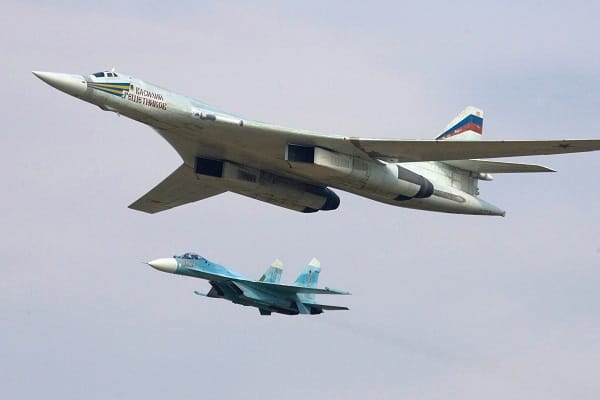
The appearance of Russian strategic bombers over the Norwegian and Barents Seas would once have been viewed as a routine demonstration of military capability. Today, it is interpreted through a far darker lens.
As Moscow dispatched Tu-160 nuclear-capable bombers on a 16-hour mission north of Britain this week, NATO fighter jets moved swiftly to intercept and monitor the aircraft.
The manoeuvre came amid some of the most explicit nuclear rhetoric to emerge from senior Russian circles since the invasion of Ukraine began more than four years ago.
The timing was difficult to ignore.
While the Kremlin continues to reject Western demands for a ceasefire in Ukraine, reports from Moscow suggest that Foreign Minister Sergei Lavrov privately expressed support for the potential use of nuclear weapons during a closed-door foreign policy discussion.
Read more related news:
Moscow warns UK to stop arming Ukraine or London will ‘go up in flames’
Russia’s ‘invincible’ missile factory turns into a giant smoke stack
Ukraine puts Crimea in a chokehold as Putin runs out of options
Putin’s riviera has no fuel, no tourists, bridges burning and soldiers fleeing
Whether intended as a serious policy signal or an exercise in strategic ambiguity, the remarks have reinforced concerns that Russia’s political elite is becoming increasingly comfortable discussing scenarios that were once considered unthinkable.
For European capitals, the concern is not that nuclear conflict is imminent. Rather, it is that the threshold for nuclear brinkmanship appears to be falling.
The Tu-160, known by NATO as the “Blackjack”, occupies a unique position in Russia’s military arsenal. Designed during the Soviet era and capable of carrying both conventional and nuclear cruise missiles across intercontinental distances, it remains one of the most visible symbols of Moscow’s strategic deterrent.
Flying such aircraft close to NATO territory sends a message that extends beyond military signalling. It is intended to remind Western governments that Russia retains escalation options far beyond the battlefields of eastern Ukraine.
Financial markets, notably, have shown little reaction.
Investors have become accustomed to geopolitical shocks that would once have rattled global assets. Oil prices have retreated in recent weeks as traders focus on Middle Eastern diplomacy and improving supply expectations. Equity markets continue to trade near record levels in many regions. Bond investors remain preoccupied with inflation and interest rates rather than military tensions in northern Europe.
Yet history suggests that markets often underprice low-probability, high-impact risks until they become unavoidable.
The greater concern for policymakers is that repeated nuclear threats gradually become normalised. Each strategic bomber patrol, each warning from Moscow and each confrontation between Russian and NATO aircraft risks becoming another data point in a dangerous cycle of escalation.
Meanwhile, the conflict itself shows little sign of easing.
Ukrainian forces continue to target military infrastructure and fuel facilities in occupied Crimea, seeking to weaken Russia’s grip on the Black Sea peninsula. Reports of fuel shortages, disrupted transport links and repeated security alerts underscore Kyiv’s determination to raise the cost of occupation.
The temporary closure of the Crimean Bridge, one of Vladimir Putin’s flagship infrastructure projects, reflects the growing vulnerability of Russian positions far behind the front lines.


Leave a Comment