
For people like my wife, whose home was in Crimea, these developments are being watched with a mixture of hope, anticipation and caution.
After Russia’s first invasion in 2014, her family was forced to leave Crimea and rebuild their lives in Mariupol. Then, in 2022, Putin launched his full-scale invasion and stole that home too, twice displaced & twice robbed of a future they had spent years rebuilding.
They are not alone.
Millions of Ukrainians have seen their homes, businesses, livelihoods and communities taken from them by a war driven by imperial ambition and a sense of entitlement that treats sovereign nations as possessions rather than neighbours. Today, many of those internally displaced families are watching events unfold in Crimea with growing interest, wondering whether the peninsula that began this tragedy may one day be returned.
For years, Crimea was presented by the Kremlin as the jewel in Vladimir Putin’s imperial crown.
The bridge, the beaches & the Black Sea Fleet. Endless Russian propaganda depicting the peninsula as an untouchable fortress permanently secured within Moscow’s orbit.
Today that image is becoming increasingly difficult to maintain.
Across occupied Crimea fuel sales have now been halted for civilians and businesses, with supplies reserved almost exclusively for state agencies and essential government functions. Long queues have become commonplace, rationing has steadily tightened and Russian occupation authorities have openly acknowledged a crisis that only months ago many would have dismissed as impossible.
Russia, often described as little more than a gas station with nuclear weapons, has found itself unable to keep fuel flowing to one of its most prized territories, however, the fuel crisis did not appear overnight. Ukrainian strikes against logistics routes, fuel depots, ports and transport infrastructure have been steadily constricting supply lines into Crimea for months. What began as restrictions on fuel purchases evolved into rationing, coupon systems and capped sales. Today authorities have moved to prioritize military and government requirements over civilian demand altogether.
The consequences extend far beyond motorists.
Crimea’s economy has become heavily dependent on tourism since 2014. Every summer millions of Russian tourists were encouraged to visit the peninsula as both a holiday destination and a symbolic demonstration of Russian control.
This year the season has barely begun and already appears to be faltering.
Russian travel agencies report collapsing bookings, holiday cancellations and a sharp reduction in visitor numbers. Some reports suggest bookings have fallen dramatically compared to previous years, while Crimea has reportedly dropped out of Russia’s most popular domestic destinations altogether.
A tourist industry cannot function when visitors cannot reliably purchase fuel, when ferry services are disrupted and destroyed, or when drone alerts dominate local news.
Many Russians are voting with their feet.
Crimea is beginning to feel like a Mariupol moment for Russia.
Fuel shortages are spreading across the peninsula, strikes are hitting logistics, and the Kerch Bridge now appears higher on Ukraine’s target list than at any point in the war.
We’re also hearing from reliable local… https://t.co/BW7g04FB6i pic.twitter.com/oPvwD99xsr
— Shaun Pinner (@ShaunPinnerUA) June 21, 2026
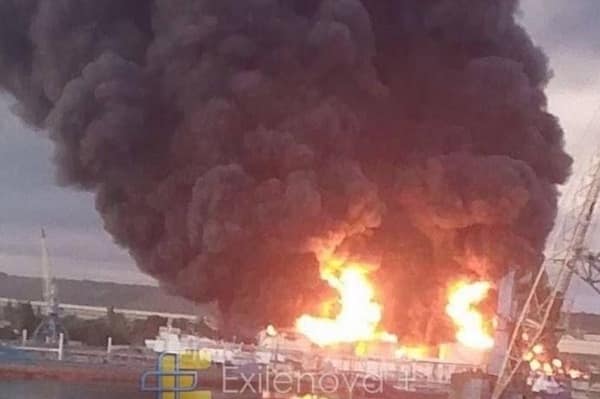
Over the weekend, Ukrainian strikes ignited fires at fuel and logistics facilities in Kerch and Port Kavkaz, targeting infrastructure critical to supplying occupied Crimea. Geolocated imagery and local footage showed major fires at oil-handling facilities, while videos emerging from Port Kavkaz appeared to show multiple ferries burning near key supply points across the Kerch Strait.
These ferries matter.
They are not merely civilian transport links. They form part of the logistical network that helps sustain Russian military operations across Crimea and the southern corridor. Every ferry disabled, every depot damaged and every delay imposed places additional strain on Russia’s ability to sustain operations on the peninsula.
That brings us to one of the most interesting developments emerging from the battlefield.
Rubicon.
Russia’s elite drone organisation was created to centralise unmanned warfare, bringing together research, procurement, training and operational deployment under a single structure. Over the last year Rubicon has become one of Russia’s most capable drone formations and a key component of Moscow’s efforts to regain the initiative in the drone war.
Yet reports increasingly suggest that significant Rubicon resources are now being directed toward defensive missions protecting critical logistics and supply routes rather than supporting offensive operations.
That should not be overlooked.
Elite units are strategic assets. Commanders generally deploy them where pressure is greatest.
If Rubicon is being increasingly tasked with defending the southern corridor, protecting logistics routes and countering Ukrainian deep-strike capabilities, it tells us something important about Russian priorities.
It suggests Moscow recognises Crimea’s vulnerability.
Every drone assigned to defensive operations is a drone unavailable for offensive action elsewhere. Every operator protecting supply routes is an operator not supporting battlefield advances.
In military terms, that is resource diversion, while in strategic terms, it is a warning sign. All of this is unfolding against the backdrop of expectations that Russia is preparing a major retaliatory strike following recent Ukrainian operations against Moscow and deep inside Russia itself.
Those attacks did more than create headlines, they exposed uncomfortable realities.
Russian air defences have repeatedly struggled against increasingly sophisticated Ukrainian drone operations while questions continue to emerge regarding training standards, readiness, command structures and the ability to protect critical infrastructure across enormous distances. Even Russian military bloggers have increasingly voiced frustrations about gaps in preparedness and coordination.
The image of total control is becoming harder to sustain, but that does not mean Russia is defeated, far from it.
Russia retains enormous military capabilities and remains capable of launching devastating strikes against Ukrainian cities and infrastructure, but, the strategic picture in Crimea is changing and for the first time since 2014, the peninsula increasingly resembles a liability rather than an asset.
Fuel is scarce.
Tourists are staying away.
Property owners are looking to leave.
Ferries are burning.
Supply routes are under pressure.
And Russia’s most capable drone formations appear increasingly focused on defending what it already holds rather than enabling new advances. Crimea was once presented as the symbol of Russia’s resurgence, today it is beginning to look more like the centre of gravity in a campaign designed to expose Russia’s vulnerabilities.
The gas station of the world has run out of gas.
And everyone can see it.


Leave a Comment