
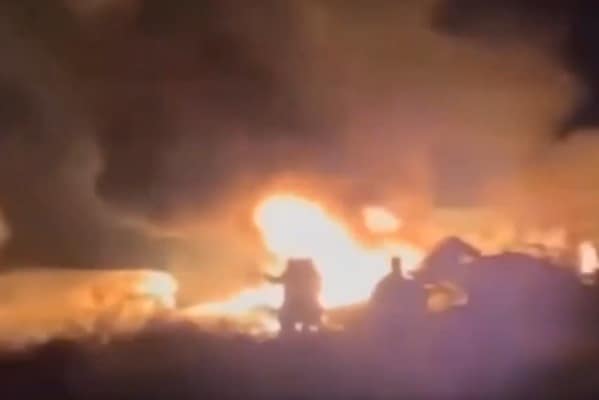
A Russian Tu-95 strategic bomber crashed during a training flight in the country’s Far East on Tuesday, killing six crew members and injuring another, in an incident that raises fresh questions over the reliability of Moscow’s ageing long-range aviation fleet.
The aircraft came down in Amur Oblast, near the village of Krasnoyarovo, according to Baza, a Telegram channel with links to Russia’s security services. Russia’s defence ministry, cited by the Kremlin-controlled Interfax news agency, confirmed the deaths and said the aircraft had been conducting a training flight.
Moscow had not publicly established the cause of the crash at the time of publication.
Baza reported that a preliminary theory was that a fuel explosion occurred on board the aircraft. The account has not been independently verified.
Read more related news:
Kremlin told an attack on Estonia could ignite a wider NATO conflict
Putin targets 1.55m active troops as Europe watches nervously
Defence Secretary tells Brits to prepare for ‘war’ and buy water and food
Estonia accuses Russian intelligence of an arson attack on a NATO defence company
The bomber was reportedly attached to the Ukrainka strategic aviation grouping, based at Ukrainka airbase in Amur Oblast. The region borders China and is thousands of kilometres from the Ukrainian battlefield.
The location is significant because Russia has moved some of its strategic bomber fleet further east following repeated Ukrainian drone attacks on military airfields closer to the front.
The Tu-95, a Soviet-era turboprop strategic bomber that entered service in 1956, remains a central component of Russia’s long-range strike capability. Moscow has repeatedly used Tu-95 aircraft to launch cruise missiles at targets in Ukraine while remaining inside Russian airspace.
The loss of another strategic aircraft would therefore have implications beyond the immediate crash, particularly as Russia continues to rely on an ageing fleet for long-range operations.
Russia’s aviation industry has also faced increasing difficulties since the invasion of Ukraine, following western sanctions that have restricted access to foreign-made components and other aviation technology.
The impact on military aviation is harder to establish, given the secrecy surrounding Russia’s defence-industrial base and the country’s ability to maintain and refurbish Soviet-era aircraft.
A Russian Tu-95MS Bear heavy bomber crashed on takeoff in Amur this evening during a training flight.
The airframe is a total loss, with no survivors reported. pic.twitter.com/tbujV6RVP5
— OSINTtechnical (@Osinttechnical) September 29, 2026
The crash nevertheless adds to a series of recent aviation accidents in Russia.
In July 2025, an Antonov An-24 passenger aircraft crashed in Amur Oblast while carrying 49 people. Russian emergency services told state media that all those aboard were believed to have died.
The Tu-95 accident occurred against the backdrop of sustained pressure on Russia’s strategic aviation forces. Ukraine has increasingly targeted Russian military infrastructure deep inside the country, forcing Moscow to disperse valuable aircraft and strengthen protection around airbases.
For Russia, the strategic bomber fleet remains particularly important because it allows the Kremlin to launch long-range cruise missiles without sending aircraft into Ukrainian-controlled airspace.
The circumstances surrounding Tuesday’s crash remain unclear. Until Russia publishes a fuller account of the incident, it is not possible to establish whether mechanical failure, fuel problems, operational error or another factor caused the aircraft to go down.
But the loss highlights the costs of maintaining a fleet whose origins stretch back to the Soviet era while Russia’s war economy and military aviation infrastructure remain under sustained pressure.


Leave a Comment