
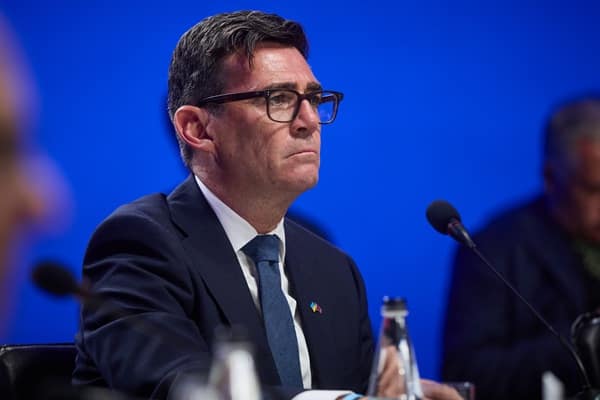
Andy Burnham has pledged to break with four decades of privatisation and reshape the relationship between the state and the British economy, using his first Labour conference speech as prime minister to promise a “new path” for the country.
Opening his address in Liverpool with a call for national unity, Burnham said his “rallying call to the country today” was “all together now”, arguing that Britain could overcome its economic and political difficulties by acting collectively.
“When we pull as one, there is nothing we can’t do,” he said.
“Today, we draw a line on a decade of division. We stop doom scrolling on posts running Britain down. And we put the country on a new path.
“Britain with belief again. People with hope again.”
Burnham also paid tribute to his predecessor, Sir Keir Starmer, thanking him for Labour’s victory at the previous general election.
“For the historic victory he achieved for us, I’m here to say thank you, Keir,” Burnham said.
But the speech quickly moved towards a critique of the economic settlement that has shaped Britain since the 1980s, with Burnham promising a significant shift towards public control of essential services.
“Britain has been on the wrong path for a long time,” he said, citing “deindustrialisation, deregulation, privatisation, austerity, Brexit” and arguing that these changes had produced “a country run for vested interests not in the public interest”.
He pledged to “make a break with the direction of the past 40 years and put Britain on a new path, build a new economy and a new politics”.
Burnham singled out the privatisation of essential services, arguing that “homes, water, energy, transport, care, healthcare” had been “broken up and sold off”.
“The British right talk about taking back control. Never let them forget, they are the ones that gave it away in the first place,” he said.
He argued that economic control had been weakened through the sale of essential services, while political control had been eroded through the reduction of local government powers.
The housing market was another target. Burnham said councils would be given greater powers to bring properties into public housing stock, particularly where homes were abandoned or poorly maintained.
He criticised landlords who fail to maintain properties while receiving income linked to the benefits system, describing homes in poor condition as a threat to both residents’ health and surrounding communities.
Negligent landlords would first be warned to improve their properties, he said. If they refused, councils would be given greater powers to acquire them, with legislation introduced if necessary.
“We don’t let people sell food which damages health, so why allow it with homes from now on? We won’t,” Burnham said.
The prime minister also announced plans for a strengthened Water Bill, to be introduced by environment secretary Angela Eagle.
Water companies have faced sustained political pressure over sewage discharges, infrastructure investment, consumer bills and financial stability. Burnham used the issue to make a broader argument about the consequences of privatisation.
“Water is a symbol of what has gone wrong with Britain,” he said.
“A service where the shareholders never lose and the public never win. From which some have syphoned out easy money, while the public picked up the bill for the sewage in our seas.
“It stinks. I will not allow it to continue like this.”
The centrepiece of the proposed legislation, Burnham said, would be the repeal of Margaret Thatcher’s “ideological ban on public ownership of water companies”.
The announcement stops short of committing the government to immediate nationalisation of individual water companies, but represents a significant shift in the policy debate over the future ownership of the sector.
Burnham presented the programme as part of a wider attempt to transfer economic power towards communities and the public sector.
His message was framed around hope, but its policy implications were rooted in a rejection of much of the economic settlement of the past four decades.
“Hope comes from honesty and we will have hope again,” he said. “But first, honesty.”
The speech therefore offered a clear political proposition: that rebuilding Britain would require not simply higher public spending or new investment, but a redistribution of control over some of the country’s most important economic assets.


Leave a Comment