
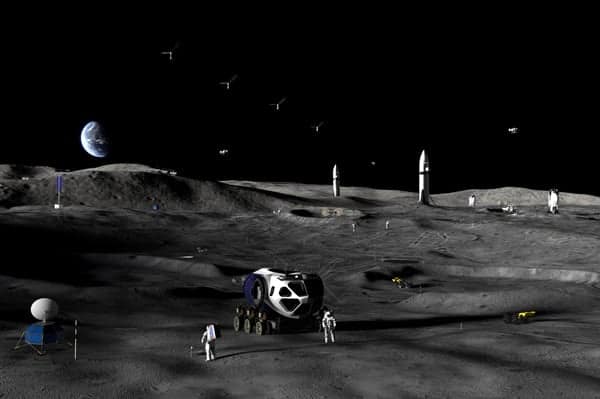
NASA has revealed ambitious new plans to establish a semi-permanent human presence on the Moon by 2029, outlining a vast lunar base that could eventually resemble “a city” spread across hundreds of square miles.
The space agency unveiled details of the programme during a press conference on Tuesday, describing it as a phased strategy developed in collaboration with commercial companies, universities and international partners.
Officials said the project would initially focus on establishing reliable access to the lunar surface through the Artemis programme before expanding into long-term habitation and scientific operations at the Moon’s South Pole.
According to NASA’s timeline, the first operational phase of the Moon base is expected to begin by 2029, with the aim of establishing a sustained human presence by 2032.
The programme is closely tied to the Artemis missions, which are intended to return astronauts to the Moon for the first time since the Apollo era.
Following the planned Artemis II lunar flyby mission, NASA intends to carry out a crewed lunar landing in late 2028 as part of Artemis V.
Blue Origin, the space company founded by Jeff Bezos, will play a major role in the programme by developing lunar landers and logistics systems.

NASA also announced a series of unmanned precursor missions beginning this year, including Moon Base 1 — described as the first privately funded lunar lander mission in history.
Another mission, Moon Base 2, will involve delivering cargo and a rover to the lunar surface using a Griffin 1 lander.
A third mission will carry scientific payloads from international partners, including the European Space Agency and South Korea’s space programme.
Phase one of the overall strategy will involve 25 launches and 21 lunar landings, delivering approximately 4 tonnes of equipment and supplies to the lunar surface.
NASA officials said the South Pole region was selected because of its potential access to water ice, which could prove critical for long-term habitation and future deep-space missions.
Jared Isaacman said the Moon base would serve as a training ground for eventual missions to Mars.
“Really, it is to have an environment where we can work with the water, ice and master the skills for where we go next, which is Mars,” he said.
“And it would be nice to do that when you’re four days away from home than many months away from home.”
NASA said the long-term objective remained a crewed mission to Mars, with Isaacman stating that the agency hopes to “plant the stars and stripes on Mars” one day.

Nujoud Merancy, the programme’s chief architect, said the scale of the lunar settlement reflected the Moon’s harsh, fragmented terrain, which requires power systems, scientific infrastructure and habitation zones to be spread over wide distances.
Habitats will reportedly be positioned on elevated terrain to maximise sunlight exposure, while power infrastructure will be located more than a kilometre away because of radiation concerns.
“All these things, when you start putting them together, end up sprawling a little bit more like a city,” she said.
The plans mark the most detailed blueprint yet for a long-term return to the Moon, as global competition intensifies between the United States, China and private companies seeking to shape the future of space exploration.


Leave a Comment