
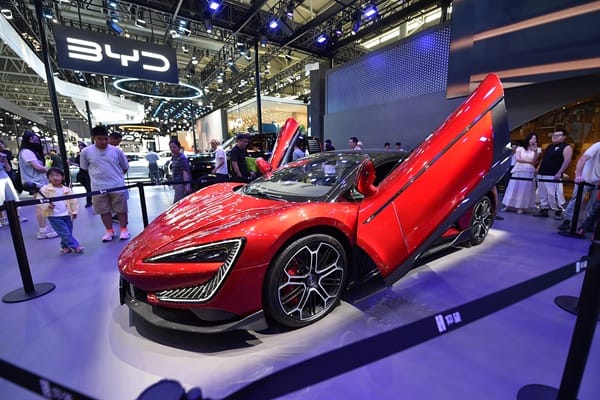
Britain is weighing tariffs on Chinese electric vehicles as ministers confront the rapid expansion of Chinese carmakers in the UK market and growing pressure to shield domestic manufacturers from subsidised imports.
Business Secretary Jonathan Reynolds is reportedly preparing a package of potential measures, according to The Times, amid concerns that Chinese manufacturers are “dumping” state-subsidised vehicles into Britain.
No tariffs have yet been imposed, and the government has stressed that any decision will be based on Britain’s economic interests rather than simply following the European Union.
A government spokesperson said: “We always put trade measures in place independently and based only on the UK’s economic interests and those of industry.
“However, Europe and the UK face many of the same challenges, which is why it is vital we protect trade flows between us.
“We want to explore deeper cooperation with the EU to unlock opportunities for industry and strengthen economic growth, while avoiding collateral damage in our shared ambition of tackling unfair trading practices globally.”
The potential move comes as Chinese brands rapidly gain ground in Britain, helped by competitive pricing, increasingly sophisticated technology and a growing range of electric and hybrid vehicles.
September’s registration figures underline the scale of the shift. The Jaecoo 7, made by China’s Chery group, was the UK’s best-selling new car, with 10,813 registrations, according to preliminary Society of Motor Manufacturers and Traders data.
Chinese manufacturers also occupied three positions in September’s top 10 battery-electric vehicle rankings. BYD’s Sealion 7 recorded 3,191 registrations, followed by the BYD Seal on 3,184, while Leapmotor’s B10 recorded 1,883.
The broader expansion is forcing established manufacturers to confront a more competitive market just as the industry is absorbing the enormous cost of the transition towards electric vehicles.
The EU has already imposed additional duties on Chinese electric vehicles, with the bloc’s measures reaching as high as 45 per cent depending on the manufacturer. Britain is now considering whether to move closer to that position.
The question is complicated by Britain’s dependence on the European market. Brussels is developing “Made in Europe” policies designed to favour European production and reduce reliance on Chinese components. Failure to align could leave British manufacturers exposed to additional costs when exporting into the EU.
That creates a difficult calculation for ministers. Tariffs could provide greater protection for established manufacturers, but could also raise prices for consumers, complicate Chinese investment plans and risk retaliation from Beijing.
For Britain, the issue is therefore no longer simply about the price of an electric car.
It is becoming a test of how far the government is prepared to intervene in trade to protect industrial capacity — while avoiding measures that ultimately make cars more expensive and weaken the supply chains on which British manufacturers themselves depend.


Leave a Comment