
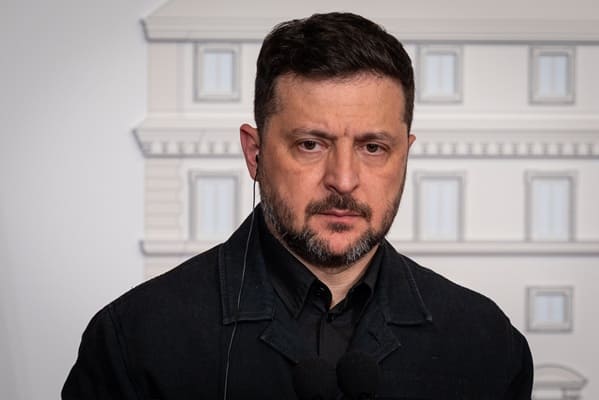
Volodymyr Zelensky has warned that Ukraine will respond to Russian ceasefire violations with what he called “long-range sanctions,” signalling a further escalation in strikes deep inside Russian territory as a fragile series of symbolic truces disintegrates within hours.
The Ukrainian president said Moscow had shown “no real interest in peace,” accusing the Kremlin of treating temporary ceasefires as little more than public relations exercises tied to Victory Day celebrations in Moscow while continuing sustained attacks on Ukrainian cities and infrastructure.
Russia announced a ceasefire for May 8–9 ahead of its annual commemorations, but Kyiv responded by proposing its own halt to hostilities starting at midnight on May 6. Within hours, Ukrainian officials said that the arrangement had already been violated on a massive scale.
Zelensky later claimed Russia had broken the Ukrainian-proposed ceasefire 1,820 times by the morning of May 6 alone, including drone strikes, artillery fire and coordinated assaults along multiple front-line sectors.
“The enemy continues to kill people and is completely inadequately concerned only about a few hours of silence in one part of Moscow,” Zelensky said in a statement, framing the Russian pause as selective and politically motivated.
The escalation continued overnight into May 7, when Russian strikes killed at least 13 civilians and injured 54 more, according to regional authorities.
Sumy Oblast suffered the heaviest toll, with five killed and several wounded, prompting local officials to declare a day of mourning. Kharkiv, Donetsk and Kherson regions also came under sustained attack, with reports of damaged residential buildings, energy facilities and transport infrastructure.
Ukrainian officials said Russia launched close to 100 attack drones overnight, alongside multiple air strikes and dozens of assaults on front-line positions. Railway infrastructure and locomotives were also hit in several regions, part of what Kyiv describes as an effort to disrupt civilian logistics and economic stability.
Beyond immediate casualties, Ukrainian authorities said Russian strikes continued to target energy systems already weakened by years of war. Power infrastructure has repeatedly been hit in waves of attacks designed to strain heating, electricity and industrial capacity.
Rail networks have also become a frequent target, with Kyiv accusing Moscow of attempting to undermine military supply routes and civilian transport links deep inside Ukraine.
In a notable escalation, Zelensky said Ukraine had conducted strikes in the Russian city of Perm, more than 1,500 kilometres from the border, alongside recent operations in Chelyabinsk, Yekaterinburg, Novorossiysk and Tuapse.
The comments underline Ukraine’s growing ability to conduct long-range operations inside Russia, likely using domestically produced drones and long-range systems. Kyiv has increasingly framed such strikes as retaliatory measures aimed at military and industrial targets supporting Russia’s war effort.
“Every day, Russia can choose to stop its war,” Zelensky said. “And not for a few hours to get permission for a parade in Moscow, but to save human lives.”
The collapse of the latest ceasefire proposal follows a familiar pattern in the war. Temporary pauses tied to symbolic dates—including religious holidays and commemorative events—have repeatedly been announced, only to break down amid mutual accusations of violations.
During the Orthodox Easter truce in April, Ukraine claimed Russia breached the ceasefire more than 10,000 times in just over a day, underscoring the absence of any sustained operational pause.
Western officials have long expressed scepticism over such announcements, viewing them as largely rhetorical rather than enforceable agreements on the ground.
Zelensky said Ukraine remains open to diplomacy, but only if Russia takes what he called “real steps” towards ending the war rather than temporary tactical pauses.
For now, however, both sides appear locked in an escalating cycle: intensified Russian strikes on Ukrainian cities, expanding Ukrainian attacks on Russian territory, and short-lived ceasefires collapsing almost as soon as they are declared.
As Victory Day approaches in Moscow, the battlefield is widening rather than narrowing—and any notion of a pause in the fighting appears increasingly distant.


Leave a Comment