
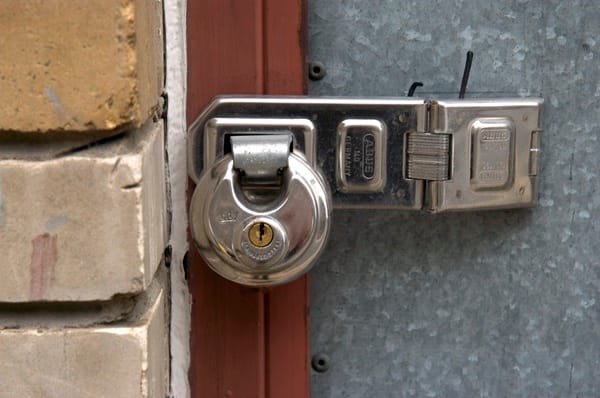
Most people treat property security as a single decision rather than an ongoing one. Something gets locked, a camera goes up, and that’s considered job done. The problem is that physical security is a system, and any one part of it is only as effective as everything around it. A good lock on a weak setup is still a weak setup. Lighting without physical hardware gives you a record of what happened but doesn’t stop it. Knowing where the gaps actually are is most of the battle. Here’s what’s worth getting right.
Match the lock grade to what you’re protecting
CEN grades on padlocks exist for a reason. The European CEN grading scale runs from 1 to 6, with Grade 6 representing the highest level of resistance to attack. For anything low-risk like a locker or luggage, a basic padlock does the job. For a van, garage, or shipping container holding anything of value, you shouldn’t be looking at anything below CEN Grade 4. The CEN grade is independently verified, not just something the manufacturer claims. If your insurer specifies a minimum security level, the CEN grade is the number they’re referencing.
The experts at Locks Direct recommend starting with your CEN grade before anything else. Get that right and the rest of the decision becomes much easier to navigate.
Fences are only as good as how they’re maintained
A fence that can be pushed over or a gate with a corroded latch doesn’t provide much of a barrier regardless of what’s on the lock. Loose panels, rotting timber, and lifted hinges are the kind of thing that’s easy to ignore until it becomes a problem. A periodic check of the perimeter, tightening fixings and replacing anything that’s degraded, keeps the physical barrier doing its job.
For gates specifically, check that the gap between the gate and the frame doesn’t allow someone to reach through and manipulate the lock or latch from the other side. A padlock positioned out of reach from outside is harder to attack than one that can be gripped through a gap.
Visibility cuts both ways
Storing expensive tools or equipment where they’re visible from the street or a footpath is an advertisement. If something worth taking can be seen easily, it’s already halfway to being a target. Where it’s possible, store high-value items in a shed or inside rather than out in the open.
The flip side is that a visible, clearly specified padlock on a gate or door does act as a deterrent. Something that looks like it would take significant effort to defeat changes the calculation for an opportunist who’s looking for an easy job.
A good padlock on a bad hasp is still a bad setup
This is probably the most common mistake people make. The hasp and staple, the two-part fitting the padlock clips through, is just as important as the lock itself. If the hasp is mild steel, poorly fixed, or leaves the padlock shackle exposed, a thief can go straight past the lock entirely.
According to the team at LocksDirect, there are a few things to look for: the hasp should hide its fixing screws when it’s in the closed position, so they can’t be unscrewed from the outside. The hinge should be solid and welded, not a weak point that levers apart with minimal effort. And the hasp security rating should match the padlock it’s paired with. Fitting a high-grade padlock to a basic hasp is a mismatch, and it’s something LocksDirect’s team flags regularly when customers call in.
Lighting does more work than people give it credit for
Opportunist thieves rely on time and cover. A motion-activated floodlight covering a gate, shed, or yard removes both. It doesn’t need to be complicated: a solar-powered unit positioned so it triggers before someone reaches the access point is enough to make most people reconsider. Dark corners next to outbuildings are worth prioritising, as they’re typically where someone would stand to work on a lock without being seen from the road.
Lighting also supports whatever else you’ve got in place. A camera without adequate light won’t capture anything useful. A padlock in the dark is harder to check and easier to tamper with undetected.
Get the hasp fixings right
Even a good hasp becomes a weak point if it’s poorly installed. The most important principle is bolts over screws wherever the construction allows it. Carriage bolts run through the door and frame and are secured from the inside with a washer and nut, so there’s nothing accessible to remove from the outside.
If you’re fixing into timber, the frame itself needs to be substantial. A well-made hasp bolted to a thin decorative board is still a thin decorative board. And once everything’s fitted, check that there’s no noticeable play when the hasp is in the closed position. Any gap is what a bolt cutter needs to work with.
Outdoors means weatherproof, not just weather-resistant
Standard padlocks corrode, seize, and fail when they’re left outside through a British winter. A lock that worked fine in September can be completely seized by February, which is not when you want to find out it’s failed.
Weatherproof padlocks are built differently to standard models. They use corrosion-resistant materials like solid brass or stainless steel, and the mechanisms are sealed to keep moisture out. ABUS and Squire’s weatherproof ranges use what they describe as NANO-PROTECTION on the internal components, which makes them genuinely suited to years of outdoor exposure rather than a single season.
If a lock is going to live outdoors permanently, specify weatherproof from the start. Replacing a seized lock mid-winter costs more time and money than getting it right the first time.
Anchor points matter as much as locks for bikes and equipment
A padlock securing a bike to nothing is just a padlock. The lock needs something substantial to attach to, which is where ground or wall anchors come in. Locks Direct stock anchors specifically designed for this purpose: floor-mounted anchors for garages and outbuildings, and wall-mounted options where a floor fix isn’t practical. A bike or generator secured to a properly fixed anchor with a decent chain and padlock requires a level of effort and noise that most thieves won’t risk.
The chain matters too. A lightweight cable attached to a high-grade padlock is still a weak chain, and the weakest point determines how long the whole thing holds.
Cameras and alarms complement physical security, they don’t replace it
A visible camera is a deterrent and, if something does happen, it gives you something to work with afterwards. Shed alarms triggered by motion or door contact are affordable and loud enough to stop most people in their tracks. Both are worth having where the risk justifies it.
That said, neither substitutes for physical security. A camera records what happened. A decent padlock and solid anchor point is what prevents it from happening. The two approaches work together rather than instead of each other.
Restricted keys are worth considering for business premises
For anyone managing staff access, key control is a concern. Standard keys can be copied at any locksmith, which means you can’t be sure how many copies exist once a key leaves your hands.
Restricted key padlocks use patented key profiles that can’t be duplicated without authorisation from the original supplier. They give you more control over who can get a copy cut. It’s the kind of thing that seems like a detail until someone leaves and you’re trying to figure out if they copied their key on the way out.


Leave a Comment