
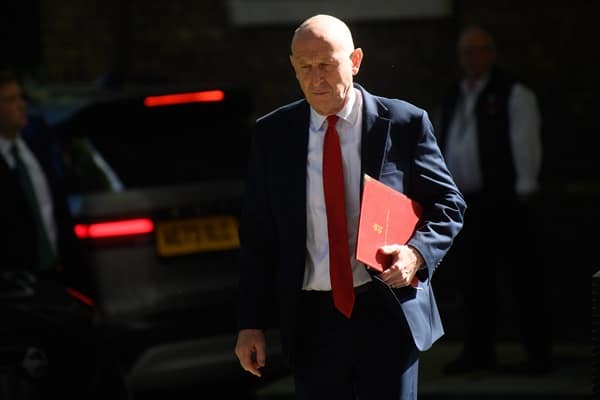
John Healey faces mounting pressure to fund a £10billion annual increase in defence spending as Conservatives demand a credible path to the 2030 target, amid warnings that Britain remains dangerously exposed to growing threats.
Chancellor John Healey faces a high-stakes Budget showdown, with the Conservatives demanding he resign if he fails to set out a credible plan to raise Britain’s defence spending to 3 per cent of gross domestic product by 2030.
The ultimatum places the Chancellor under growing pressure to explain how the Government intends to strengthen Britain’s military at a time of mounting concern over the threat from Russia, vulnerabilities in the Arctic and the security of critical infrastructure.
Shadow Chancellor Andrew Griffith said Mr Healey must “follow his own principles and resign” if he failed to provide a credible route to the target in Wednesday’s Budget.
“By the end of his Budget statement, John Healey must have fully funded 3% defence spending, or resign,” Mr Griffith said.
“We are living in an era of extraordinary threats, and yet the Chancellor is dithering over finding the money to pay the country’s insurance premium. No firm would be left unscathed by a serious attack on UK soil. It’s time for John Healey to get a grip, because you cannot have a strong economy without a strong defence.”
The Conservatives estimate that reaching the 3 per cent target would require an additional £10billion a year, arguing that the money should be found through difficult spending decisions, including reforms to housing benefit and the reinstatement of the two-child benefit cap.
The demand presents the Government with a stark political and fiscal choice: how to strengthen national security while managing competing pressures on public spending.
Mr Healey’s position is particularly sensitive given his previous criticism of the Government’s approach to defence funding. He helped bring down Sir Keir Starmer when he resigned as Defence Secretary in June in protest at what he regarded as inadequate military investment.
The Conservatives now argue that he is responsible for the very Treasury decisions he previously condemned.
Warnings over Britain’s military vulnerabilities
Pressure is also building within Labour. Tan Dhesi, chairman of the defence select committee, warned last month against “kicking the can down the road” and urged the Prime Minister to “urgently commit” to the 3 per cent target.
On Thursday, the cross-party committee warned of “glaring gaps” in Britain’s ability to confront adversaries in the Arctic. A shortage of warships and submarines, it said, left the country’s energy supplies and undersea communications cables exposed.
The warnings come as the Government has urged households to prepare for national emergencies by keeping three days’ worth of food and water in reserve.
Conservatives have seized on the advice as evidence of a wider failure to prepare the country for international instability, accusing Labour of overlooking the role its own decisions have played in leaving Britain exposed to crises abroad.
Shadow Defence Secretary James Cartlidge described a failure to provide a credible plan for reaching the spending target as a “dereliction of duty”.
“In an increasingly uncertain and dangerous world, with threats growing on multiple fronts, we need to get serious about funding defence and make the tough choices needed to protect our national security,” he said.
“That means cutting welfare spending and investing billions into improving our defensive capability. Yet Burnham continues to prioritise a ballooning benefits bill over our national security.”
The debate underlines the growing tension between defence ambitions and the spending choices required to deliver them. While the Conservatives insist that welfare reductions are necessary to fund the military, Labour has accused its opponents of attacking the Government over problems they failed to address during their own time in office.
Defence Secretary Wes Streeting said the Conservatives “owe Britain an apology, not another lecture”.
“Kemi Badenoch’s Conservatives shrunk the British Army to its smallest size since the Napoleonic era and left a £17billion hole in the equipment plan,” he said.
“Their fantasy economics won’t keep Britain safe – just as their reckless hollowing out of our armed forces didn’t when they were in power.”
Mr Streeting added that Labour was determined to provide the Armed Forces with the investment required to protect the country, claiming the Government had delivered the biggest sustained increase in defence spending since the Cold War.
A Treasury source pointed to Mr Healey’s first interview as Chancellor, in which he said: “the first duty of any government is to keep the country safe and protect our citizens”.
But the central question facing the Chancellor is whether Wednesday’s Budget will translate that commitment into a sufficiently detailed and funded plan to meet the 2030 target.
Tax crackdown offers a separate source of revenue
Alongside the defence spending dispute, Mr Healey is preparing a crackdown on tax evasion involving overseas property, in a move the Treasury hopes will raise more than £100million.
The Chancellor is expected to announce plans for Britain to join a new international agreement under which information about property ownership would be shared automatically between 25 jurisdictions, including France, Germany and Spain.
The initiative forms part of a broader effort to close loopholes exploited by individuals seeking to conceal income and gains beyond the reach of domestic tax authorities.
According to the Treasury, international cooperation has already made it “much harder” to hide wealth in offshore bank accounts through the automatic exchange of financial information. It argues that some individuals have increasingly turned to overseas property to conceal assets and income.
Mr Healey is said to be determined to ensure that those using foreign property to evade their obligations are brought within the tax net.
A Treasury spokesperson said: “It’s simply not fair that honest taxpayers play by the rules while others hide wealth overseas to avoid paying what they owe. The Chancellor is closing the net on tax dodgers and making sure everyone pays their fair share.”
The anticipated revenue would represent only a fraction of the additional annual defence spending the Conservatives say is required. The property initiative is therefore a separate part of the Government’s effort to improve tax compliance, rather than an answer in itself to the military funding challenge.
The competing demands will sharpen scrutiny of the Budget’s wider priorities. The Government must demonstrate how it intends to protect the public finances while responding to security risks that defence officials and parliamentarians say cannot be ignored.
For Mr Healey, Wednesday’s statement will be a test not only of his fiscal strategy but also of his credibility on an issue over which he has previously challenged his own government.
The Conservatives have made their position explicit: unless he can set out a credible route to 3 per cent of GDP for defence by 2030, they believe he should resign.
Whether the Budget provides that route — and how the Government proposes to pay for it — will determine whether the Chancellor can turn his security commitments into a convincing financial plan.


Leave a Comment