
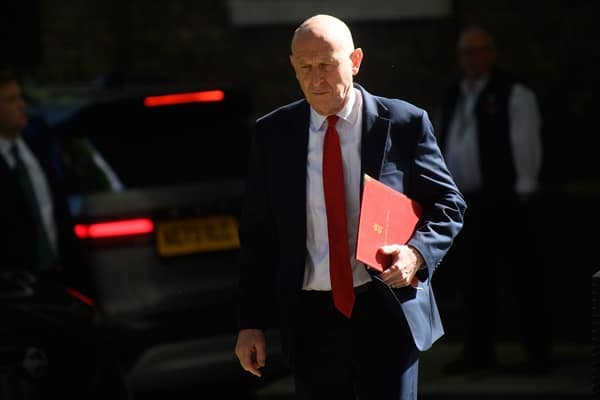
The Governor of the Bank of England has warned that Britain risks a renewed loss of financial market confidence if government spending and borrowing plans undermine the credibility of its public finances, delivering a pointed message to Chancellor John Healey less than three weeks before his first Budget.
Andrew Bailey stopped short of referring directly to the forthcoming fiscal statement, but invoked the turmoil triggered by Liz Truss’s 2022 mini-Budget as an example of what can happen when investors lose confidence in the government’s economic strategy.
His intervention comes as borrowing costs climb, inflationary pressures threaten to intensify, and the Chancellor’s already limited fiscal headroom comes under further strain.
The combination leaves Healey facing a difficult choice between meeting Labour’s spending commitments, preserving his fiscal rules and avoiding tax rises that could weaken an already fragile economy.
Speaking to fellow central bankers on Thursday, Bailey said Truss’s mini-Budget had been “an illustration of what can happen in these much-changed conditions”.
He warned that government spending plans, regardless of the party in power, must “be directed towards stability and be seen by markets as credible” after Britain had absorbed a succession of costly shocks, including the Covid pandemic and the energy crisis triggered by Russia’s invasion of Ukraine.
“If markets begin to doubt the fiscal trajectory, bond yields can rise further,” Bailey said.
Governments could ordinarily use their balance sheets to cushion a severe downturn and rebuild fiscal capacity when conditions improved, he added. But that flexibility was becoming harder to maintain as shocks grew more frequent, underlying growth weakened and public debt accumulated.
The warning coincided with a sharp rise in UK government borrowing costs. The yield on the benchmark 10-year gilt reached about 5.53 per cent on Thursday, its highest level since 2007, increasing the cost of financing the state and adding pressure to the public finances.
For Healey, the danger is not simply that higher yields make borrowing more expensive. They can also reduce the room available to absorb economic shocks without breaching the government’s fiscal rules or resorting to further tax increases or spending restraint.
EY estimates that the Chancellor’s fiscal headroom has fallen from £23.6bn in March to £11.3bn. That margin could be wiped out if the war involving Iran continues to restrict energy supplies, push inflation higher and weigh on economic growth.
The resulting squeeze would leave Healey with less protection against adverse forecasts when the Office for Budget Responsibility assesses whether the government remains on course to meet its fiscal targets.
Andrew Griffith, the Conservative shadow chancellor and a former Treasury minister under Truss, said Bailey’s remarks amounted to a warning against sacrificing growth or eroding the limited room available in the Budget.
“Reading between the lines, the Governor is clearly warning Healey about the need for better economic growth and not to reduce the already slender Budget headroom,” Griffith said.
Griffith has defended aspects of Truss’s tax-cutting agenda but acknowledged that the administration made a critical mistake by failing to explain how its policies would be funded.
“I said in that interview that there was a fatal mistake that we will not make again,” he said. “That was not setting out clearly the choices to actually balance the books and show how if there are tax cuts being made, how they’re going to be paid for.”
He added: “That is my pledge, as a former finance director for over a decade. It is second nature to always show where the money is coming from to show our workings.”
Griffith argued that the same problem was now confronting the government. “That was the mistake of Liz Truss’ mini budget. It’s a mistake the Government is making again today.”
The Treasury sought to reassure investors that fiscal discipline would remain central to the Budget.
“Fiscal discipline is the bedrock of economic stability and national security,” a spokesman said. “The Chancellor and Prime Minister are in lockstep that the Government will meet the fiscal rules, with a buffer against uncertainty and that includes getting debt down.”
Bailey’s warning underlines the narrow margin for error facing the government. With borrowing costs elevated and the economic outlook exposed to another energy shock, the Budget will be judged not only on its tax and spending measures but on whether investors believe the government has a credible plan to stabilise debt without undermining growth.
The lesson of 2022 is that fiscal credibility can deteriorate quickly when markets lose confidence. For Healey, the immediate challenge is to demonstrate that Britain’s public finances remain under control before the bond market delivers its own verdict.


Leave a Comment