
If someone had suggested a few years ago that one of America’s best-known conservative commentators would be interviewing Russian state media personalities in Moscow while another toured wartime Ukraine, most people would have dismissed it as political satire.
Yet that is exactly where we find ourselves.
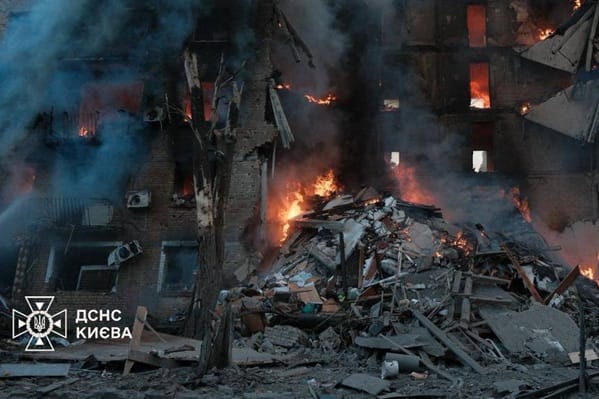
Meanwhile, here in Ukraine, apartment blocks continue to burn under nightly missile and drone attacks, civilians are still dying, and the war shows little sign of slowing.
It is an increasingly bizarre contrast between the reality experienced by Ukrainians and the conversations dominating social media thousands of miles away.
Living in Ukraine today means existing in two completely different worlds.
One is the real war, measured in air raid sirens, destroyed homes, military casualties and exhausted emergency workers digging survivors from collapsed buildings. The other exists online, where personalities, influencers and political tribalism often generate more attention than the conflict itself.
The disconnect has rarely felt greater.
According to the United Nations Human Rights Monitoring Mission in Ukraine, civilian casualties have continued to climb at an alarming rate. Between January and June 2026, 1,396 civilians were killed and 7,978 injured, a 37% increase compared with the same period in 2025 and a 114% increase compared with 2024. June alone saw 293 civilians killed and 1,990 injured, making it the deadliest month for civilians since April 2022. The surge has been driven primarily by Russia’s intensified use of ballistic missiles, long-range attack drones, Shahed UAVs and glide bombs, together with a sharp rise in short-range drone attacks against communities close to the frontline.
At the same time, reports continue to suggest the Kremlin is preparing the administrative and legal framework for another mobilisation, while President Volodymyr Zelenskyy has warned that Russia is also preparing to deploy an additional 30,000 North Korean troops in support of its war effort. Meanwhile, recent analysis by the Center for Strategic and International Studies (CSIS) estimates Russia is suffering more than 30,000 battlefield casualties every month while recruiting only around 27,000 new soldiers, indicating a widening manpower deficit that could ultimately force Moscow into another politically risky nationwide call-up.
That should concern policymakers far more than the latest social media controversy.
Despite suffering enormous battlefield losses, Russia has so far avoided another nationwide mobilisation on the scale witnessed in September 2022. Instead, Moscow has relied on generous financial incentives, prison recruitment, contract soldiers and increasingly foreign recruits to sustain its manpower.
Having interviewed captured foreign fighters myself, including recruits from Africa, Nepal and South America, it is clear the Kremlin has increasingly looked abroad to delay another politically unpopular call-up at home with the current strategy unsustainable.
Modern warfare has fundamentally changed the economics of offensive operations. The widespread use of drones, precision artillery, minefields and constant aerial surveillance has made attacking prepared defensive positions extraordinarily costly.
Military doctrine has always recognised that attackers generally suffer higher casualties than defenders. In Ukraine, those ratios appear to have become even more severe as technology increasingly favours defence.
Every advance comes at an immense human cost, which explains growing speculation surrounding another Russian mobilisation. Moscow has spent recent months expanding digital conscription systems, tightening administrative controls and strengthening legislation surrounding military registration. None of these measures prove another mobilisation is imminent, but collectively they suggest the Kremlin is ensuring the mechanisms already exist should President Vladimir Putin decide additional manpower is politically unavoidable.
Timing will also matter.
Russia’s regional elections this autumn provide a natural political milestone, making many analysts believe any deeply unpopular decision would more likely come afterwards rather than beforehand.
Should another large-scale mobilisation occur, it would represent more than simply another recruitment campaign. It would amount to an acknowledgement that Russia’s existing model of volunteers, financial incentives and foreign recruitment is no longer sufficient to sustain the scale of the war the Kremlin intends to fight.
That reality often receives surprisingly little attention online.
Instead, discussion increasingly revolves around political personalities and culture-war narratives.
We now live in a world where Biff Tannen got his hands on the Sports Almanac. It feels like we’ve slipped into an alternative timeline. https://t.co/olrVL0CD0j pic.twitter.com/hUYEN2YVJj
— Shaun Pinner (@ShaunPinnerUA) July 27, 2026
Recent visits by prominent American commentators to both Russia and Ukraine have generated significant interest across social media. People are, of course, entitled to change their opinions, and Ukraine benefits from genuine support wherever it comes from.
However, accountability still matters.
For many Ukrainians, particularly those who have lived through occupation, captivity or repeated missile attacks, sudden political reversals naturally invite questions. Trust is not rebuilt overnight through carefully managed photo opportunities; it is earned over time through consistency, transparency and accountability.
Information has become another battlefield so it is incredibly important to make that distinction.
Russia has invested enormous resources into shaping international narratives surrounding the conflict, with state media organisations playing a central role in that effort. As someone who was forced into Russian propaganda after being captured in Mariupol, I have seen firsthand how information operations form part of a broader system designed to legitimise aggression while obscuring its human cost.
The danger is not simply misinformation itself, but distraction.
Every hour spent debating influencers is an hour spent talking less about missile attacks, civilian casualties, economic resilience and the strategic decisions that will ultimately determine Ukraine’s future, and it’s already started.
Meanwhile, the war continues.
Kyiv still wakes to ballistic missile alerts. Ukrainian cities continue repairing damaged infrastructure while Russia continues launching mass drone attacks while Ukraine expands its long-range strike capability against military and industrial targets deep inside Russian territory.
Neither side currently believes it has exhausted its military options.
That is perhaps the most important reality to recognise.
As long as Moscow believes it can achieve its objectives through continued attrition, and Ukraine believes it can further degrade Russia’s military capacity and make occupation increasingly unsustainable, neither side has sufficient incentive to accept a settlement on terms it considers unacceptable.
Unfortunately, that means Europe should prepare not for peace, but for a prolonged conflict.
While social media debates continue to dominate headlines, the reality on the ground remains unchanged.
For Ukrainians, the war is not a political performance or an online culture war, it is simply another night waiting for the next air raid siren.


Leave a Comment