
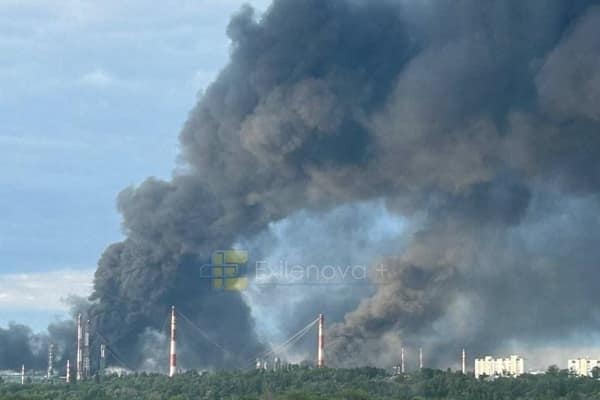
Ukraine launched a sweeping wave of long-range drone strikes deep inside Russia overnight, setting fire to a major oil refinery and targeting key energy infrastructure hundreds of miles from the battlefield in a fresh blow to Vladimir Putin’s war machine.
The Saratov oil refinery, owned by Russian energy giant Rosneft, erupted in flames after being struck during what Kyiv described as a carefully planned operation against facilities supporting Moscow’s military campaign.
The attack formed part of a broader barrage aimed at weakening Russia’s energy network, which Ukrainian officials argue remains a crucial source of funding for the Kremlin’s invasion.
Volodymyr Zelensky hailed the operation as a significant success, revealing that Ukrainian forces had struck the refinery approximately 700 kilometres from the front line.
Tonight, our soldiers applied Ukraine’s long-range sanctions against an oil refinery in Saratov, Russia,” the Ukrainian president said. “A significant achievement.”
Footage circulating on social media appeared to show thick plumes of black smoke rising above the refinery complex as emergency services rushed to contain the blaze.
Roman Busargin, the governor of Russia’s Saratov region, confirmed that drones had struck civilian infrastructure but stopped short of identifying the facility involved. Independent Russian outlet Astra later reported that the refinery had been set ablaze.
The strike was one of several coordinated attacks across Russia’s energy sector.
Despite Russia's massive Saratov refinery already burning in multiple areas, more drones are on their way, flying in groups.
An air-defenseless Russia is the best Russia. pic.twitter.com/MARh3OVwVt
— Jay in Kyiv (@JayinKyiv) May 31, 2026
In the neighbouring Rostov region, which borders occupied eastern Ukraine, drone debris ignited a major fuel depot, forcing authorities to evacuate nearby residents as firefighters battled a large-scale blaze.
Ukraine’s General Staff confirmed responsibility for the attack, describing the facility as a legitimate military target due to its role in supplying Russian forces.
Further north, Ukrainian drones reportedly reached the Lazarevo pumping station in Russia’s Kirov region, more than 700 miles from Ukrainian-controlled territory. The facility forms part of a strategic pipeline network that transports Siberian oil to Belarus and western markets.
Regional governor Alexander Sokolov acknowledged that a facility had been struck but declined to provide further details.
The attacks underline Ukraine’s growing ability to project force far beyond the front line through increasingly sophisticated drone operations.
Kyiv has intensified strikes against Russian oil refineries, fuel depots and pipeline infrastructure in recent months, arguing that every disruption weakens the Kremlin’s ability to sustain its war effort.
The latest offensive came amid renewed tensions surrounding the Zaporizhzhia nuclear power plant, Europe’s largest nuclear facility.
Russia accused Ukraine of carrying out a drone strike against one of the plant’s turbine halls, claiming a kamikaze drone had penetrated the building and detonated inside.
Alexei Likhachev, head of Russia’s state nuclear corporation Rosatom, described the incident as an unprecedented attack on critical nuclear infrastructure and warned of potentially catastrophic consequences.
Ukraine swiftly rejected the allegations.
Kyiv insisted its forces had not targeted the facility and accused Moscow of orchestrating another propaganda campaign designed to discredit Ukraine and manipulate international opinion.
A statement from Ukraine’s military stressed that its forces operate in accordance with international humanitarian law and fully understand the risks posed by military activity around nuclear sites.
The Zaporizhzhia plant has remained one of the most dangerous flashpoints of the war since Russian forces seized it during the opening weeks of the invasion in 2022.
Repeated shelling and military activity around the facility have triggered international fears of a potential nuclear disaster, with both sides routinely accusing one another of endangering the site.
As the war enters another phase of long-range strikes and counter-strikes, Ukraine’s expanding ability to hit targets deep inside Russia appears increasingly capable of threatening infrastructure once considered safely beyond the reach of the battlefield.


Leave a Comment