
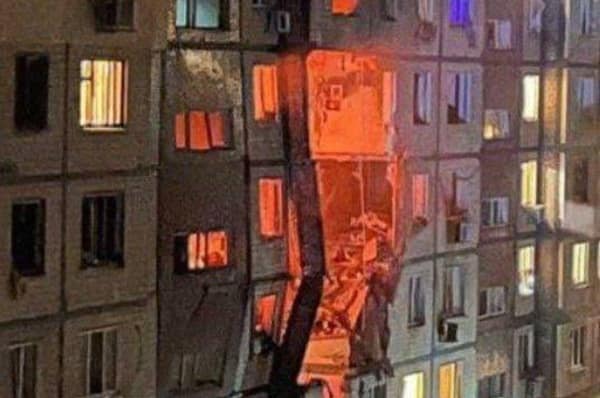
Russia has intensified its campaign against Ukrainian cities, launching a sustained wave of missile and drone strikes that killed at least five people and injured 25 in the central city of Dnipro.
According to Ukrainian authorities, the attacks began with ballistic missile strikes during the day, followed by waves of Iranian-designed Shahed drones overnight, targeting civilian infrastructure and residential areas. Emergency services responded across multiple impact sites as rescue operations continued into the early hours.
President Volodymyr Zelenskyy condemned the strikes, stating that Russia “continues to deliberately target civilians,” adding that Ukraine’s air defences remain under constant strain.
“Every such strike proves once again that Russia is not seeking peace,” he said.
Unfortunately, Russia killed 5 people and injured at least 25 more today in a daylight attack on civilians in Dnipro, a city the size of North London, with a river even wider than the Thames running through it.
On what should have been a calm, beautiful day, Russian forces chose… https://t.co/37bJaMLW8y
— Shaun Pinner (@ShaunPinnerUA) April 14, 2026
Air raid sirens sounded across much of Ukraine, including Kyiv, Kharkiv, Zaporizhzhia, and Odesa, as Russian forces launched a mixed package of missiles and drones designed to overwhelm air defences.
According to Ukraine’s Air Force, approximately 129 drones and several missiles were launched. Ukrainian forces intercepted or suppressed 114 drones and at least one missile, but multiple impacts were still recorded across several regions. This reflects a continued reliance on saturation tactics, combining high-speed ballistic systems with slower, low-flying drones to stretch defensive coverage and increase the probability of successful strikes.
Ballistic systems such as the Iskander-M remain particularly difficult to intercept due to their speed and limited response window, when paired with drone swarms, they create a layered threat environment that forces Ukraine to defend multiple axes simultaneously. Officials in Kharkiv, Zaporizhzhia, and Odesa reported infrastructure damage, while warning that continued attacks are placing increasing strain on both military resources and civilian resilience. Ukraine’s leadership has also renewed calls for faster delivery of Western air defence systems.
Former Foreign Minister Dmytro Kuleba warned that delays “cost lives every single day,” urging partners to accelerate support , while Germany remains a key partner in supplying modern systems such as Patriot and IRIS-T, though gaps remain, particularly against sustained drone attacks and high-speed ballistic threats.
The latest strikes underline a broader shift in Russia’s approach, with limited success on the battlefield, Moscow is increasingly targeting urban centres, infrastructure, and civilian morale, projecting power where it cannot achieve decisive gains at the front.
But this shift is not happening in isolation.
At the same time, Europe is beginning to close political openings that Russia has long exploited. The fall of Viktor Orbán marks more than just a domestic political change, it represents the weakening of one of Moscow’s most reliable levers inside the European Union. Orbán didn’t lose because of a single moment, he lost because he stopped listening, “No Russia” was not a fringe message, it was repeated throughout the campaign, reflecting a clear shift in public sentiment. Instead of adapting, he doubled down, aligning more closely with Moscow at a time when that association carries increasing political cost, with Russia’s strategy always being to use anyone, and everyone where it can, political allies, narratives, divisions, anything that creates friction inside Europe.
So as the war grinds deeper into attrition, one reality is becoming impossible to ignore: the frontlines may be largely static, but the war itself is not, it has simply expanded, with successive offensives failing to deliver decisive breakthroughs, Russia is reverting to a familiar playbook, sustained pressure on cities to compensate for stagnation at the front.
At the centre of this is Vladimir Putin, a leader still projecting strength, but operating within tightening constraints with the gap between rhetoric and reality is narrowing. Increased reliance on long-range strikes, combined with moves to tighten control over information platforms such as Telegram, suggests a system under pressure, not just externally, but internally.
What follows is a war no longer defined by lines on a map, but by reach, extending far beyond the frontline, and into the everyday lives of millions, and as I’ve said before,
this war is unlikely to be decided on the battlefield alone.


Leave a Comment