
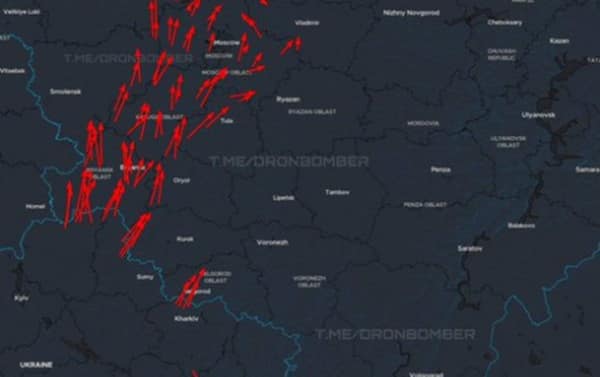
Claims circulating online that “almost 300 drones” are en route toward Moscow have added fresh volatility to an already charged information environment, as Russia prepares for its annual Victory Day commemorations under heightened security.
The reports, which have not been independently verified, suggest a large-scale aerial operation may be targeting the Russian capital at a politically sensitive moment, with Moscow already tightening restrictions and expanding air defence measures ahead of May 9.
The alleged figure — close to 300 drones — has spread rapidly across social media channels and pro-war commentary networks, though no official confirmation has been provided by Ukrainian authorities or Western defence sources.
The claim comes amid an intensifying cycle of battlefield strikes and reciprocal long-range attacks between Russia and Ukraine, with both sides increasingly targeting infrastructure far beyond the front line.
Read more related news:
Kremlin calls time-out on war for Putin’s parade, but Zelensky threatens ‘long-range sanctions’
Another day, another ‘impossible’ Ukrainian strike deep inside Russia
Russia shuts down internet in capital as confidence in its own security collapses
Zelensky rejects Russia’s ‘ceasefire’ as drone and missile attacks continue across Ukraine overnight
The timing of the reports has fuelled speculation and competing narratives, with Russian sources framing the alleged drone activity as part of what they describe as Ukrainian efforts to “pressure” Moscow during Victory Day commemorations.
The Kremlin has already warned of potential disruptions to its May 9 parade, while simultaneously scaling back elements of the event and imposing unusual restrictions, including temporary mobile internet limitations in Moscow and expanded air defence deployments around the capital.
Ukrainian officials, meanwhile, have not confirmed any mass drone operation of the scale being suggested, and Kyiv has repeatedly maintained that it does not comment on operational details in advance.
The result is a familiar pattern in the war: rapid claims of major military developments spreading ahead of verification, feeding a wider information struggle that runs parallel to the physical battlefield.
Security in the Russian capital has been visibly tightened in recent days, with authorities increasing patrols, deploying additional air defence systems and restricting access to certain areas ahead of the parade.
Several Russian regions have also reportedly scaled back or cancelled public Victory Day events, citing security concerns linked to the ongoing conflict.
The Kremlin has described its commemorations as a central national event marking the Soviet victory in the Second World War, but this year’s preparations have taken place under the shadow of sustained Ukrainian long-range strikes and repeated drone incursions into Russian territory.
Hope it will changes soon.
❗️Almost 300 (!) drones are flying to attack Moscow and make negotiations from the right position) pic.twitter.com/KeE1HatPdB— Andrii fella (@andrii_soloviov) May 7, 2026
At present, there is no independent confirmation of a coordinated wave of drones approaching Moscow on the scale suggested online.
Military analysts have repeatedly cautioned that information emerging during active conflicts is often fragmented, deliberately exaggerated, or shaped by competing narratives intended to influence public perception.
Both Russia and Ukraine have used long-range unmanned systems extensively throughout the war, with strikes deep into each other’s territory becoming an increasingly regular feature of the conflict.
However, the scale, timing and origin of any specific reported operation remain unclear.
With Victory Day approaching, tensions remain high as Moscow prepares for one of its most symbolically important annual events while the war continues unabated.
Whether the latest claims prove accurate or not, they underscore a broader reality: the conflict is no longer confined to front-line regions but is increasingly defined by long-range strikes, contested information, and rapidly shifting narratives that often outpace verification.
For now, the situation remains fluid — both in the skies over the region and in the competing accounts of what is actually unfolding.


Leave a Comment