
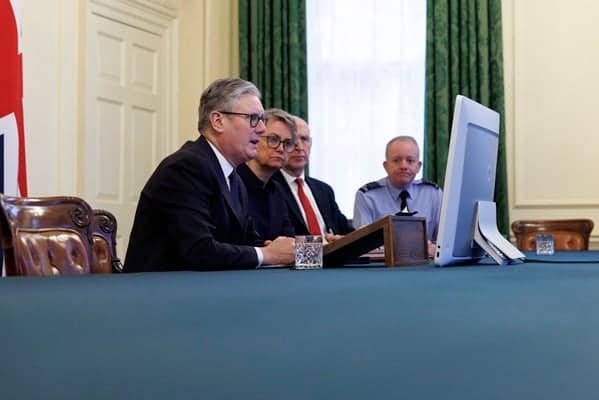
Keir Starmer has been plunged into a fresh defence funding crisis after Britain’s most senior military officer took the extraordinary step of writing directly to the Prime Minister amid mounting fears the Government’s long-delayed Defence Investment Plan will fall billions short of what the Armed Forces require.
Air Chief Marshal Sir Richard Knighton, the Chief of the Defence Staff, is understood to have put his concerns in writing to Sir Keir as tensions intensified between the Ministry of Defence and the Treasury over the scale of Britain’s military rearmament programme.
The intervention is highly unusual and will fuel fears that senior military figures are becoming increasingly alarmed by the direction of negotiations inside government.
At the centre of the dispute is the amount of money ministers are prepared to commit to rebuilding Britain’s Armed Forces in an increasingly dangerous world.
Rachel Reeves is understood to have offered the Ministry of Defence around £13 billion over four years to fund new submarines, warships, combat aircraft, missiles and drone technology.
But defence chiefs have privately argued that the figure falls well short of what is required.
Military planners are believed to have identified a funding requirement closer to £18 billion, with some experts warning that even that sum may prove insufficient to reverse years of declining capability.
The row has become one of the most sensitive disputes facing the Government as ministers attempt to reconcile growing security threats with increasingly strained public finances.
One source told Sky News that Sir Richard met fellow service chiefs earlier this week to discuss the proposed settlement, with at least one senior military figure reportedly deeply unhappy with the Treasury’s offer.
The disclosure raises fresh questions about whether Labour’s promised defence spending increase will be enough to satisfy military leaders who have repeatedly warned that Britain faces its most challenging security environment since the Cold War.
The Defence Investment Plan was originally expected to be published months ago but has suffered repeated delays as negotiations dragged on between the Treasury, the Ministry of Defence and Downing Street.
There had been hopes that ministers would finally unveil the strategy this week.
Those expectations were subsequently pushed back to Friday before further uncertainty emerged over whether the announcement would happen at all.
The confusion prompted an extraordinary intervention from Commons Speaker Sir Lindsay Hoyle, who warned that publishing the plan on a non-sitting day would be “an utter disgrace” and “an utter kick in the face” to MPs.
His remarks reflected growing frustration across Westminster over the Government’s handling of the process.
Conservative figures accused ministers of attempting to avoid scrutiny of politically difficult decisions.
Former Security Minister Tom Tugendhat claimed Labour was hiding from Parliament, while other opposition MPs argued that any further delay would undermine confidence in Britain’s commitment to strengthening its defences.
The dispute comes as ministers attempt to balance competing demands across Government, with other departments reportedly being asked to find savings in order to help finance increased defence spending.
Defence Secretary John Healey has repeatedly argued that Britain must accelerate military investment in response to lessons from Ukraine, growing instability in the Middle East and mounting pressure from NATO allies.
Speaking this week, Mr Healey declined to discuss specific funding figures but insisted the Prime Minister understood the scale of the challenge facing the country.
He also strongly hinted that the plan would not be released on Friday, emphasising the importance of parliamentary scrutiny.
Defence Minister Luke Pollard meanwhile promised the strategy would be published “shortly”, insisting it would demonstrate Labour’s commitment to ending what ministers describe as years of underinvestment under previous governments.
Yet the fact Britain’s top military officer has felt compelled to intervene directly with the Prime Minister will raise serious questions about whether those assurances have convinced the people responsible for defending the country.
With the NATO summit in Ankara looming next month and allies demanding greater military readiness, the Government now faces growing pressure not only to publish its defence blueprint, but to prove it is willing to fund it properly.


Leave a Comment