
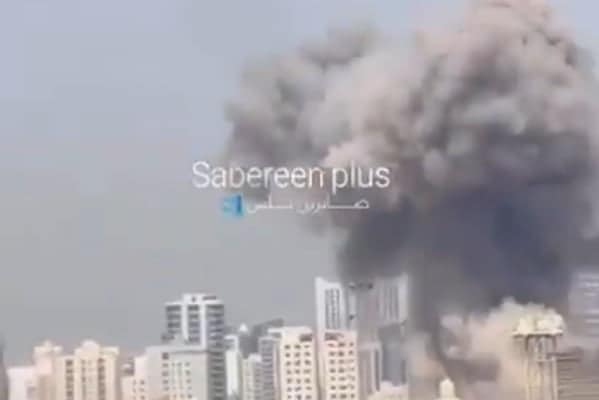
In a distressing development, the United Arab Emirates (UAE) has been rocked by explosions as tensions escalate between the United States, Israel, and Iran.
This volatile situation has seen a significant increase in hostilities, with the region now facing direct threats from missile exchanges linked to the ongoing US-Iran conflict.
Reports indicate that Iran has launched retaliatory strikes in response to recent US-Israeli military actions targeting Iranian installations.
Missiles were reportedly aimed not only at Israel but also at the UAE and Saudi Arabia, raising alarms about the potential for widespread regional instability.
In Abu Dhabi, a tragic incident occurred when debris from one of these missiles fell into a residential area, resulting in the death of one civilian, identified as being of Asian nationality. This tragic loss underscores the collateral damage that can arise from military conflicts, where innocent lives are impacted as a result of geopolitical tensions.
The Iranian Revolutionary Guard Corps, said they consider “all US bases, resources, and interests in the region to be legitimate targets” in retaliation.
The IRGC said: “We know the United States as the main factor in today’s aggression, and the Zionist regime is the sponsor of this aggression.
“At the same time, we consider both to be one.”
The IRGC added: “The armed forces, and especially the IRGC Aerospace Forces, immediately after the regime’s shameless aggression, began retaliatory operations against US bases in the region and the Zionist regime.
“We consider all American bases, resources, and interests in the region, space, and land as the legitimate target of the armed forces.
“We will confront the United States and the Zionist regime stronger than the 12-day war. People should know that there is nothing to worry about.”
Other disturbances were noted in Dubai Marina, where an explosion was reported; however, officials have yet to confirm the precise cause of this incident. The ambiguity surrounding such events adds to the uncertainty and concern felt by residents and authorities alike.
In a statement released by the UAE Ministry of Defence, it was confirmed that the country’s air defence systems operated with “high efficiency” to intercept several of the Iranian ballistic missiles that had been launched. Despite this success in interception, some debris managed to fall to the ground, leading to material damage in the area and contributing to the tragic casualty in Abu Dhabi.
The ministry characterised the missile strike as “a dangerous escalation and a cowardly act,” asserting that it represents a “blatant violation of national sovereignty and international law.” In light of these developments, UAE officials have declared that they “reserve their full right to respond to this escalation and will take all necessary measures to protect their territory, citizens, and residents” from further threats.
To alleviate public anxiety, the government has reassured residents that the security situation remains stable. Authorities are actively monitoring the developments around the clock to ensure a swift response to any emerging threats. The ministry reinforced its commitment to maintaining a state of “full readiness and preparedness” to counter any further attacks, highlighting the safety of citizens, residents, and visitors as its top priority.
In this climate of heightened tension, residents are being urged to remain vigilant and avoid circulating rumours or unverified information. They are encouraged to depend exclusively on official updates for accurate information to prevent unnecessary panic.
This recent escalation is significant, marking a broader confrontation that now directly involves Gulf states amid the ongoing US-Israel-Iran conflict. Analysts express concern that such attacks on Gulf infrastructure could have far-reaching consequences, potentially disrupting regional stability, energy markets, and international shipping routes—factors critical to both local and global economies.


Leave a Comment