
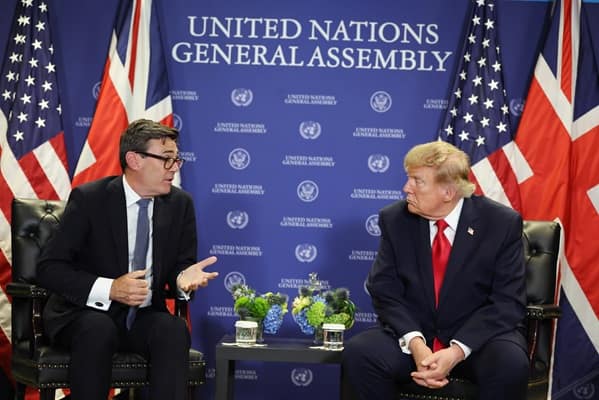
Andy Burnham has ordered the creation of a new National Centre for Information Defence to counter what he described as an “industrial-scale assault” by hostile states on Britain’s information environment, placing the UK on a potential collision course with Donald Trump over the regulation of online speech and artificial intelligence.
The centre, announced during Burnham’s first address to the UN General Assembly, will be tasked with detecting, attributing and disrupting foreign information attacks, including deepfakes and other AI-enabled campaigns.
Security chiefs have been instructed to establish the new body, initially from the Office for the Prime Minister and Cabinet. It will work alongside intelligence agencies, government departments, police forces and social media companies.
Burnham told the UN there could be “no national security without a strong, cohesive society”.
“That’s the starting point for everything we hold dear and everything we want to achieve,” he said.
“But the fact is that it has been under attack.”
The prime minister accused Russia of conducting an “industrial-scale assault by hostile actors on the information environment”, alleging that Russian agencies had used bots, fake websites and forged media content to manipulate public opinion.
“They’ve used bots and fake websites,” Burnham said. “Falsified newspaper articles and forged the branding of 28 British organisations – including universities and the BBC.
“They’ve amplified far right narratives. And we have evidence that they tried to interfere with the 2019 General Election.”
Burnham said Moscow had also attempted to “stoke tensions and unrest in the wake of horrific events”, describing such activity as “repulsive”.
The government’s announcement comes as Britain seeks to position itself as a leading force in international AI governance, while Washington is moving in the opposite direction.
Burnham said the UK would push for international standards governing frontier AI, warning that technological development could outpace safeguards. Reuters reported that he wants Britain to lead an international effort to establish common standards for the technology.
The prime minister also announced that Britain and the US were developing a new AI defence partnership to protect critical national infrastructure.
Trump, however, used his own UN appearance to reject attempts to establish what he described as a global regulatory framework for AI.
The US president said America would continue to lead in “super intelligence” and argued against efforts to rein in the technology. Reuters reported that Trump said the US Department of Justice could intervene if necessary, while maintaining his opposition to broad new AI regulation.
“The United States totally rejects any attempt to construct a globalist scheme to control the artificial intelligence,” Trump said during his UN address.
The contrasting positions have raised questions about how closely London and Washington can align on one of the most rapidly developing areas of technology policy.
Nile Gardiner, a former aide to Margaret Thatcher, told GB News that Burnham’s speech represented precisely the kind of approach the Trump administration opposes.
“Andy Burnham’s speech was talk of control and censorship. Exactly the kind of messaging that the Trump administration absolutely hates,” he said.
“I think this very chilling, Orwellian-style message with regard to AI is going to lead to a great deal of conflict with the Trump White House.
“In fact, Trump has already spoken out against these kinds of regulations, which will be used, of course, to control freedom of speech.”
The tension comes after US officials summoned senior British officials to the US embassy in London to discuss concerns over Britain’s approach to online regulation, according to reports.
Among the issues raised were restrictions affecting under-16s, the Online Safety Act and government proposals concerning “trusted and accurate” news sources.
Burnham’s speech nevertheless framed the new centre primarily as a national-security response to foreign interference rather than a general system of domestic content regulation.
The official Downing Street account said the centre would “detect, attribute and disrupt” hostile state information attacks and support democratic resilience.
Burnham said Britain would also share its experience with other countries, pointing to support already provided to Moldova to protect its elections from Russian interference.
“As more elections approach across Europe, more nations are grappling with these issues – some for the first time,” he told the UN.
“So we must raise our sights.”
The creation of the centre marks a significant expansion of the government’s attempt to treat information warfare, deepfakes and foreign online influence as national-security threats.
But with Washington simultaneously rejecting international efforts to regulate AI, the UK’s push for stronger safeguards could become another source of friction between two governments that remain closely aligned on defence and intelligence.
The emerging divide is therefore not over whether technology poses security challenges, but over how far governments should go in controlling the systems and information networks through which those challenges are addressed.


Leave a Comment