
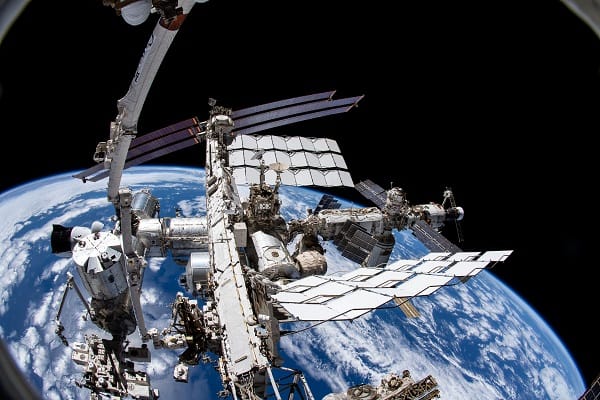
Astronauts aboard the International Space Station have been ordered to prepare for a potential emergency evacuation after concerns mounted over a worsening air leak in the Russian segment of the orbiting outpost.
The incident, unfolding 250 miles above Earth, has reignited fears about the ageing infrastructure of humanity’s most ambitious space project and forced crews to take precautionary measures as engineers race to understand the extent of the problem.
Crew members from the United States, Russia, Europe, Japan and Canada were instructed to shelter inside their spacecraft as officials assessed the situation. The precautionary move would allow astronauts to undock rapidly and return to Earth should conditions deteriorate.
The leak is understood to be located within the Russian section of the station, specifically an area that has long been a source of concern for both Russian and American space officials.
For years, engineers have monitored cracks in the Zvezda service module transfer tunnel, undertaking repeated repairs to prevent a more serious loss of pressure. While previous leaks have been managed without significant danger to the crew, the latest developments have raised fresh concerns about the long-term viability of parts of the station.
Bethany Stevens, a senior adviser and press secretary at NASA, confirmed that cracks within the affected area had been under close observation for some time.
“The cracks have always been a concern,” she said, adding that NASA and the Russian space agency Roscosmos had worked together extensively to investigate their cause and monitor their progression.
She added: “Following new leaks, Roscosmos has elected to proceed with a more extensive repair operation on Friday, June 5.
“Out of an abundance of caution, NASA has directed all four of the agency’s SpaceX Crew-12 members and NASA astronaut Chris Williams to assume an elevated safety posture in the Dragon spacecraft while the repair is underway.
“We continue to work with our Russian counterparts, along with the rest of the international community that supports the space station, to arrive at a more permanent resolution.”
The International Space Station remains one of the greatest engineering achievements in human history. Larger than a football field and travelling at approximately 17,500 miles per hour, it circles the Earth every 90 minutes while serving as a permanent laboratory for scientific research.
Since the first modules were launched in 1998, the station has hosted more than 280 astronauts and cosmonauts from 26 countries. Continuous human occupation has been maintained since November 2000, making it the longest-running example of an uninterrupted human presence beyond Earth.
Yet the ageing complex is increasingly showing signs of wear.
Many of the station’s oldest Russian modules were originally designed for far shorter operational lifespans than they have ultimately served. Engineers on both sides of the partnership have frequently acknowledged that maintaining the structure becomes more challenging with each passing year.
For now, officials insist there is no immediate danger to the crew. A Russian cosmonaut was reportedly working to repair the affected section while flight controllers monitored pressure levels and structural integrity from the ground.
Nevertheless, the incident serves as a stark reminder of the unforgiving nature of spaceflight.
Unlike emergencies on Earth, where assistance may be minutes away, astronauts aboard the station operate in an environment where even a small crack can rapidly become life-threatening. Outside the station lies the vacuum of space, where exposure would prove fatal within moments.
As engineers work to stabilise the situation, attention is once again turning to the future of the International Space Station itself. With retirement plans already under discussion for the coming decade, questions are growing over how much longer the ageing orbital laboratory can safely continue operating.
For the seven astronauts currently circling the planet, however, the priority remains far simpler: keeping the air inside and the vacuum outside.


Leave a Comment