
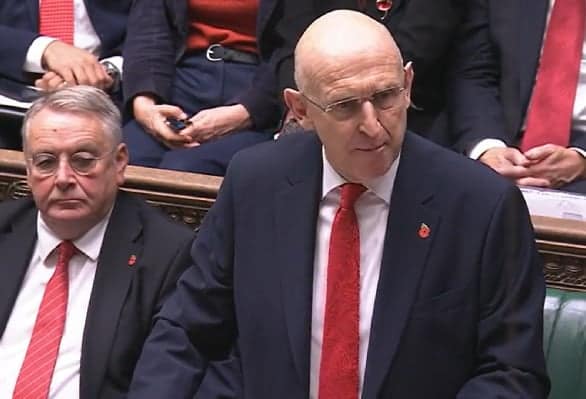
Chancellor John Healey has come under fierce fire from Britain’s business community and leading economic think tanks after his first Budget was accused of failing to deliver the investment boost needed to revive growth, as forecasts warn households could suffer a £1,050 fall in disposable income by the end of the Parliament.
The Confederation of British Industry (CBI) said the Chancellor had failed to provide meaningful support for companies struggling with high energy bills, rising costs and an uncertain economic outlook, despite promising that his Budget would give households and businesses “breathing space”.
The criticism exposes a growing challenge for the Government; delivering immediate relief to households while tackling the deeper problems of weak productivity, sluggish wage growth and a deteriorating outlook for living standards.
Rain Newton-Smith, chief executive of the CBI, said the Budget lacked “the bold moves that would have made it easier for firms to invest, hire and grow”.
“Households will be grateful for some relief on energy bills, but there is nothing concrete to provide breathing space for the vast majority of businesses,” she said.
Newton-Smith warned that British companies were already paying energy bills a third higher than their European counterparts, with prices expected to rise further next year.
Her intervention adds to mounting criticism of the Chancellor’s fiscal strategy, with business leaders questioning whether targeted household support and limited tax measures can generate the investment required to strengthen the UK economy.
Government defends Budget against ‘nothing’ accusations
Prime Minister Andy Burnham has defended the Budget against accusations that it lacked ambition, pointing to measures designed to reduce household energy costs and ease pressure on high streets.
“It’s pretty bold to help 20 million households with energy costs through the council tax cut this winter,” he said.
He also highlighted plans to lift 70,000 businesses out of business rates, arguing that the changes would provide a significant boost to struggling town centres.
However, the Government’s defence has done little to silence critics. Conservative leader Kemi Badenoch described the Budget as “not good enough, not strong enough, not bold enough”, while Reform UK Treasury spokesman Robert Jenrick dismissed it as a “nothing burger”.
The dispute reflects a wider argument over whether short-term relief can compensate for the structural weaknesses holding back Britain’s economic performance.
IFS warns of worst decade for household income growth
The Institute for Fiscal Studies (IFS) has delivered a particularly stark assessment of the outlook for living standards, warning that the current decade could prove the worst on record for household income growth.
Helen Miller, the think tank’s director, described the outlook as “depressing” and argued that temporary cost-of-living measures would not address the underlying problem.
“This decade looks set to be the worst decade for growth in household incomes on record,” she said.
“No amount of temporary cost-of-living packages will fix that.”
The warning presents a serious challenge for ministers seeking to demonstrate that their economic policies are improving conditions for working households.
While energy support may offer some immediate relief, sustained improvements in living standards ultimately depend on stronger real wage growth, affordable housing and a more favourable economic environment.
Disposable incomes face £1,050 decline
The Resolution Foundation has warned that household living standards are set to deteriorate again after an initial improvement during the first year of the Parliament.
Excluding pensioners, the think tank estimates that disposable income after housing costs will fall by 3%, or £1,050, between the current year and the end of the Parliament.
The projected decline reflects a combination of weak real wage growth, a rising tax burden and housing costs increasing faster than general inflation.
The Office for Budget Responsibility’s forecasts, as cited by the foundation, suggest average real weekly wages will edge down by 0.1% between 2026-27 and 2028-29, while rents and mortgage payments rise more quickly than the general price level.
Such pressures threaten to leave households with less money available for discretionary spending, potentially weighing on consumer demand and the wider economy.
The Resolution Foundation has criticised the Budget as a “scattergun” approach, raising doubts about whether the measures are sufficiently targeted to protect those facing the greatest financial strain.
Former Business Secretary warns outlook remains bleak
Vince Cable, the former Liberal Democrat leader and Business Secretary, has also warned that Britain faces a difficult economic future.
Describing the outlook as “pretty bleak”, he said living standards and disposable incomes had failed to grow over the previous decade and were not expected to improve significantly in the coming years.
His assessment reinforces concerns that Britain’s weak growth performance is becoming a persistent problem rather than a temporary setback.
For businesses, subdued household incomes could limit demand just as companies are being asked to invest, expand and recruit. High energy costs and uncertainty over future taxation add to the challenge.
Chancellor faces test over growth and investment
The competing assessments leave Healey facing a difficult task: convincing businesses that the Government can create the conditions for growth while persuading households that its policies will improve their financial security.
The Budget offers targeted support for energy bills and business rates, but critics argue it lacks a convincing plan to raise productivity, encourage investment and deliver sustained increases in real wages.
The central risk is that temporary relief will prove insufficient if the underlying economy remains weak. With disposable incomes forecast to fall and business costs continuing to weigh on investment decisions, the Government’s economic credibility will increasingly depend on whether it can turn promises of growth into measurable improvements in living standards.
For now, the reaction from business leaders and economists suggests that the Chancellor’s first Budget has done little to settle the debate over how Britain can escape a decade of stagnation.


Leave a Comment