
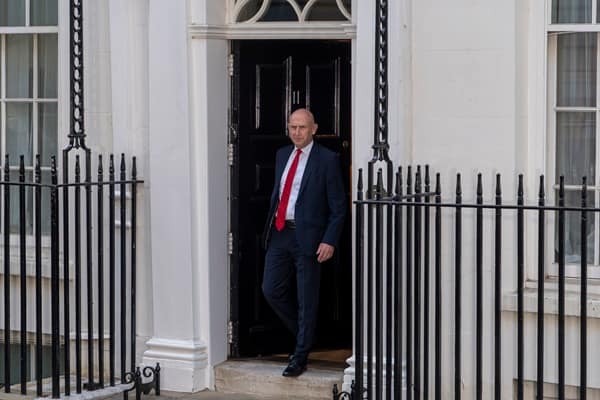
Chancellor John Healey has warned that his first Budget could involve difficult decisions as the economic consequences of Donald Trump’s war with Iran feed through into inflation, growth and government borrowing costs.
The warning comes after a sharp rise in UK government borrowing costs this week, reflecting growing concern among investors about the inflationary consequences of the conflict in the Middle East and its potential impact on global energy markets.
Mr Healey said his Budget on October 28 would seek to ensure that the public finances retained a substantial “buffer against uncertainty”, amid mounting pressure on the fiscal headroom established by his predecessor.
Economists have warned that the margin built by Rachel Reeves through a combination of tax rises and departmental spending reductions could be eroded by higher inflation and borrowing costs resulting from renewed global instability.
That would complicate the government’s ability to deliver on Andy Burnham’s promises to ease the cost-of-living crisis while maintaining spending commitments across other areas of the administration’s programme.
Speaking to the Financial Times, Mr Healey said: “What’s happening in the Middle East is hitting inflation, it’s hitting growth, it’s hitting borrowing costs.”
He added: “It’s part of a more dangerous world that is more uncertain and it’s one of the challenges we have to meet in this country, but have to meet with other [countries].”
The Chancellor declined to specify the level of fiscal headroom he intended to retain following the Budget, but insisted that the government remained committed to meeting its self-imposed fiscal rules.
Under the Treasury’s framework, the government must ensure that day-to-day spending is covered by revenues by the end of the parliament, with investment spending excluded from the calculation.
Mr Healey said he was “in lockstep in our determination to meet the fiscal rules” with the Prime Minister, adding that this could be achieved “with a buffer against the sort of uncertainty that we have talked about”.
The remarks underline the increasingly difficult environment facing the Treasury ahead of the autumn statement. Higher energy prices risk pushing inflation above expectations, potentially delaying interest rate cuts and increasing the cost of servicing Britain’s substantial public debt.
A weaker economic outlook could also reduce tax receipts, further narrowing the Chancellor’s room for manoeuvre.
Mr Healey’s approach to defence spending is likely to add another layer of pressure to the public finances.
The Chancellor previously served as defence secretary under Sir Keir Starmer but resigned after failing to secure a commitment to raise defence spending to 3 per cent of gross domestic product by 2030.
Now responsible for the Treasury, he has committed the UK to reaching defence spending of 3.5 per cent of GDP by 2035, in line with a wider Nato commitment.
Mr Healey has said the pathway towards that target will be set out at next year’s spending review.
Alongside the fiscal challenges facing the Budget, the Chancellor has also announced changes to Treasury investment rules designed to accelerate regional regeneration.
A significant reform to the Treasury’s Green Book — the framework used to assess the costs and benefits of government projects — will involve lowering the so-called discount rate used to calculate the long-term value of public investment.
Reducing the rate from 3.5 per cent to 3 per cent would increase the relative value assigned to projects whose economic benefits emerge over longer periods.
The Treasury hopes the change will make it easier to justify investment in infrastructure such as schools, roads and other regeneration projects, particularly outside London and the south-east.
The reforms reflect a broader attempt by the government to combine fiscal discipline with a more interventionist approach to regional investment.
However, the deteriorating international outlook threatens to overshadow those ambitions.
With markets increasingly sensitive to Britain’s borrowing requirements and the economic consequences of the conflict in the Middle East still uncertain, the Chancellor faces a difficult balancing act between maintaining investor confidence, protecting fiscal rules and delivering the government’s domestic agenda.
Mr Healey is expected to provide further detail on the state of the economy in a major speech on Monday, setting the stage for what could be an increasingly challenging Budget later this autumn.


Leave a Comment