
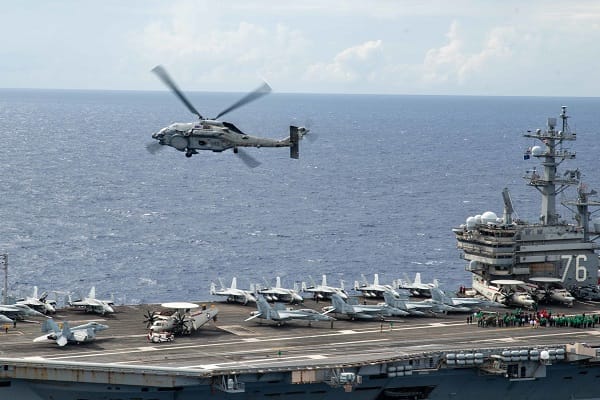
The United States has warned that any vessel attempting to enter or exit the Strait of Hormuz without permission will be “subject to interception, diversion, and capture”, in a dramatic escalation following the collapse of peace talks with Iran.
United States Central Command said in a notice to seafarers that it would enforce sweeping restrictions on maritime traffic, with operations extending into the Gulf of Oman and the Arabian Sea to the east of the Strait.
CENTCOM said: “Any vessel entering or departing the blockaded area without authorisation is subject to interception, diversion, and capture.
“The blockade will not impede neutral transit passage through the Strait of Hormuz to or from non-Iranian destinations.”
The move follows an announcement by Donald Trump that the US Navy would begin enforcing a blockade of the strategic waterway from 3pm on Monday, raising fears of a direct confrontation with Tehran.
The Strait of Hormuz, through which roughly a fifth of global oil supplies pass, is one of the world’s most critical energy routes. Any disruption is expected to send shockwaves through global markets, with oil prices already under upward pressure.
The Prime Minister Keir Starmer said: “The ongoing closure of the Strait of Hormuz is deeply damaging.
He added: “Getting global shipping moving is vital to ease cost of living pressures.
“The UK has convened more than 40 nations who share our aim to restore freedom of navigation.
This week the UK and France will co-host a summit to advance work on a coordinated, independent, multinational plan to safeguard international shipping when the conflict ends.
Security analysts warn that the threat to “capture” vessels marks a significant escalation in maritime posture, effectively placing commercial shipping at the centre of a rapidly intensifying geopolitical crisis.
Iran has previously indicated that any attempt to restrict access to the Strait would be treated as an act of war, increasing the risk of retaliation against US naval forces and allied shipping in the region.
The extension of enforcement measures into surrounding waters suggests a broad operational perimeter, heightening concerns that the crisis could spill beyond the narrow confines of the Strait itself.
Shipping companies are now expected to reassess routes and risk exposure, while insurers are likely to raise premiums sharply or withdraw cover altogether for vessels transiting the area.
The development marks one of the most serious escalations in Gulf tensions in recent years, with diplomats warning that the scope for miscalculation is growing as military activity intensifies in one of the world’s most heavily trafficked and strategically sensitive maritime corridors.


Leave a Comment