
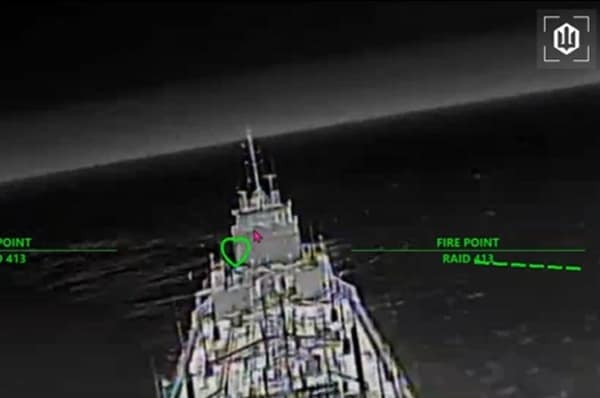
For more than three years, Russia’s so-called shadow fleet has sailed beneath the radar.
A vast armada of ageing oil tankers, obscure cargo ships and reflagged vessels has quietly kept Vladimir Putin’s war machine alive, carrying billions of pounds’ worth of crude around the globe while skirting Western sanctions.
Now, if Ukraine’s latest claims are to be believed, that era of relative impunity may be coming to an end.
Kyiv says it has launched its most ambitious campaign yet against Russia’s maritime lifeline, claiming to have struck another 14 vessels overnight and a staggering 90 ships over the course of a week.
Those figures have not been independently verified, and should be treated with caution.
But even if the true number is considerably lower, the direction of travel is unmistakable.
Ukraine is no longer content with simply defending its front lines.
It is systematically trying to dismantle the economic engine that keeps Russia’s invasion alive.
Ukrainian forces carried out another major maritime raid overnight in the Sea of Azov, hitting 10 oil/fuel tankers.
Ukrainian drones also hit 4 immensely valuable ferries used to move vehicles across the Kerch Strait between Russia and Crimea. pic.twitter.com/AnP4IZIuKE
— OSINTtechnical (@Osinttechnical) July 12, 2026
For much of the war, attention has focused on trenches in Donetsk, missile barrages over Kyiv and drone attacks deep inside Russian territory.
Yet wars are not won by bullets alone.
They are won by logistics, fuel, money and the ability to keep armies supplied.
That is precisely why Russia’s shadow fleet matters.
Since Western sanctions were imposed after the full-scale invasion in 2022, Moscow has assembled an enormous network of ageing tankers operating under opaque ownership structures, foreign flags and complex insurance arrangements.
The objective has been simple: keep Russian oil flowing to international markets despite sanctions designed to squeeze the Kremlin’s finances.
Every successful voyage represents another stream of revenue flowing into Russia’s treasury.
Every cargo helps finance missiles, drones, tanks and artillery shells.
Destroying those revenue streams is therefore not merely symbolic.
It strikes at the financial foundations of the war itself.
Ukraine appears to understand that reality better than ever.
Unable to match Russia shell for shell or soldier for soldier, Kyiv has increasingly embraced asymmetric warfare.
Cheap drones have sunk or damaged major warships.
Long-range strikes have repeatedly hit oil depots, refineries, ammunition warehouses and military airfields hundreds of miles behind the front.
Now the campaign appears to be expanding towards the commercial shipping network that underpins Russia’s wartime economy.
If that strategy succeeds, the consequences could extend far beyond the battlefield.
Insurance premiums would rise.
Shipping companies would face growing risks.
Ports servicing Russian exports could become increasingly vulnerable.
Oil buyers may begin questioning whether discounted Russian crude is worth the mounting danger.
Even uncertainty carries a price.
Markets dislike risk.
Investors dislike unpredictability.
And Russia’s shadow fleet depends on both confidence and continuity.
The psychological effect may prove almost as valuable as the physical destruction.
The Kremlin has spent years projecting an image of resilience.
Yet every successful Ukrainian strike chips away at that narrative.
The Black Sea Fleet has already been forced to retreat from its traditional bases.
The Kerch Bridge has repeatedly come under attack.
Military airfields once considered untouchable are now routinely targeted.
If commercial shipping also becomes a battlefield, Putin faces an entirely new strategic headache.
Of course, caution remains essential.
Battlefield claims from both sides of the conflict are often impossible to verify independently in real time.
Ukraine has every incentive to emphasise the scale of its successes, just as Russia frequently downplays or denies its losses.
The true extent of the reported damage may not become clear for some time.
But that does not diminish the broader picture.
The war is evolving.
This is no longer solely a contest over villages, trenches and artillery duels.
It is increasingly a campaign against infrastructure, supply chains and economic endurance.
Ukraine knows it cannot simply outgun Russia.
Instead, it is trying to make the war prohibitively expensive.
If every tanker carries greater risk…
If every shipment becomes harder to insure…
If every barrel of exported oil becomes more difficult to move…
Then every missile launched by Moscow ultimately becomes more expensive to replace.
That is precisely the kind of pressure Kyiv hopes to create.
Whether these latest claims withstand scrutiny or not, one conclusion is difficult to ignore.
The shadow fleet that once operated largely beyond the reach of Ukraine is now firmly in its sights.
And if that pressure continues to intensify, the greatest threat to Putin’s war machine may no longer come from the trenches of eastern Ukraine.
It may come from the sea.


Leave a Comment