
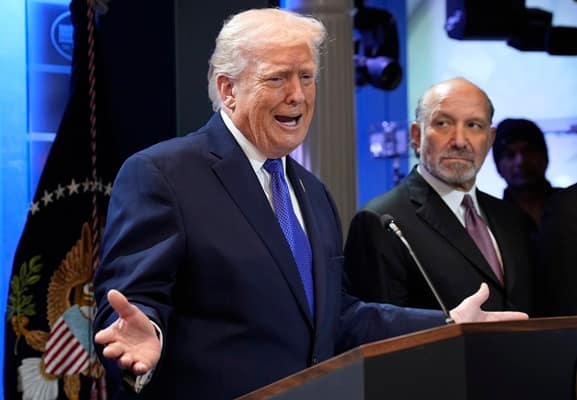
Donald Trump says rising economic costs will not force him into an Iran deal, but Nigel Green, CEO of one of the world’s largest independent financial advisory organisations, says triple-digit oil, rising Treasury yields, and mounting pressure on US consumers will ultimately narrow the White House’s room for manoeuvre.
Nigel Green of deVere Group, which has $14bn under advisement, is speaking out after the US president insisted soaring energy prices and market volatility would not push him into a settlement with Tehran to reopen the Strait of Hormuz.
Trump on Wednesday said he did not “care” about mounting economic pressure or political fallout ahead of the 2026 midterms, arguing Americans support the broader objectives of the conflict despite rising energy costs.
“Triple-digit oil changes the macro picture very quickly,” says Nigel Green.
“No administration can absorb a prolonged energy shock without eventually facing economic and political consequences.
“The idea the US economy can indefinitely power through sustained $100-plus oil without pressure building across markets and households is unrealistic.”
His comments come as Brent crude remains volatile amid fears over disruption to the Strait of Hormuz, through which roughly a fifth of global petroleum liquids consumption moves.
Oil prices have repeatedly surged above $100 a barrel during the conflict, while US gasoline prices have climbed sharply since the start of the war in Iran earlier this year.
At the same time, Treasury markets are already reflecting growing inflation anxiety.
The benchmark 10-year US Treasury yield climbed as high as 4.67% earlier this month before easing back toward 4.5%, while the 30-year yield moved above 5% as investors reassessed the inflation risks tied to prolonged energy disruption.
The deVere CEO says investors are already beginning to price the wider consequences of sustained energy disruption.
“Energy shocks feed directly into inflation expectations, Treasury yields, borrowing costs, freight prices and consumer confidence.
“Fuel prices are among the most politically sensitive indicators in the US economy because consumers feel the effects immediately.
“Americans see petrol prices every day. Higher fuel costs hit commuters, trucking firms, airlines, farmers, delivery companies and households almost instantly.”
Nigel Green argues inflationary pressure linked to energy costs would become increasingly difficult politically heading into the 2026 midterm elections.
“Voters may initially support a hardline geopolitical position during a conflict. Sustained cost-of-living pressure is different.
“History shows prolonged energy-driven inflation rapidly changes consumer sentiment and political dynamics.”
He warns bond markets could become a major constraint if oil prices remain elevated.
“A prolonged Hormuz disruption creates a classic stagflationary setup: higher inflation combined with slowing growth.
“That’s one of the most difficult environments for policymakers because central banks lose flexibility and markets begin repricing interest-rate expectations.
“Treasury markets are highly sensitive right now to any sign inflation could become re-embedded in the economy.
“If energy-driven inflation persists, markets are likely to price fewer rate cuts and a higher-for-longer rate environment.
“That means upward pressure on yields, tighter financial conditions and more expensive borrowing across the economy.”
Investors are already watching whether rising oil prices begin feeding further into long-dated Treasury yields, which directly influence borrowing costs throughout the economy.
“Mortgage rates remain elevated, with US 30-year fixed mortgage rates back above 6.6% as Treasury yields rise. Corporate refinancing becomes more costly. Credit conditions tighten.
“Higher oil feeds directly into transport, logistics, manufacturing, aviation, chemicals and agriculture.
“Some companies pass costs on to consumers, reinforcing inflation. Others absorb the hit and see margins compressed. Neither outcome is supportive for broader equity markets.”
Nigel Green believes sustained disruption would likely push investors toward defensive sectors, commodities and inflation hedges while weakening overall risk appetite.
“Consumer discretionary sectors would come under pressure. Long-duration growth assets become more vulnerable if Treasury yields continue climbing.”
Iran, he argues, does not need military superiority to continue exerting influence over global markets
“Markets price disruption risk, not battlefield scorecards.
“Iran only needs to create enough uncertainty around shipping lanes, insurance costs and Gulf exports to maintain a geopolitical premium in crude prices.”
Nigel Green says even partial disruption is capable of sustaining inflationary pressure globally.
“Shipping costs rise, tanker insurance rises, and refiners compete harder for supply. Asian importers scramble for alternative barrels.
He concludes: “Ultimately, triple-digit oil becomes the forcing mechanism.
“It becomes a consumer problem, an inflation problem, a Treasury market problem, and a corporate earnings problem simultaneously.
“The higher crude rises, the narrower the administration’s room for manoeuvre becomes.
“Trump says rising economic pressures won’t force him into an Iran deal. Ultimately, I don’t think he’ll have a choice.”


Leave a Comment