
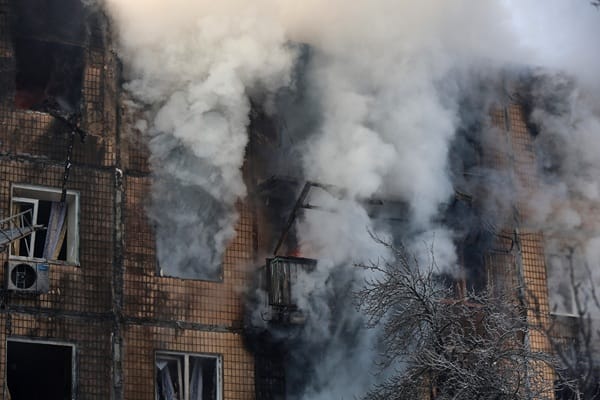
I woke up this morning in Ukraine to the familiar sound of air-raid alerts and the less familiar feeling that reality is being rewritten somewhere far away.
Overnight, the New York Post reported that Donald Trump said Vladimir Putin had “kept his word” on a ceasefire.
Yesterday, from the ground here in Ukraine, I wrote the complete opposite, and like Witkoff’s recent comments to Trump, which only confirmed what I’d already reported, that claim feels completely detached from what people here are actually living through.
Over the past week, I’ve written repeatedly about the growing gap between diplomatic language and battlefield reality.
That gap is no longer subtle, it’s now open, public, and deeply disturbing to watch.
Read more related news:
UK kicks out Russian diplomat and summons ambassador Kelin
Russian politician admits Putin’s war in Ukraine has failed
Russian school in London teaching children ‘very real military skills’
Putin’s uses ballistic missiles to freeze Ukrainians as part of peace talks
While talk of a “ceasefire” circulates in headlines, Ukrainians are still counting ballistic strikes, still pulling civilians out of wreckage, and still boarding trains that can become targets.
One of the most basic problems has never been solved: nobody can clearly explain what this ceasefire is even supposed to mean. When does it start? When does it end? What can be hit and what cannot? Energy infrastructure? Cities? Transport? Military targets only?
These aren’t technical footnotes, but they are the difference between real de-escalation and a public relations exercise. Yet this kind of vagueness has become a bad trademark of the Trump administration’s approach: sloppy, unorganised, heavy on statements, light on structure.
The result is predictable. Russia continues to strike, including with ballistic missiles, and civilians continue to die. In Kharkiv, a passenger train was hit, that is not a rounding error in a negotiation; that is a civilian target in a country that is supposedly under some form of ceasefire understanding.
What this so-called ceasefire has actually achieved is not restraint, but optics, allowing Moscow to present itself as a participant in a “process” that is fundamentally flawed and heavily tilted in Russia’s favour.
More disturbingly, militarily, Russia is already using ballistic missiles hand to mouth. Stockpiles are low enough that, under normal circumstances, you would expect a pause of days or even a week to build up enough for another meaningful strike package.
That is how this campaign has worked repeatedly. Which raises the obvious question: if nothing has changed on the battlefield, if the strikes are still coming, and if civilians are still being hit, then what exactly did this ceasefire change, other than providing political cover and a talking point for those who want to pretend restraint is being shown?
From Kyiv to Dnipro to Kharkiv, the mood is not cautious optimism, its bloody disbelief hardening into distrust that’s growing. Ukrainians are not parsing press releases; they are listening for explosions, they are watching emergency crews work and asking, again & again, whether anyone in Washington is actually looking at what is happening here, rather than what they wish were happening.
What makes this moment different is not just the continued strikes. It is the open validation of Putin’s narrative in the face of them. When a U.S. presidential figure suggests Russia is behaving responsibly while civilians are still being hit, it doesn’t land as diplomacy here, just lands as denial.
Trust is not an abstract concept in a war zone, it’s a must in any peace negotiation & practical. It is the belief that statements made by powerful actors have some relationship to reality, right now, that trust in the Trump administration is not just low, it is eroding by the day. Each vague promise, each premature declaration of success, each ignored strike widens the gap further and further.
Peace processes live or die on credibility, you cannot build one on undefined terms and selective vision. If Washington wants to be taken seriously as a broker, it has to start by acknowledging what Ukrainians are actually waking up to: not peace, not even a pause, but another day of a war that is being politely talked away while Russia keeps killing people.


Leave a Comment