
Exactly one year on from the death of my friend Chris “Swampy” Garrett, today has to be a better day than this time last year.
But across Ukraine, countless people carry the same scars of this war, knowing somebody who has been killed, wounded, gone missing, or remains in captivity. It is a harsh reality forced upon an entire nation by Russia.
A nation imperialist by nature, and increasingly indistinguishable from the very darkest chapters of World War II it claims to commemorate defeating during its annual Victory Day parade, a spectacle that now feels anything but victorious.
The ceasefire had not even begun before Russia once again demonstrated exactly what its promises are worth.
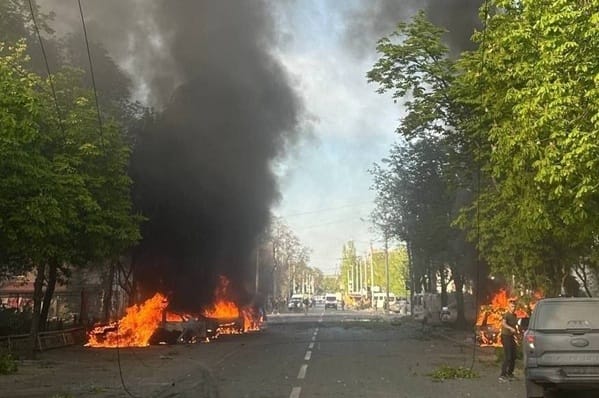
Hours before Moscow’s self-declared Victory Day truce was due to come into effect, Russian missiles, glide bombs and drones tore across Ukraine overnight, striking civilian infrastructure, city centres and residential districts in what has become an increasingly familiar pattern, publicly talking of peace while escalating violence on the ground.
The Kremlin had announced a unilateral ceasefire tied to its May 9 commemorations, the annual Victory Day parade Moscow uses to project military strength and invoke the Soviet defeat of Nazi Germany during the Second World War. Ukraine, meanwhile, had pushed for a broader and more meaningful cessation of hostilities earlier in the week and has consistently called for a ceasefire and genuine negotiations, proposals repeatedly rejected by Russia.
Victory Day has become a grotesque joke.
Russia claims to honour those who defeated fascism, while bombing civilians, apartment blocks, trains and city centres across Ukraine.
Hard to see the difference anymore between what they commemorate defeating and what they’ve become.… https://t.co/NGwU8KfHFk pic.twitter.com/5OGTCwNYFk
— Shaun Pinner (@ShaunPinnerUA) May 6, 2026
Initially, Donald Trump publicly called for a ceasefire, but later appeared to soften or shift his position, something many in Ukraine viewed as an early warning sign of where parts of the wider US approach may now be heading.
That uncertainty has only deepened as figures associated with Trump’s so-called peace team, including Steve Witkoff and Jared Kushner, have notably never actually visited Ukraine during the past two years of full-scale war, despite regularly discussing pathways to peace and territorial realities from afar and visiting Russia on several occasions.
Instead, Ukrainians spent the night under ballistic missile alerts.
According to Ukrainian officials, at least 27 civilians were killed and more than 100 injured across multiple regions in the hours leading up to the supposed truce. The attacks stretched from Zaporizhzhia and Dnipro to Kramatorsk, Kharkiv, Poltava and beyond.
In Zaporizhzhia, Russian aerial bombs and Shahed drones struck civilian areas, killing at least 12 people and injuring around 20 others. Residential buildings, businesses and civilian infrastructure were damaged in attacks local authorities described as some of the most intense in recent weeks.
Further east in Kramatorsk, strikes reportedly hit directly in the city centre. Ukrainian President Volodymyr Zelensky said there was “absolutely no military justification” for the attack, accusing Russia of deliberately targeting civilians. Initial reports indicated at least six people were killed, with rescue operations continuing into the morning.
My city of Dnipro also came under attack, with explosions heard across the city overnight as missile and drone alerts persisted into the early hours. Local officials confirmed civilian casualties and damage to infrastructure, adding to what has become a sustained intensification of strikes far beyond immediate frontline areas.
Meanwhile, gas production facilities in the Poltava and Kharkiv regions were hit in separate attacks that killed several workers and emergency responders. Ukrainian officials described some of the strikes as “double tap” attacks, where follow-up strikes target rescue personnel arriving at the scene. Ukraine’s Interior Ministry stated Russian attacks hit at least nine regions in a single night, including Poltava, Kharkiv, Donetsk, Dnipropetrovsk, Zaporizhzhia, Kherson, Odesa, Chernihiv and Sumy.
Ukraine’s Air Force reported Russia launched 11 ballistic missiles alongside 164 drones during the assault, but while many were intercepted, enough penetrated air defences to inflict widespread civilian casualties and infrastructure damage, additionally, at the time of writing this, air raid warnings remain active with Russian drones again reported around Kharkiv despite the supposed ceasefire period now being underway.
Zelensky also condemned what he described as Russia’s “utter cynicism,” pointing to the contradiction between Moscow publicly speaking about peace while simultaneously escalating attacks on civilians.
But where is everybody else?
That question is becoming harder to ignore with every passing week.
For weeks now, Ukraine has faced an intensifying wave of strikes targeting not only frontline positions, but civilian infrastructure on a scale increasingly difficult to dismiss as collateral damage. Residential towers, railway infrastructure, buses, markets, city centres and even places of worship continue to come under repeated attack.
Yet international condemnation remains remarkably muted.
Statements of concern appear briefly before disappearing into the wider churn of global politics, while Ukrainians continue spending night after night sheltering from ballistic missiles, cruise missiles and Shahed drones under the false pretence of a ceasefire.
The longer attacks on civilians continue without sustained outrage or political pressure, the greater the danger that they simply become accepted background noise. Already, attacks on Ukrainian cities have visibly escalated during Trump’s tenure, with many in Ukraine believing Putin has become increasingly emboldened by rhetoric now viewed as far softer toward Moscow.
But for those living here, there is nothing normal about it.
Russia claims Victory Day commemorates the defeat of Nazism and wraps itself in the symbolism of liberation, sacrifice and historical memory. Military parades will roll through Red Square while speeches invoke the fight against fascism and tyranny.
But increasingly, the reality unfolding across Ukraine tells a very different story.
The deliberate targeting of civilians, the destruction of residential districts, the bombardment of city centres and the use of terror against civilian populations are becoming impossible to separate from the darkest chapters of European history Russia claims to commemorate defeating.
The irony is no longer subtle.
A state presenting itself as the guardian of the Second World War’s legacy now stands accused of conducting one of Europe’s largest campaigns of civilian terror since the war itself.
And while Moscow continues staging its Victory Day theatre, Ukrainians remain underground in shelters listening for drones, missiles and air raid sirens, still waiting not only for protection,
but increasingly for the world to find its voice.


Leave a Comment