
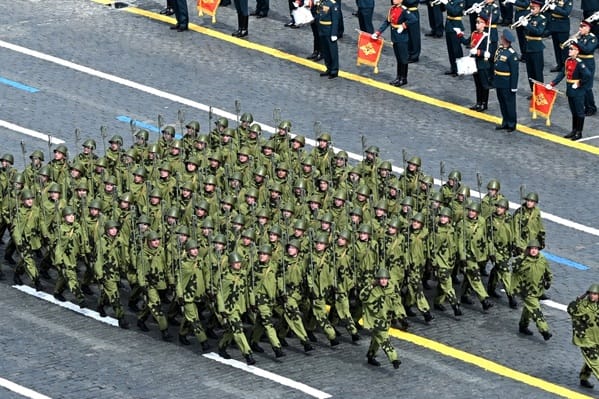
While the Kremlin attempted to present its May 9th “Victory Day ceasefire” as a humanitarian gesture tied to commemorations of the Soviet victory in the Second World War, the reality across Russia and Ukraine overnight looked very different.
Explosions, air raid alerts, drone interceptions and infrastructure strikes echoed across multiple regions as both sides accused the other of violating the truce almost immediately after it came into effect.
Yet beneath the ceasefire rhetoric sat another unmistakable political calculation. Since the start of the full-scale invasion, Vladimir Putin has consistently framed the war domestically as a continuation of Russia’s fight against “Nazism,” attempting to portray Ukraine through the lens of the Second World War.
Against that backdrop, any Ukrainian strike connected to Moscow’s May 9 parade would almost certainly serve another purpose for the Kremlin: reinforcing one of its central propaganda narratives for a domestic audience already conditioned around the symbolism of Victory Day.
Read more related news:
Zelensky rejects Russia’s ‘ceasefire’ as drone and missile attacks continue across Ukraine overnight
Russia shuts down internet in capital as confidence in its own security collapses
Another day, another ‘impossible’ Ukrainian strike deep inside Russia
Kremlin calls time-out on war for Putin’s parade, but Zelensky threatens ‘long-range sanctions’
Instead of calm, however, the hours leading into the parade saw waves of Ukrainian drones targeting Russian territory, air traffic disruptions across multiple cities, fresh strikes on energy infrastructure including the Yaroslavl oil refinery, and continued Russian attacks against Ukrainian cities despite the supposed “silence regime” already being in effect.
The breakdown in confidence surrounding the latest ceasefire proposals did not happen overnight and has instead unfolded through a series of competing announcements, accusations and alleged violations over the past week.
Timeline of the Ceasefire Dispute
- May 6: Volodymyr Zelenskyy again called for a broader unconditional ceasefire lasting at least 30 days, arguing that any meaningful truce needed international monitoring, clear guarantees and immediate implementation rather than pauses tied to symbolic political events. Kyiv maintained that a real ceasefire could begin immediately if Moscow genuinely wanted one.
Zelensky stated: “There is no reason to wait until May 8. The ceasefire should be immediate, full and unconditional for at least 30 days to ensure it is secure and guaranteed.”
- May 6–7: The Kremlin rejected Ukraine’s broader proposal. Instead, Vladimir Putin announced a unilateral “Victory Day ceasefire” scheduled to begin at midnight on May 8 and run through May 10, specifically timed around Russia’s annual Red Square celebrations. Moscow framed the move as a humanitarian initiative honouring the Soviet victory in the Second World War and called on Ukraine to reciprocate.
The Kremlin stated the ceasefire was being introduced “based on humanitarian considerations during the days marking the 80th anniversary of Victory in the Great Patriotic War.”
- Before Midnight, May 7: Ukrainian officials expressed scepticism almost immediately, pointing to previous short-term truces, including Easter ceasefires, which Kyiv claimed Russia had violated shortly after coming into effect. Ukrainian authorities also questioned why Moscow was unwilling to implement an immediate ceasefire rather than one designed around a military parade.
Zelensky criticised the proposal directly, saying: “For some reason everyone is supposed to wait until May 8 before ceasing fire, just to provide Putin with silence for his parade.”
- Midnight, May 8: Russia’s proposed “silence regime” officially came into effect. However, according to Ukrainian military statements, frontline shelling, assault operations and drone activity continued almost immediately after the ceasefire window began. Kyiv later claimed Russia had carried out more than 140 shelling attacks, multiple assaults and hundreds of drone strikes by early morning, accusing Moscow of effectively breaking its own ceasefire within hours.
By early morning, Zelensky stated: “As of now, according to military reports, Russian assaults and shelling continue. Russia has not stopped using weapons.”
- Simultaneously Overnight: Moscow accused Ukraine of violating the ceasefire first through continued long-range drone strikes against Russian territory, including attacks targeting Moscow, regional airbases, logistics hubs and energy infrastructure. Russian officials claimed Ukraine was attempting to deliberately undermine Victory Day commemorations.
Russian Foreign Ministry spokesperson Maria Zakharova accused Kyiv of trying to “demonstrate its terrorist nature to the entire world” through continued strikes during the ceasefire window. The result was effectively a ceasefire in name only, with both sides entering the truce already accusing the other of violating it first.
On the ground inside Ukraine, the reality feels even starker. As I write this from Dnipro this morning, air raid alarms continue sounding across the city, with fresh warnings of potential ballistic missile threats issued overnight and again into the early hours. For civilians living through it daily, the so-called “silence regime” has brought little noticeable change beyond the political messaging surrounding it.
The constant sound of alerts, the monitoring of Telegram channels for missile warnings, and the now routine expectation of drones or strikes during the night remain part of everyday life. Whatever language is being used publicly by Moscow or Kyiv, for many Ukrainians on the ground the situation remains fundamentally unchanged
Overnight, Ukraine launched one of its largest coordinated long-range drone operations of the war so far, according to Russian authorities. Moscow claimed hundreds of UAVs were intercepted across more than 20 regions, with temporary airport shutdowns once again affecting Moscow and several major cities.
Hope it will changes soon.
❗️Almost 300 (!) drones are flying to attack Moscow and make negotiations from the right position) pic.twitter.com/KeE1HatPdB— Andrii fella (@andrii_soloviov) May 7, 2026
Particular attention focused on reported strikes reaching Grozny, highlighting Ukraine’s growing ability to project drone operations far beyond the frontline and into politically symbolic regions of the Russian Federation itself.
Meanwhile, footage and reports also emerged of the Yaroslavl oil refinery burning following reported Ukrainian drone strikes overnight, adding to a growing list of Russian energy infrastructure increasingly targeted by Kyiv’s expanding long-range campaign. Images circulating online appeared to show large fires and smoke rising from the facility, continuing Ukraine’s strategy of applying pressure not only militarily, but economically and psychologically deep inside Russia.
The attacks form part of a broader Ukrainian effort that has increasingly focused on Russian oil infrastructure, logistics hubs, airbases and defence industry facilities. Recent weeks have already seen reported strikes against refinery infrastructure in Perm, industrial facilities in Chelyabinsk and Yekaterinburg, along with sustained pressure on Moscow’s air defence network itself.
Even Rostov-on-Don was hit overnight, with footage appearing to show a Russian air defence missile slamming into a residential area during interception attempts, scenes of chaos that felt strikingly different to how I remember the city during my prisoner exchange in 2022. At the time, the idea that Ukraine would eventually be capable of projecting this level of pressure deep into Russian territory would have seemed a distant pipe dream. Four years later, the war has changed dramatically. What was once largely confined to occupied Ukrainian territory and border regions now increasingly reaches Russia’s own cities, infrastructure and airspace, bringing parts of the conflict much closer to ordinary Russians than the Kremlin likely ever anticipated.
For the first time in years, Moscow’s Victory Day celebrations are taking place under the visible threat of Ukrainian drones reaching not only the Russian capital, but regions previously viewed as politically untouchable. Russian authorities have reportedly scaled back parts of this year’s celebrations amid growing security concerns surrounding May 9 events.
At the same time, Russia continued overnight strikes against Ukraine despite publicly speaking about a temporary truce. Ukraine’s Air Force stated that Russia launched more than 100 drones overnight, including Shahed-type UAVs and decoy drones intended to overwhelm Ukrainian air defences. Kyiv reported most were intercepted, although damage and injuries were recorded across several regions.
In his latest remarks, Zelensky criticised Moscow’s ceasefire proposal as political theatre, describing the idea of pausing the war purely to safely conduct a military parade as “strange” while Ukrainian cities continued facing nightly drone and missile attacks.
For many Ukrainians, the symbolism is becoming impossible to ignore. A state presenting itself as the defender of the legacy of defeating fascism in the Second World War now spends nights launching drones and missiles at Ukrainian cities while simultaneously demanding temporary pauses to safely conduct military celebrations in Red Square.
And as both sides continue exchanging strikes despite competing ceasefire narratives, the events of the past 24 hours reinforced a reality already widely understood across Ukraine: for now, there is no ceasefire, only war conducted under different messaging.


Leave a Comment