
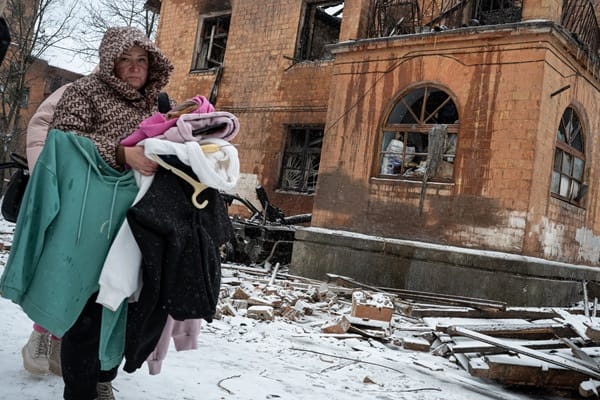
Ukraine did not wake up to diplomacy this week. It woke up to ballistic missiles, freezing temperatures, and burning infrastructure.
There has been little out of the ordinary, despite Donald Trump announcing a promised ceasefire on energy infrastructure, as temperatures plunged towards –20°C.
In the early hours of the night, Russia launched another coordinated strike package against Ukrainian cities, combining drones, cruise missiles, and most significantly, ballistic missiles.
It was a deliberate escalation, timed not only for maximum physical damage, but for maximum political effect.
These strikes came days before so-called trilateral talks in Abu Dhabi, billed optimistically by some as “productive,” yet once again exposed as hollow by Moscow’s actions. Russia’s pattern is all too familiar: talk by day, terror by night, a reality seemingly ignored by the Trump administration when confronted with events on the ground.
On 29 January, Steve Witkoff suggested the Ukrainian people could be “hopeful” that a peace deal was within reach. For someone who has never actually visited Ukraine, this looked less like informed diplomacy and more like a man telling his boss what he wanted to hear. The reality on the ground telling a very different story: civilians were still being targeted, attacks continued unabated, and Russia even struck a passenger train in Kharkiv—an act of terrorism designed solely to harm civilians.
A night of missiles
The attack followed a now-familiar Russian template. Shahed-type drones were launched first, probing air defences and forcing Ukrainian systems to remain active for hours. As those defences were engaged, ballistic missiles were fired, fast, difficult to intercept, and designed to punch through to high-value targets.
Kyiv was placed under a ballistic threat alert shortly after midnight. Explosions were heard across the capital as air defence systems engaged incoming targets, the air raid lasting more than five hours. By daylight, the damage was clear.
Five districts of Kyiv were affected. Three residential apartment buildings were struck, a building housing a kindergarten was damaged and a gas station a blaze. Cars were also destroyed, power lines hit & civilians injured.
Kharkiv, closer to the Russian border and under constant pressure, suffered a sustained strike sequence. Ballistic missiles targeted energy infrastructure in and around the city. Local authorities were forced into emergency measures, draining heating systems to prevent catastrophic freezing of the network while more than 800 buildings were affected, many left without heat as overnight temperatures dropped to minus twenty degrees Celsius.

In Sumy region, residential buildings were hit. In other regions like my city Dnipro, explosions and air defence activity were constant. The geographic spread was not incidental. It was a reminder that nowhere in Ukraine is truly “rear-area” territory anymore.
Winter as a weapon
The cold is part of the strike plan.
Russia has repeatedly attempted to weaponise winter by degrading Ukraine’s energy and heating systems at the coldest moments of the year. Each missile fired at a power node carries a multiplier effect: no electricity means no heat, frozen pipes, and infrastructure damage that takes weeks, not days to repair.
When temperatures plunge this low, every hour without power becomes dangerous. The elderly, children, hospitals, and entire residential blocks are put at risk. Emergency crews work in blackout conditions, often while fresh air-raid alerts interrupt repairs. Even when missiles are intercepted, falling debris still causes fires and destruction.
This is why talk of “energy ceasefires” rings so hollow in Ukraine. There is always a justification, always a loophole, always another strike explained away as misunderstanding or retaliation. What matters is effect, not rhetoric, and the effect last night was predictable and brutal. Many Ukrainians now watch Western media frame these developments while seeing Trump repeatedly validate Putin’s position, even as missiles continue to fall.
Ballistic messages before talks
The timing of this strike matters as much as its scale.
This week’s trilateral discussions, bringing together Ukrainian, Russian, and American representatives, were already fragile. There is no ceasefire, there are no agreed enforcement mechanisms & there are no ratified security guarantees. Territory, the biggest issue, remains entirely unresolved, while prisoners of war and abducted children still remain bargaining chips.
Into this vacuum, Russia continues to fire ballistic missiles. The signalling could not be clearer.
Moscow is demonstrating that negotiations do not constrain it, that talks do not equal restraint, and that any process allowing Russia to continue striking civilian infrastructure serves Russian interests first.
For Ukrainians, the message is unmistakable: nothing has changed.
For international observers describing these talks as “constructive,” this night should be sobering. If diplomacy cannot even pause attacks on kindergartens and apartment blocks during a deep freeze, then it is not diplomacy, it is theatre, and we are entitled to ask: constructive for whom?
Each missile widens that gap. Each “productive meeting” that coincides with civilian strikes erodes trust further, not just in Russia, but in the credibility of the process itself.
What comes next
Ukraine’s Air Force will publish full figures in due course, numbers intercepted, missile types used, trajectories identified. Those details matter, but they will not change the core reality.
Russia chose attacks during talks.
Russia chose winter targeting.
Russia chose civilian pressure.
Until that behaviour carries real consequences, no amount of diplomatic choreography will alter Moscow’s calculus.
Ballistic missiles are not noise in the background of negotiations.
They are the negotiation.
And last night, Russia made its position brutally clear.


Leave a Comment