
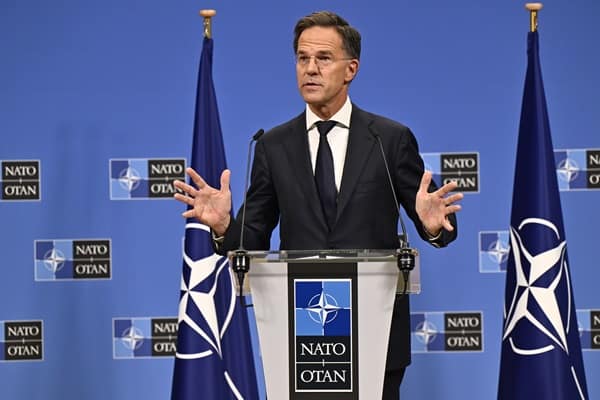
NATO will not publicly disclose the precise circumstances that could trigger its collective-defence commitment, Secretary General Mark Rutte has warned, saying revealing the alliance’s threshold would allow adversaries to calculate how far they could escalate without provoking a response.
“Article 5 is deliberately ambiguous, so we will never exactly tell anyone when Article 5 is exactly triggered or not,” Rutte said during a discussion on the future of NATO and the alliance’s importance to US security.
The comments come as NATO faces growing concern over Russia’s use of cyberattacks, sabotage, disinformation, drone incursions and other forms of hybrid activity aimed at testing the alliance without crossing an obvious conventional military threshold.
Rutte said NATO had “all the response options we need” to deal with hybrid threats, but stressed that some measures could remain secret.
The alliance would also not necessarily respond to an attack in the same way it was carried out. Responses could be “symmetric”, using similar means, or “asymmetric”, employing different political, economic, cyber or military measures.
Read more related news:
More than 250,000 Russian soldiers confirmed as rotting fertiliser in Ukraine
Russian attack helicopter breaches NATO airspace ‘to once again test air defences’
ISW warns Russia could try and seize Estonian city in a test of Article 5
Brits on holiday in NATO hotspot warned of Russian explosive drones
That flexibility is intended to prevent potential adversaries from anticipating precisely how NATO would respond to an attack.
NATO’s formal position is that Article 5 applies to an “armed attack”, but the alliance does not prescribe a fixed threshold. Whether an incident constitutes such an attack is assessed case by case. NATO says significant cyber and hybrid attacks may also be considered capable of amounting to an armed attack.
Article 5 states that an armed attack against one member is considered an attack against all. However, it does not require every ally to respond identically or automatically commit forces to war. Each member is required to assist the ally under attack by taking “such action as it deems necessary”, which can include the use of armed force.
The provision has been invoked only once, following the September 11 2001 terrorist attacks against the United States.
NATO has explicitly acknowledged for years that hybrid warfare creates a particularly difficult challenge because attacks can be designed to remain ambiguous and difficult to attribute. At the 2016 Warsaw summit, allies agreed that the North Atlantic Council could decide to invoke Article 5 in response to a hybrid attack.
The distinction has become increasingly important as Russia and other potential adversaries employ methods that fall between conventional warfare and ordinary peacetime activity.
Drone incursions, sabotage, cyber operations, covert action and information campaigns can cause significant disruption while making it more difficult to establish responsibility or determine whether an incident constitutes an armed attack.
Rutte’s warning effectively leaves Moscow without a publicly defined ceiling below which it could assume NATO would not respond.
The NATO chief has previously argued that Russia understands the seriousness of Article 5 even though the alliance does not publish its precise thresholds. His latest comments underline the importance NATO places on strategic ambiguity as part of its deterrence.
Polish Prime Minister Donald Tusk has separately warned that Russia could seek to exploit uncertainty by carrying out hybrid attacks against countries supporting Ukraine and presenting them as accidents. Tusk said such operations could be intended to persuade European populations that Article 5 was “more theoretical than practical”.
Rutte’s position points in the opposite direction: an attack does not need to resemble a conventional invasion to produce consequences, and the consequences may not be immediately visible.
NATO has increasingly developed a broader toolbox for responding to hostile activity below the level of an obvious conventional war, including sanctions, diplomatic measures, cyber responses, intelligence operations and other forms of pressure. The alliance has previously acknowledged that responses to hybrid threats can range from national measures to collective action.
For NATO, the objective is therefore to preserve uncertainty over the precise point at which collective defence would be activated while making clear that ambiguity should not be mistaken for inaction.
As Russia continues to probe the boundaries between peace and conflict, the alliance is deliberately keeping its most important red line unwritten.


Leave a Comment