
Running a business well is rarely about perfection. It’s about keeping things moving—even when there are delays, breakages, and people spilling coffee in the middle of it. There’s no better teacher of that than the London transport system.
All is in flux, and nothing shatters, and there’s a rhythmic quality to the London transport system that’s difficult to ignore. Far from perfect, but if you look at the sheer magnitude of things happening—subterranean and above ground, through stops and across the platforms—it’s miraculous that it all works. Trains arrive. People get on. Others get off. The signals and systems and unobtrusive choreography of tunnels and timetables—somehow it’s oddly calming to observe even when surrounded by strangers on the Jubilee line.
So, how does it all manage to keep on trucking and not collapse? That’s the moment business owners should sit up and take note. London’s public transport may appear chaotic on the surface, but under the hood, it has a grasp on the concept of flow. The same movement and order is what a business requires if it is to remain solid.
Timetables and trust: Fulfilling promises at scale
When you’re running a transport system with millions of passengers a day, “close enough” does not suffice. The whole system relies on confidence. People organise their meetings, flights, pickups, and drop-offs of the kids, and dates on the assumption that a train will arrive on time as indicated on the board.
You’re sending a clear message to businesses: consistency is mandatory—it’s non-negotiable. If clients don’t know they can count on having a deadline met or connecting on a scheduled call, their faith begins to break down. Of course, the trains aren’t always punctual. The system does have fallbacks—service updates, detour routes, and communication.
If you want a brand to last, build it with foresight. Communicate as directly as possible. Fulfil promises—particularly the seemingly small ones.
Hidden infrastructure we all depend upon
Not many individuals are enthusiastic about cables, signal boxes, and air ducts. When one does malfunction, however, everything unravels. London’s transport relies on out-of-sight infrastructure—hundreds of unappreciated parts whose presence is noticed only when they fail.
The same applies to your company. Consider invoice forms, password management tools, and files neatly organised by system. They might not seem glamorous, but they are the foundation of your operations.
If you’re looking to scale, don’t ignore those back-end systems. Your clean internal systems may never win you a trophy, but they’ll keep burnout out of your team and out of your life. Truthfully, that’s worth more than any trophy.
Balancing the old and the new
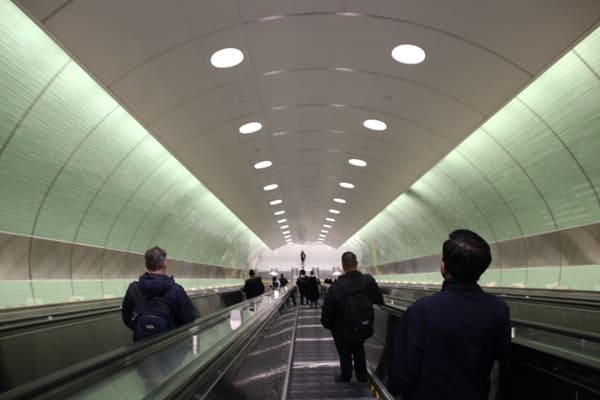
The London Underground is over 160 years old. Of course, it rides alongside brand-new additions such as the Elizabeth Line, which has stations boasting Wi-Fi and huge escalators reminiscent of a sci-fi movie.
That balance of old infrastructure with modern innovation is something every business faces at some point. You don’t need to scrap everything to stay current. Sometimes, it’s about finding the bits that still work and building new layers around them.
You may still utilise your spreadsheet, of course. Perhaps it’s time to merge it with a CRM, which indeed reports back to you on things.
The individuals calling the shots are out of the public eye
Take a glance around a London station and you’ll see it: the most indispensable individuals aren’t the suits. They’re the ticket checkers, the spilling clean-up crew, and the platform change announcer when the tannoy breaks down. They make things work without ever being in the public eye.
If your team makes you invisible, likely something is amiss. Recognition is more than bonuses or ‘employee of the month’ awards. It’s about providing your team with space to own it, make decisions, and believe their work matters—because it does.
The transport system would break down without its daily workers. Your business would too.
Adapting in real-time, not panicking
A malfunctioning signal in Stratford. A Northern Line passenger alarm. Someone has left a case on the tracks. It is a mess, but. Not a catastrophe. Because there are procedures. Contingencies. Human beings are trained to respond and not simply react.
What do you do when your business encounters a sudden wall? Your product flops. The supplier goes radio silent. The client jumps ship. Do you melt—or do you move?
The greatest systems are the ones that do not avoid failure at all costs. They’re the ones who anticipate that eventually, they most definitely will. And are prepared to deal with it.
Efficiency does not equal speed
The Central Line is technically the city’s quickest route. It’s also the line on which most complain. Why? It’s too hot and too crowded, and if you’re even a minute late on one, the next is already full.
Faster isn’t always better. Sometimes, it’s worse.
That includes everything from deadline deliveries to how fast you answer emails. Urgency and speed are two very different things. One exhausts you. The other generates momentum.
Have workflows that breathe. Leave a little space between tasks. The objective isn’t to stuff more into the day—it’s to make it work.
Feedback loops that do something
TfL does have a system of feedback. Anyone who has ever attempted to report a broken lift will attest it’s far from flawless. But when it is a major event—a strike, a policy change, a modification to timetables—you’ll usually discover they’ve taken real commuter feedback on board.
It’s a subtle reminder that hearing is not sufficient. You have to do something with what you hear.
Whether it’s a client complaining about how complicated your billing system is or a colleague alerting you to burnout, it’s up to you to ensure the loop is two-way. A system without feedback slowly dies. A business that takes action on it? That’s the sort of firm that endures.
Don’t underestimate the physical facets of operations
While technology and automation are trendy today, London transport is still on extremely hands-on, person-operated systems. Escalators. Doors. Maintenance crews. Drivers. There is so much actual lifting and handling that goes on every single day—and it’s all part of the bargain.
Businesses are no different. No matter if it’s moving stock around, having an event, or providing a service itself tangibly, you simply cannot avoid the ‘real world’ part of things. That tangible work does add up. That’s where brand experience starts—or falls apart.
Routine doesn’t mean stagnant
If the same train is ridden every day, it appears as if nothing ever changes. In the midst of it all, however, predictability is continuous refinement. Engineers implement system improvements. Staff members change roles. Schedules are set to variable demand. All façade of routine is really a dynamic process, subtly adjusting to cater to today’s requirements.
Here’s a gentle reminder to recall that just because a thing works does not automatically imply it cannot be optimised. Firms equate “steady” with “done” by mistake. Routines are supposed to be scanned, stress-tested, and optimised. That monthly team meeting? Maybe it’s a different structure it needs. Your welcome emails? They’re likely five years outdated. The magic is in small, incremental tweaks and not when things break and we have to fix them.
What businesses can learn from all of this
You might not be running 11 lines of track through city tunnels, but you are aiming to keep things moving when pressure is applied. London’s transport system teaches you that order emerges out of less than perfection—it emerges out of good systems, clear tasks, and a willingness to respond rather than react.
So the next time you’re delayed by a forgetful ‘tap-on’, try to consider it as a reminder. To stop. To rethink. To build a firm that functions like the Tube at its best: on the whole, on time, surprisingly elegant in motion, and able to hold up to pressure when it comes to it.



Leave a Comment