
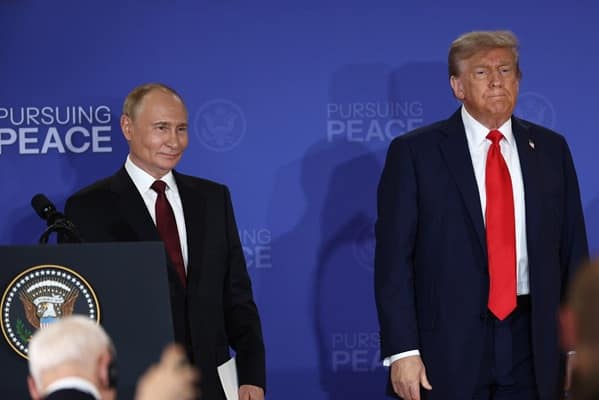
In the aftermath of a lengthy phone call between Donald Trump and Vladimir Putin, the resulting public statements from Washington have once again sparked confusion, concern and renewed scrutiny over the direction of U.S. foreign policy.
Nothing new, you might say, but this time the volume has been turned up.
The dial isn’t creeping anymore; it’s been slammed forward, with Trump, while making a complete dog’s dinner of it, appearing to repeat Kremlin talking points almost verbatim.
What should have been a routine diplomatic explanation of the call instead unravelled into a sequence of remarks that felt disjointed, contradictory and, at times, indistinguishable from a Kremlin press release, you could almost find yourself waiting for Trump to confirm Kupyansk had “fallen” once again, a town Moscow has claimed to have taken more times than anyone can realistically count, routinely echoed back up the chain to Putin by figures such as Valery Gerasimov.
Only this time, it went a step further.
Trump appeared to blur Iran and Ukraine into one confused narrative, either a genuine mix-up or something that raises deeper questions. During his post-call comments, he conflated two entirely separate conflicts, mischaracterising military realities and merging geopolitical theatres in a way that left analysts and observers questioning whether this was simply a slip or something more concerning altogether.
That alone would have raised eyebrows, but, unfortunately, it didn’t stop there.
Wait, what?
Say that again? pic.twitter.com/RYFEITNKdz
— Shaun Pinner (@ShaunPinnerUA) April 29, 2026
Trump doubled down by reiterating that Ukraine is effectively “defeated”, a claim that stands in stark contrast to the reality on the ground. This isn’t a war wrapped up neatly for either side, it’s grinding, costly, still evolving and far from decided, certainly not as clear-cut as Trump would have you believe. Having just returned to Dnipro after time in Canada speaking with the Ukrainian diaspora, the idea of “defeat” feels not just premature, but completely detached from reality, especially as I’ve just taken the train into the city only a couple of hours from the frontline.
If anything, the pressure is building on the Kremlin.
Ukrainian strikes deep into Russian territory, the steady degradation of air defence systems, and growing economic strain are beginning to bite in a war now into its 5th year. Even within Russia, military bloggers, often a useful barometer of sentiment, are showing increasing frustration, this not a profile of a state comfortably winning a war.
By echoing a narrative long pushed by Moscow, that Ukraine has “already lost”, he risks doing more than misreading the situation. He feeds directly into a well-established Russian information strategy: project inevitability, create fatigue and fracture Western support, saying far more about Trump’s current political positioning than it does about the battlefield itself, with a delivery didn’t help his case.
The messaging was muddled, at times incoherent, falling back on the familiar line that if you don’t accept his version of events, you must be buying into “fake news.” It’s a tactic we’ve seen before, but this time it landed with less authority and more confusion, quickly picked apart across social media for what many saw as a rambling and inaccurate assessment.
The timing, too, is hard to ignore.
Putin is under increasing pressure, militarily, economically and politically, certainly more than I’ve ever seen in my lifetime. Ukrainian strikes on key infrastructure, including energy facilities such as Tuapse, have forced visible changes inside Russia. Air defences are being repositioned, military displays scaled back, and the narrative tightly controlled, even down to the size and composition of audiences, as Western social media platforms continue to be restricted.
At the same time, Moscow continues to push for symbolic ceasefires, like the proposed Victory Day truce, moves widely viewed as opportunities to pause and regroup rather than genuine steps toward peace. Against that backdrop, Trump’s comments don’t read as strategy but reinforcement, repeating Russian framing at a moment when that framing is under strain.
And then came the follow-up.
In a Truth Social post, Trump floated the idea of reducing U.S. troop levels in Germany, home to a significant American military presence and a cornerstone of NATO’s operational structure. The justification followed familiar lines: frustration with defence spending and dissatisfaction with European positions on Iran.
Germany is not just another ally, it is a central logistical hub for U.S. operations across Europe, the Middle East and Africa. Facilities like Ramstein underpin everything from troop movement to medical evacuation. Any reduction in presence isn’t symbolic, it carries real operational consequences.
So why now?
It feeds a growing perception that U.S. security commitments are becoming conditional, something to be traded, rather than upheld through strategic consistency. This isn’t new territory, Trump has long criticised NATO, questioning its value and publicly pressuring allies on burden-sharing, some things which I whole heartedly agree on.
In addition, King Charles III, during his recent state visit to the United States, used the platform to reinforce support for Ukraine and the NATO alliance, stressing unity, collective defence and the enduring importance of transatlantic cooperation, something later Trump blew off, messages that sit uneasily alongside Washington’s increasingly transactional tone.
Taken together, the sequence is hard to ignore with confusion in messaging, alignment, intentional or not, with adversarial narratives, and simultaneous pressure on allies.
There is now, without doubt, a dangerous overlap.
Portraying Ukraine as defeated while signalling a potential drawdown of U.S. forces in Europe sends a clear message: resistance is futile, and support is not guaranteed. For NATO’s eastern flank, where the threat from Russia is not theoretical but immediate, that is deeply unsettling.
At a time when Putin is facing genuine constraints from battlefield attrition to economic pressure, Western unity remains one of the most effective counterweights, so any sign of division, hesitation or mixed messaging risks handing Moscow exactly what it wants.
Diplomacy is rarely clean, but what followed this call was something else entirely. A muddled, inconsistent narrative that blurred conflicts, misrepresented realities to intentionally unsettle allies, all while echoing the language of the very state the West is trying to contain.
Whatever is happening during these calls remains to be seen, but shaping the political environment for an aggressor intent on erasing a nation is something we’ve seen before.
The difference is, last time, America ended up on our side.


Leave a Comment