
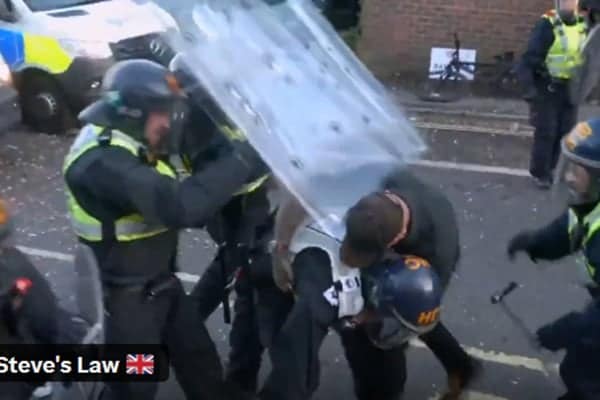
Few phrases in modern British politics provoke as much controversy as “two-tier policing”.
For years, critics have alleged that police forces have increasingly adopted different approaches to different groups, influenced by concerns over race, identity and community relations.
Police leaders have consistently rejected the charge, insisting that officers enforce the law impartially and without fear or favour.
Yet the murder of Henry Nowak has propelled the debate from the fringes of political discourse to the centre of national attention.
The reason is simple: millions of people watched the footage.
This body cam footage is extremely shocking.
You can hear Henry Nowak’s pleas about being unable to breathe.
And you can hear how the police dismissed them and failed to take action to try to save his life.
This is not just about knife crime. This is about police failure, poor…
— Suella Braverman (@SuellaBraverman) June 1, 2026
The bodycam video released following the Southampton teenager’s death did not require lengthy explanation or political interpretation.
Viewers saw an 18-year-old repeatedly saying he had been stabbed while officers focused on allegations that he had used racist language. The images were shocking, the circumstances deeply troubling, and the public reaction immediate.
Within hours, questions were being asked not merely about the actions of individual officers but about the culture that may have shaped those decisions.
Police leaders are correct to point out that public perception is not the same thing as evidence.
The Independent Office for Police Conduct is investigating the circumstances surrounding the incident and whether any misconduct occurred. The facts must be established through evidence rather than emotion.
However, policing ultimately relies on public confidence.
The fear of being called racist was greater than dealing with Henry Nowak’s murder.
We should respond to this with pure cold rage.
Britain’s historic way of life is being thrown away. pic.twitter.com/4N6vL76q1F
— Nigel Farage MP (@Nigel_Farage) June 2, 2026
The challenge for forces across the country is that many members of the public believe they have already seen enough to form a judgment.
Whether those conclusions ultimately prove correct is almost secondary to the damage done to public trust.
In policing, perception matters.
When large sections of the public begin to suspect that officers are applying different standards depending on race, ethnicity or identity, confidence in the entire system is undermined.
The controversy surrounding Hampshire and Isle of Wight Constabulary did not emerge in a vacuum.
In recent years, police forces have invested heavily in diversity, equality and inclusion programmes. Officers have received training covering unconscious bias, privilege, institutional racism and community engagement.
Supporters argue these initiatives are necessary.
They point to historical failings, including the findings of the Macpherson Report, which concluded that institutional racism existed within parts of British policing.
The argument is that improving relationships with minority communities leads to better policing outcomes, greater cooperation and stronger public confidence.
Many senior officers continue to view these programmes as essential.
Yet critics argue that something has gone badly wrong.
They claim that legitimate efforts to tackle discrimination have evolved into an ideological framework that encourages officers to view incidents primarily through the lens of race and identity.
For those critics, the Henry Nowak case appears to confirm their worst fears.
The debate intensified further following reports that officers within Hampshire and Isle of Wight Constabulary themselves expressed concerns about diversity training.
According to survey findings reported by The Times, some officers said they felt “controlled and pressured” by training programmes and worried that saying the wrong thing could damage their careers.
Others reportedly feared being judged or rejected for expressing views that departed from approved orthodoxy.
Supporters of diversity initiatives argue such findings are unsurprising whenever organisational culture changes.
Critics see them as evidence that officers may be becoming excessively cautious when dealing with issues involving race.
The concern is not that officers are deliberately favouring one group over another.
Rather, it is that fear of allegations of racism may influence operational decision-making at critical moments.
Whether that happened in the Nowak case remains the central question under investigation.
The issue has rapidly become a major political dividing line.
Nigel Farage has argued that the case represents clear evidence of two-tier policing and warned that public confidence is being eroded.
Meanwhile, Keir Starmer has strongly rejected that accusation, describing attempts to use the tragedy to fuel division as irresponsible.
The Prime Minister has repeatedly pointed to the wishes of Henry’s family, who have urged people not to use their son’s death to inflame tensions.
That appeal has resonated with many.
Yet it has not silenced wider concerns.
The political reality is that public trust in institutions was already fragile long before Henry Nowak’s death.
Trust in politicians has fallen.
Trust in the media has weakened.
Trust in policing has been damaged by a succession of scandals.
Against that backdrop, the footage acted as a catalyst for frustrations that had been building for years.
Perhaps the most important point is that the argument is no longer solely about what happened in Southampton.
The IOPC investigation may establish whether officers acted appropriately, whether mistakes were made or whether misconduct occurred.
But even if individual officers are cleared of wrongdoing, the wider political debate is unlikely to disappear.
For critics, the Nowak case has become symbolic of broader concerns about identity politics, institutional culture and equal treatment under the law.
For defenders of current policing practices, it risks becoming a vehicle for sweeping accusations that unfairly undermine officers who serve all communities.
Both sides view the stakes as exceptionally high.
The central question is no longer simply whether mistakes were made during Henry Nowak’s final moments.
It is whether Britain’s police can convince the public that every citizen is treated equally regardless of race, ethnicity, religion or background.
That principle lies at the heart of policing by consent.
If confidence in it begins to erode, the consequences extend far beyond a single force, a single incident or a single investigation.
The investigators’ findings may answer some of the factual questions.
Whether they restore public trust is a far more difficult challenge.


Leave a Comment