
The head of Britain’s police watchdog has urged the public to stop speculating about the circumstances surrounding the death of Henry Nowak.
But for many people, the problem is that speculation has filled a vacuum created by a collapse in trust.
Millions watched the horrific bodycam footage for themselves. Millions saw an 18-year-old repeatedly saying he had been stabbed while officers handcuffed him after allegations of racist abuse, whilst he was dying.
Millions then formed their own conclusions over the brutal handling of Mr Novak by Hampshire Police.
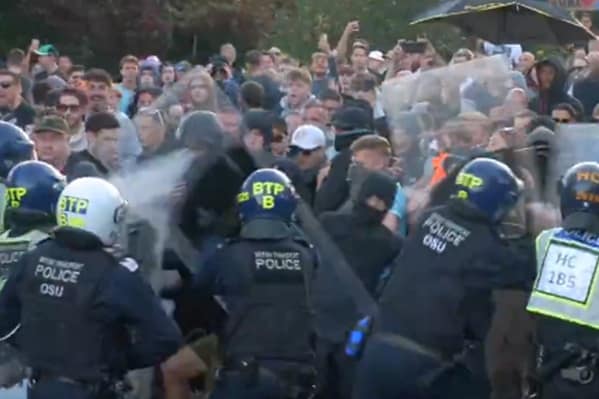
This has led to calls to end “two-tier” policing in Britain and led to clashes with protesters in Southampton, to which the Reform UK leader warns this is “the beginning.”
That is the challenge now confronting not only the Independent Office for Police Conduct but policing itself.
Derek Campbell, the director of the IOPC, insisted the investigation must be allowed to run its course. He warned that ongoing commentary risked prejudicing proceedings and could ultimately prevent Henry’s family from obtaining the answers they deserve.
His concerns are understandable.
Every suspect, witness and officer involved deserves due process. Investigations should be based on evidence, not on social media outrage.
Yet the reason public debate has become so fierce is that many people no longer automatically trust official assurances.
The footage triggered an emotional reaction because it appeared to capture a catastrophic failure of judgment. It is that perception, whether ultimately upheld by investigators or not, that has driven the public response.
The controversy has since evolved far beyond the actions of individual officers.
It has become a wider argument about policing priorities, diversity training and allegations of “two-tier policing” that have simmered beneath the surface for years.
Recent revelations that officers within Hampshire and Isle of Wight Constabulary felt “controlled and pressured” by mandatory diversity training have only intensified those concerns.
Critics argue the case raises uncomfortable questions about whether officers have become overly concerned with accusations of prejudice at the expense of common-sense policing.
Police leaders strongly reject that claim.
Chief Constable Alexis Boon has repeatedly insisted he does not recognise the concept of two-tier policing. Sir Keir Starmer has similarly dismissed the allegation, accusing critics of exploiting a tragedy to create division.
Yet simply telling people not to believe what they think they saw may prove politically impossible.
The reality is that confidence in institutions is fragile.
Trust in politicians is low and trust in policing has suffered repeated blows over recent years.
Against that backdrop, asking the public to suspend judgement becomes far harder when the evidence that triggered their concerns is already in the public domain.
Nigel Farage’s warning that public anger could worsen if confidence is not restored reflects a broader political reality. Whether one agrees with his analysis or not, there is little doubt that many voters feel increasingly alienated from institutions they once trusted.
The problem is that a lot of the public has lost faith in the police, and many do not trust the police to investigate the police.
Nigel Farage warned on Wednesday: “The division will get far worse. What you saw in Southampton last night is the beginning.
“If we get large numbers of young white males who think the police are prejudiced against them, goodness knows where we go. This has to end.”
The central problem facing politicians and police leaders is not merely what happened in Southampton that night. It is that millions of people watched the footage and reached their own conclusions.


Leave a Comment