
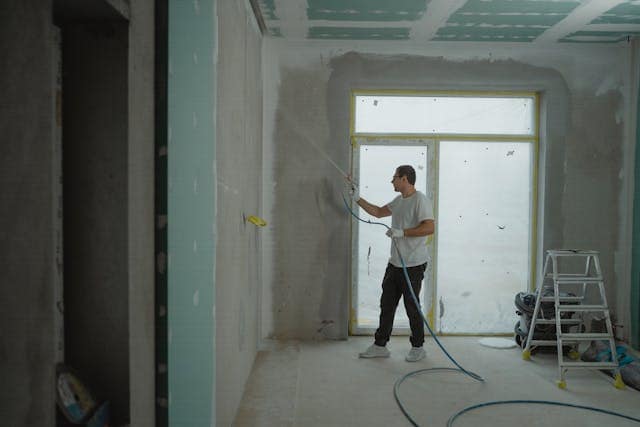
Choosing plasterboard is not only about sheet size or price. Standard plasterboard, fire rated plasterboard, acoustic plasterboard and moisture resistant plasterboard may look similar, but they are used for different rooms, finishes and performance needs.
For builders, dryliners and refurbishment teams, choosing plasterboard should start with the application, substrate, finish and performance requirements – not just the sheet size. MGN Builders Merchants helps customers match the right board to real site conditions, from standard wall linings and ceilings to moisture-prone rooms, garages, partitions and insulated drylining.
Comparing plasterboard types: Standard, fire rated, acoustic and moisture resistant
Different plasterboard types are designed for different site conditions. The main options include:
- Standard plasterboard – suitable for many dry internal walls, ceilings, partitions and general drylining jobs where no extra performance is required.
- Fire rated plasterboard – used where fire performance is part of the wall, ceiling or lining specification. Fire performance depends on the full system, including board layers, fixings, joints, framing and insulation.
- Acoustic plasterboard – used where sound reduction matters, such as bedrooms, home offices, flats, media rooms and internal partitions. Good sealing and the right wall build-up are just as important as the board itself.
- Moisture resistant plasterboard – designed for higher-humidity areas such as bathrooms, kitchens and utility rooms. It is not waterproof, so wet zones or tiled areas may still need tile backer board, tanking or a suitable tiling system.
- Insulated plasterboard – useful where internal lining also needs to improve thermal performance, especially on external-facing walls and refurbishment projects.
The key point is simple: the board should match the room, the build-up and the finish, not just the nearest available sheet size.
Choosing the right board for the room and finish
Start with the room conditions. A dry bedroom ceiling, bathroom wall, garage lining and separating partition may all need different plasterboard.
For most dry internal spaces, standard plasterboard is often enough. In humid areas, moisture resistant plasterboard is usually the safer choice. Where fire, acoustic or thermal performance is specified, use a board designed for that requirement rather than relying on a general-purpose sheet.
Before ordering, check how the board will be finished:
- skimmed with plaster;
- taped and jointed;
- tiled;
- painted after jointing;
- used as part of a fire, acoustic or insulated system.
This matters because the finish affects the board type, edge type, fixings and follow-on trades. A board that works well for skimming may not be the best option for a tiled wet area or a sound-sensitive partition.
When standard plasterboard is enough – and when a specialist board is needed
Standard plasterboard works well for many everyday drylining jobs, including:
- internal walls in dry rooms;
- standard ceilings;
- simple partitions;
- general refurbishment work;
- areas that will be skimmed or taped and jointed.
A specialist board is needed when the room or specification asks for more:
- use moisture resistant plasterboard in higher-humidity areas;
- use fire rated plasterboard where fire performance is required;
- use acoustic plasterboard where sound reduction is important;
- use insulated plasterboard where thermal improvement is part of the job.
Board thickness also needs checking. Common plasterboard thicknesses include 9.5mm, 12.5mm and 15mm, but they are not always interchangeable. The right thickness depends on the application, fixing background, performance requirement and finish.
Edge type is another practical detail. Tapered edge plasterboard is commonly used for taping and jointing, while square edge plasterboard is often selected where a skim finish is planned.
Final site checks: Thickness, edge type, fixings and finish
Before ordering plasterboard, check the details that affect installation and finish quality:
- Is the board for a wall, ceiling, partition or lining?
- Is the room dry, humid or moisture-prone?
- Is fire, acoustic or thermal performance required?
- What thickness and edge type are needed?
- Can the sheet size be handled safely on site?
- Are the right drywall screws, adhesive, tapes and jointing materials included?
- Will the board be skimmed, taped and jointed, tiled or decorated?
Plasterboard is only one part of the finished wall or ceiling. The fixing method, background, joints, accessories and finish all affect the final result.
Whether the job is a standard ceiling, bathroom lining, garage wall or sound-sensitive partition, choosing the right board helps improve durability, finish quality and site efficiency. A reliable plasterboard range for walls, ceilings and drylining projects makes it easier to match the board to the room, specification and final finish.


Leave a Comment