
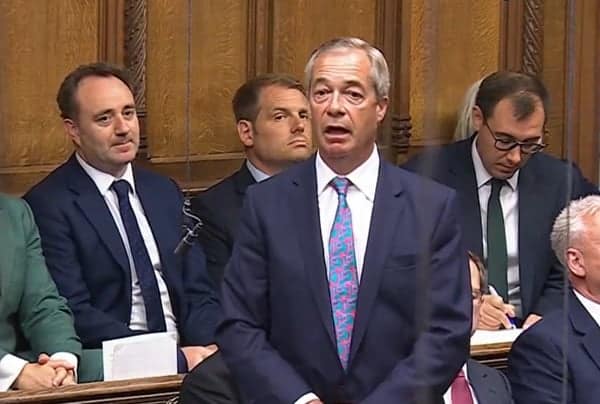
Nigel Farage has triggered a major political confrontation with Downing Street after intensifying claims that Britain is operating a “two-tier policing” system in the aftermath of the murder of Henry Nowak, prompting accusations from the Prime Minister that he has sought to “fuel rage” during a period of national grief.
The Reform UK leader used a series of interventions on X, in broadcast-style statements, and during Prime Minister’s Questions to argue that public confidence in policing is being undermined by inconsistent treatment across communities.
He claimed that senior policing guidance and wider institutional culture have led to differential approaches in how incidents are handled, warning that failure to address the issue risks “turning millions of law-abiding citizens against the police and the state”.
On Wendesday night, the Reform UK leader told his X followers: “When I spoke out yesterday morning about the appalling murder of Henry Nowak and the way in which he was treated by the police, the point that I was trying to make is the police forces themselves have become so obsessed with DEI and with not treating everybody equally, namely treating people differently if they’re white, as opposed to minority ethnic groups.
He added: “One thing I did achieve was to break the wall of silence, because we did not have senior political figures speaking up in outrage about what had happened.
“And my stuff on social media was watched by tens of millions of people.
Britain’s police are obsessed with DEI.
White people are not being treated fairly or equally under the law.
We must end two-tier policing. pic.twitter.com/JW5gTzrt37
— Nigel Farage MP (@Nigel_Farage) June 3, 2026
Farage’s remarks came following renewed attention on the case of Henry Nowak, whose killing in Southampton has become a focal point for political and media dispute over policing practice and public order. The Reform leader suggested that aspects of the police response — including the handling of allegations surrounding the suspect and earlier investigative decisions — reflected what he described as a growing pattern of unequal application of justice.
The comments have ignited a sharp backlash across Westminster. Keir Starmer accused Farage of exploiting a bereaved family and “pouring petrol on anger at precisely the moment restraint is needed”, arguing that his intervention risked inflaming tensions already visible in parts of Southampton following recent unrest.
In an unusually direct intervention at PMQs, the Prime Minister condemned the Reform leader’s rhetoric, saying he had ignored explicit appeals from the victim’s family not to politicise the case. Starmer said Farage’s decision to escalate the issue in public amounted to a deliberate attempt to stoke division, adding that leadership required “calm, not provocation”.
The confrontation was echoed across other senior political figures. Kemi Badenoch criticised the framing of the policing debate, warning that sweeping claims risk undermining public confidence in law enforcement institutions. Sadiq Khan also joined those expressing concern about the tone of the intervention, amid fears it could exacerbate tensions in already volatile urban settings.
Farage, however, has doubled down, insisting that he is voicing concerns shared by “growing millions” of voters who believe the criminal justice system is no longer applied evenly. He argues that official guidance to police forces has increasingly prioritised sensitivity to identity-related factors in a way that, in his view, compromises equal treatment before the law.
He also rejected accusations that he was responsible for stoking disorder, pointing instead to what he described as a failure by mainstream politicians to acknowledge public anger. In his view, the lack of immediate, high-profile political response to the murder case created a vacuum that has now been filled by public frustration and protest.
The controversy has spilled beyond Westminster into wider political discourse, with supporters of Reform UK claiming Farage is articulating concerns that are otherwise ignored by the political establishment, while critics say his language risks legitimising unrest and mistrust in policing at a sensitive moment.
The unrest in Southampton following the sentencing of the attacker has added further pressure on ministers, who are now facing competing demands: to defend the integrity of policing structures while also addressing perceptions of inconsistency in enforcement.
For Downing Street, the central concern is that the debate risks shifting from a contested but technical discussion about policing practice into a broader culture war narrative, with implications for public order. For Farage, meanwhile, the issue has become a defining political battleground — one that plays directly into his wider argument about institutional bias and declining trust in authority.
As tensions continue to build, both sides appear entrenched: the Government insisting that equal application of the law is already fundamental to policing in Britain, and Reform UK arguing that public perception — whether accurate or not — now reflects a deep and growing loss of faith in that principle.


Leave a Comment