
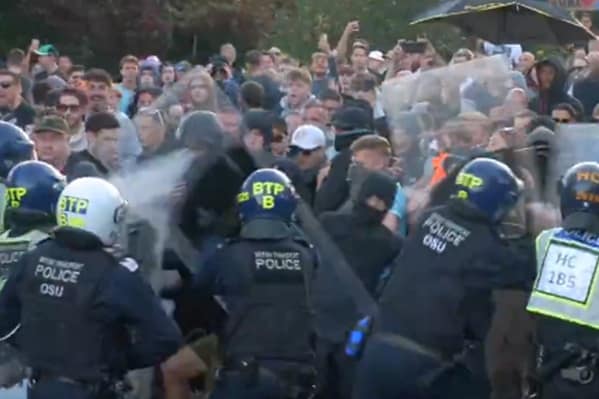
Ministers have urged the public to remain calm after violent clashes erupted between protesters and police near the scene of the murder of Henry Nowak, as mounting political pressure forces a review of controversial policing guidance accused of prioritising race over justice.
The unrest follows days of public anger over the handling of the 21-year-old student’s killing in Southampton, after body-worn footage showed officers handcuffing Mr Nowak while responding to claims from his attacker that he had been subjected to a racist assault.
In footage released by police, Mr Nowak can be heard repeatedly telling officers, “I’ve been stabbed”, only for one officer to respond: “Don’t think you have, mate.”
The disturbing images have ignited a national debate over modern policing, race policies and police priorities, drawing intervention from senior politicians and prompting demonstrations that spilled into disorder on Tuesday night.
Read more related news:
Police officer relocated after false Nowak case claims spark threats
Police credibility once again questioned after Manchester Airport assault prosecution falls apart
Farage demands ‘cold rage’ amid Hampshire police’s damning handling over horror killing
Henry Nowak murder sparks Lowe’s call for death penalty comeback ‘enough is enough’
Speaking after hundreds gathered outside Southampton Central Police Station, Policing Minister Sarah Jones acknowledged public anger but warned against allowing the tragedy to fuel wider tensions.
“We are urging that people take the anger that they feel, which I understand, but let’s allow justice to do its course, and let’s not over-react,” she said.
Her comments came after violent scenes unfolded when demonstrators marched towards the Portswood area of Southampton. Protesters chanting “Henry, Henry” confronted police lines, with officers pelted by bricks, flares, cans and chairs. Riot police were eventually forced to retreat alongside several police vehicles.
Two people were arrested on suspicion of assaulting police officers and possession of a weapon.
The political fallout has intensified pressure on the policing establishment. The National Police Chiefs‘ Council announced it would review elements of its anti-racism guidance after critics linked the case to broader concerns about identity-based policing.
The guidance forms part of the police Race Action Plan, which aims to improve outcomes for ethnic minority communities but has come under renewed scrutiny following the Nowak case.
Gavin Stephens, chairman of the NPCC, said police leaders were listening to concerns about how some commitments had been phrased.
“We are listening to legitimate concerns about how some of these commitments are worded or phrased, and where needed, we can and will make changes,” he said.
The controversy has rapidly become a flashpoint in Britain’s wider culture wars.
Kemi Badenoch accused what she described as “pernicious identity politics” of pushing Britain backwards, arguing that anti-racism initiatives had created confusion within public institutions.
Meanwhile, Nigel Farage claimed Mr Nowak had been “treated in a way that meant an accusation of a racial slur was treated more seriously than an act of murder.
The case has also attracted attention from figures including Tommy Robinson and Elon Musk, helping propel the story into a national political controversy.
Home Secretary Shabana Mahmood condemned the violence, saying protesters had sought to exploit a tragedy for political ends.
“The scenes were completely unacceptable,” she said, accusing demonstrators of “hijacking this tragedy to stir up violence and disorder”.
At the centre of the storm remains the death of Mr Nowak. His killer, 23-year-old Vickrum Digwa, allegedly told officers at the scene that he had been the victim of a racist attack shortly after the stabbing occurred.
For critics, the case has become a symbol of what they see as a policing culture too heavily influenced by race-conscious policies. For ministers and police leaders, it has exposed the challenge of restoring public confidence while preventing legitimate anger from descending into disorder.
As investigations continue, the Government faces growing demands not only for accountability over the handling of Mr Nowak’s final moments, but also for a broader reckoning with the principles that guide modern British policing.


Leave a Comment