
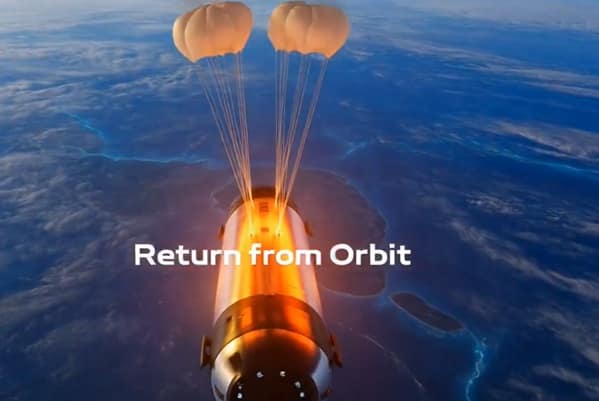
The US Federal Aviation Administration has cleared SpaceX to begin test flights of a new orbital return capsule, marking a fresh step in Elon Musk’s push to build a commercially viable “space economy” beyond Earth’s atmosphere.
The spacecraft, known as Starfall, has been approved for two re-entry trials into the Pacific Ocean, approximately 1,300 kilometres off the coast of California. The tests will assess the capsule’s ability to return cargo safely from orbit — a capability SpaceX hopes will underpin future commercial activity in space manufacturing and logistics.
The development places SpaceX at the centre of an emerging race to monetise low-Earth orbit, with the company seeking to move beyond satellite launch services into full-cycle orbital transport: launching, processing and returning goods from space.
According to the technical details released alongside the approval, the Starfall capsule is a compact, circular vehicle measuring 3.1 metres in diameter and 0.75 metres in height, with a total mass of around 2,100 kilograms, including a heavy heat shield designed to withstand atmospheric re-entry. The shield is jettisoned shortly before splashdown.
🚨 SPACEX JUST GOT FAA APPROVAL TO TEST ITS NEW “STARFALL” CAPSULES.
These are not regular reentry vehicles.
SpaceX’s new circular Starfall capsules are designed to bring up to 1,000 kg of payload back from orbit safely, repeatedly, and at scale.They can launch on either… pic.twitter.com/aY9AUN2hJG
— TheNewPhysics (@CharlesMullins2) June 2, 2026
The capsule is capable of returning up to 1,000 kilograms of cargo to Earth, using a combination of parachute systems — including drogue, pilot and main chutes — alongside cold-gas thrusters for attitude control during re-entry and descent. Recovery operations will be carried out by SpaceX’s maritime fleet after ocean splashdown.
While the test flights are initially focused on re-entry validation, the long-term ambition is considerably broader. SpaceX envisions Starfall as part of an “orbital manufacturing” platform, where materials are produced in microgravity before being returned to Earth for commercial use. Potential applications include high-precision semiconductors, advanced crystals and pharmaceutical compounds that are difficult or impossible to manufacture under terrestrial conditions.
In the longer term, the system is also being positioned as a rapid-response logistics tool, potentially capable of delivering cargo anywhere on Earth on compressed timelines when launched on suborbital trajectories via Falcon 9 or Starship systems.
Starfall is a game changer. Thank you, Elon Musk, for building the return lane for the future commercial space economy! 🚀🛰️
#SpaceX #Starfall #SpaceEconomy #ElonMusk pic.twitter.com/WoKQNlziAJ
— (N-A)المهيب (@al25azzani) June 2, 2026
The move could also reshape a niche but growing commercial space sector. Companies such as Varda Space Industries, Inversion and other emerging players currently rely on Falcon 9 launch capacity to deploy their own experimental return capsules. SpaceX’s entry into the same market risks turning it from infrastructure provider into direct competitor.
If successfully scaled, Starfall would mark a significant expansion of SpaceX’s industrial footprint — shifting the company further from launch services toward vertically integrated control of space-based production and return logistics.
No date has yet been confirmed for the first test flight, but regulatory approval suggests the programme is now entering its operational phase, bringing Musk’s vision of a functioning orbital economy a step closer to reality.


Leave a Comment