
China’s carefully curated image as a neutral broker in the Ukraine war has been strained by reports that its military quietly trained Russian personnel in advanced drone warfare and battlefield tactics in late 2025 — with some of those troops later returning to active combat.
According to intelligence assessments cited by Reuters, around 200 Russian servicemen underwent instruction at Chinese military facilities, including sites in Beijing and Nanjing, under a discreet agreement reportedly signed between senior officers from both countries.
The curriculum, if the documents are accurate, reads less like peace diplomacy and more like a modern war college syllabus: drone targeting, electronic warfare, counter-UAV systems, explosives handling and battlefield coordination. In short, the industrialised mechanics of 21st-century conflict.
Read more related news:
Putin’s war machine hit as Ukraine cripples Russian oil industry
NATO jet shoots down stray Ukrainian drone over Estonian airspace
Kremlin cries over the successful Ukrainian attacks on Moscow
Putin’s meat grinder army pays a catastrophic price and starts going backwards
Officials quoted in the reporting suggest some of those trained personnel were later deployed to occupied Ukrainian territory, including Crimea and the Zaporizhzhia region, where drone warfare has become central to Russia’s battlefield strategy. Beijing, for its part, maintains that it is not a party to the war and continues to present itself as a potential mediator.
That claim is becoming increasingly difficult to square with the expanding web of military and industrial contacts between the two powers.
The alleged training arrangement reportedly stems from a July 2025 agreement signed in Beijing, formalising instruction for Russian troops at Chinese facilities. Internal Russian documents described sessions involving drone spotting for artillery strikes and counter-drone techniques designed to neutralise Ukrainian unmanned systems — a defining feature of the conflict.
One European intelligence official suggested the development points to something more significant than quiet sympathy: a “deeper operational alignment” between China and Russia than previously acknowledged.
For Ukraine, already fighting a technologically evolving war of attrition, the implications are obvious. Its battlefield has become a laboratory for drone warfare innovation — and now, potentially, a training ground whose lessons are being exported via third countries.
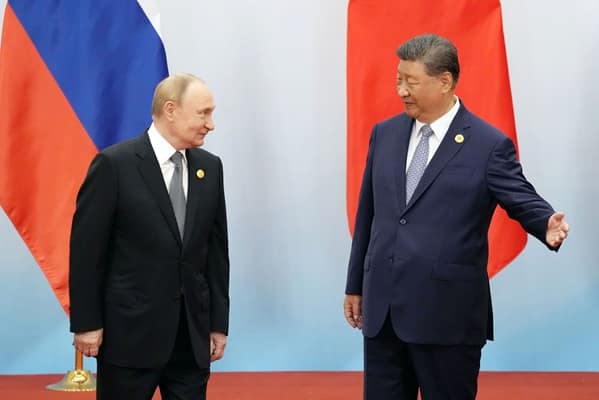
The timing is also awkward. The revelations come just as President Vladimir Putin is expected in Beijing for talks with Xi Jinping, amid continued declarations of a “no limits” partnership first announced shortly before Russia’s full-scale invasion in 2022.
China has repeatedly rejected accusations of direct military involvement in the conflict, insisting it respects sovereignty and supports peace negotiations. Yet Western intelligence services increasingly argue that the line between economic partnership, technological support and military enablement is becoming harder to define — and easier to cross without formal acknowledgement.
None of the claims can be independently verified in full. Beijing has not responded in detail to the specific allegations of training Russian troops, and Moscow has remained silent on the matter.
Still, the broader direction of travel is becoming clearer: what was once described as strategic alignment is, in practice, beginning to look rather more operational.


Leave a Comment