
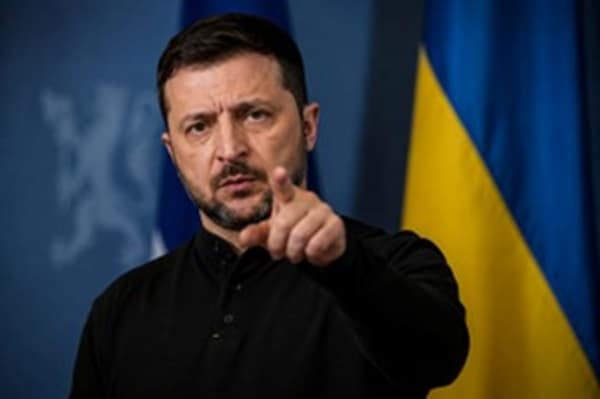
Volodymyr Zelensky has issued a direct personal appeal to Vladimir Putin to meet for negotiations aimed at ending the war in Ukraine, in an unusually blunt open letter that places responsibility for the conflict squarely on the Russian president.
Published on June 4, the letter offers a potential diplomatic opening even as fighting continues to intensify, coming just a day after Ukraine launched a large-scale strike on St Petersburg that hit an oil terminal and military-linked infrastructure during a high-profile economic forum attended by international delegates.
In his message, Mr Zelensky argues that the war is not the product of external pressure or geopolitical circumstance, but the result of a conscious decision by the Kremlin leadership.
“Almost half of your 26 years of power in Russia you have spent in the war against Ukraine,” he wrote. “Whatever you say about NATO, geopolitics and the Russian language, this war is your personal choice — a war without a real reason. This is how history will remember it.”
The Ukrainian president set out a catalogue of what he described as the consequences of the invasion, pointing to Russia’s failure to achieve its initial military objectives in 2022, the impact of sweeping international sanctions, mounting personnel losses and growing domestic strains inside Russia as the conflict drags on.
He also highlighted the increasingly direct effects of the war on Russian civilians, referencing fuel shortages, rising prices and disruption linked to Ukraine’s expanding long-range strike campaign.
“They do not like our drones and missiles,” he wrote. “They do not like the shortage of gasoline and the constant rise in prices.”
Mr Zelensky called for a neutral venue for talks, proposing a face-to-face meeting and suggesting an immediate ceasefire during negotiations, alongside a broader prisoner exchange framework.
“We need to determine what the future will be for all future generations of Ukrainians and Russians,” he said. “Ukraine offers to end this war.”
The proposal also urged the involvement of the United States and European partners, while warning against what Kyiv views as repeated Russian attempts to delay or precondition any meaningful dialogue.
But the Kremlin response was immediate and dismissive. Spokesman Dmitry Peskov reiterated Moscow’s longstanding position that any meeting could take place only on Russian terms, saying: “If Zelensky wants to meet with Putin, he can come to Moscow.”
The exchange underscores the continuing gulf between the two sides, even as diplomatic language has resurfaced alongside escalating military pressure. Moscow has repeatedly signalled conditional openness to talks, while simultaneously insisting on demands that Kyiv and its allies have rejected as tantamount to capitulation.
The diplomatic messaging also comes against a backdrop of shifting battlefield momentum. Ukrainian officials argue that recent operations, including deep strikes into Russian territory, are intended in part to alter the strategic calculus in Moscow by bringing the war’s costs closer to home.
Speaking earlier this week, Mr Zelensky suggested there is a limited “window” for diplomacy before winter, warning that opportunities for negotiation may narrow as the conflict continues into another year.
For now, however, the positions remain entrenched. Kyiv is offering talks and a ceasefire. Moscow is offering conditions and distance. And between the two lies a war that neither side appears ready to end on the other’s terms.


Leave a Comment