
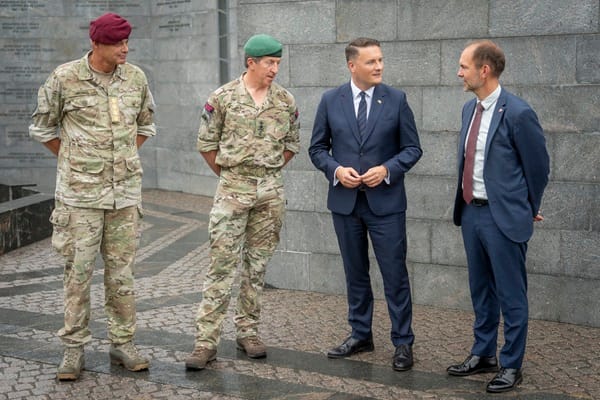
Britain faces its “greatest risk” of war in decades as Russia continues to test NATO defences, Defence Secretary Wes Streeting has warned, as the government prepares to make the case for a sustained increase in military spending.
Streeting described Russia and Vladimir Putin as the “biggest threat” facing Britain, arguing that the war in Ukraine and Moscow’s broader military posture had fundamentally altered the security environment facing the UK.
“Without a shadow of a doubt, the biggest threat facing Britain is Russia and President Putin,” said Streeting.
“We’ve got war in our continent. We’ve got a Russian president who has imperialist ambitions, who is constantly testing Britain’s defences, NATO defences and testing the strength of our alliances.
“And so, the sobering reality is that we face a greater risk of war than we’ve done at any point in my lifetime.”
Read more related news:
British bosses given secret Whitehall briefings on Russian attacks
Spanish fighters scrambled after NATO airspace breach
Poland tells citizens how to survive air attacks as Russia ramps up strikes
Russia builds huge nuclear command centre deep beneath the Urals
His remarks come ahead of the Labour conference, where Streeting is expected to set out the government’s plans for what it describes as the biggest sustained increase in defence spending since the end of the Cold War.
The government has increasingly presented military readiness as an economic and strategic priority, with Streeting arguing that higher defence investment is intended primarily to strengthen deterrence rather than prepare Britain for an inevitable conflict.
The Defence Secretary said he remained confident that the UK had what it needed to remain safe, but warned that this could change if military capabilities were allowed to “stand still” for five years.
“Strength builds deterrence, and deterrence makes it far less likely that we will end up in a place we don’t want to be – which is at war with Russia or, indeed, anyone else,” he said.
The argument comes as Britain and its European allies reassess defence requirements after more than four years of Russia’s full-scale war in Ukraine. Nato members have faced growing concerns over military probing, cyber attacks, sabotage and other activity designed to test the alliance without necessarily crossing the threshold of open conflict.
Streeting has separately described hostile states as probing Britain “on a daily basis”, warning that threats are becoming more complex and closer to home. In a speech this month, he said Russia was waging war in Europe while China was reshaping the economic and technological order.
The government has also put greater emphasis on emerging domains of warfare. Streeting has said Britain must strengthen its ability to protect satellites and other space infrastructure, with the Ministry of Defence announcing a new squadron dedicated to the UK’s “Control of Space” mission.
The shift reflects a broader calculation in European capitals that conventional military strength, industrial capacity and technological resilience have become central to national security.
Britain’s nuclear deterrent remains at the centre of its defence posture. A government update published this month said investment in the Defence Nuclear Enterprise was supporting more than 6,000 UK-based businesses and is expected to increase the sector’s workforce from about 47,000 to 65,000 by 2030.
Streeting’s warning also comes against a backdrop of heightened concern over British support for Ukraine.
In early September, former prime minister Boris Johnson accused Russia of attempting to bomb a train he was travelling on near the Polish-Ukrainian border. The allegation has not been independently established as a Russian attack.
Before that incident, a Russian spokesperson warned that Britain could face attacks from “unknown sources” over its continued support for Ukraine.
For ministers, the central policy argument is that maintaining a credible military capability should reduce the likelihood of direct conflict by increasing the potential costs for any adversary contemplating an attack.
Streeting’s language nevertheless marks a significant shift in the way the British government is describing the security environment.
The Defence Secretary is not predicting that war with Russia is imminent. Rather, he is arguing that the risk environment has deteriorated sufficiently to require Britain to invest heavily in readiness, technology and military capacity.
That calculation is likely to form a central part of the government’s defence agenda as it seeks to balance increased military spending against competing demands on the public finances.
The strategic premise is straightforward: Britain cannot guarantee that a major conflict will never occur, but ministers argue that credible deterrence can make it less likely that the country will ever have to fight one.


Leave a Comment