
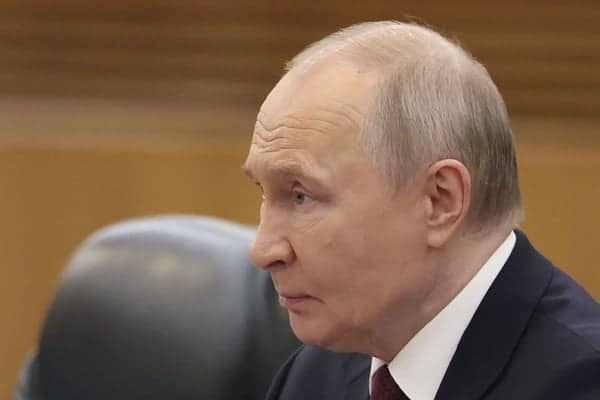
Vladimir Putin has long understood that wars are fought as much through narratives as they are through artillery.
Every economic setback is presented as temporary, every structural weakness as evidence of resilience and every warning from outside observers dismissed as Western wishful thinking.
His latest assessment of Russia’s economy follows that familiar script.
Pointing to 0.2% GDP growth during the first five months of the year, the Russian president argued that the economy continues to demonstrate remarkable resilience despite unprecedented sanctions and more than four years of war.
On paper, the figure allows the Kremlin to claim that Russia has avoided recession.
In reality, it tells a rather different story.
Growth of 0.2% for an economy mobilised almost entirely around wartime production is less a sign of strength than one of exhaustion. After years of extraordinary military spending, massive state intervention and emergency fiscal measures, Russia is now struggling to generate meaningful economic expansion at all.
That should concern the Kremlin.
The Ukrainian Center for Countering Disinformation argues that Putin’s selective presentation of the figures omits the far more uncomfortable reality. While highlighting a single month of federal budget surplus, he ignored the much larger picture: a budget deficit that has reportedly reached 5.7 trillion roubles during the first half of the year.
Context matters.
Budget deficits are hardly unusual during wartime. Britain, the United States and the Soviet Union all accumulated enormous debts fighting existential conflicts. The difference is that Russia is financing its war while simultaneously attempting to convince its population that life continues largely as normal.
That balancing act becomes harder every month.
Even the indicators presented as positives invite closer scrutiny. Putin cited expanding lending as evidence of confidence across the economy. Yet rising borrowing can just as easily signal growing financial pressure on households and businesses attempting to cope with inflation, falling purchasing power and tighter financial conditions.
Debt can support growth.
It can also conceal weakness.
Recent reports point towards broader structural strains. Analysts have highlighted declining financial reserves, stubborn inflation, mounting military expenditure and worsening fuel shortages that have spread well beyond isolated regions. Reuters has reported that gasoline has been redirected towards Moscow to preserve stability in the capital while shortages persist elsewhere, requiring increased imports from Belarus and purchases from India.
That is not how healthy economies normally behave.
None of this suggests Russia faces imminent economic collapse. Similar predictions have repeatedly proved premature throughout the war. Russia retains substantial industrial capacity, continues exporting energy and has demonstrated a greater ability to absorb sanctions than many Western policymakers anticipated in 2022.
But resilience should not be confused with sustainability.
Every economy has limits. Sustaining record defence spending while labour shortages intensify, reserves diminish and civilian sectors weaken inevitably creates trade-offs that become increasingly difficult to conceal.
Perhaps that explains the changing tone emerging from Moscow itself.
The Kremlin’s messaging increasingly alternates between reluctant acknowledgements of economic difficulties and confident declarations that everything remains firmly under control. That oscillation reflects a government attempting simultaneously to prepare the public for hardship while preserving confidence in the leadership.
It is a familiar political technique.
Yet history suggests governments usually become most insistent about stability precisely when stability is becoming harder to maintain.
Russia’s economy may not be collapsing.
Increasingly, however, it appears to be surviving through extraordinary intervention rather than genuine strength—and that is a far more fragile foundation than the Kremlin’s confident rhetoric would suggest.


Leave a Comment