
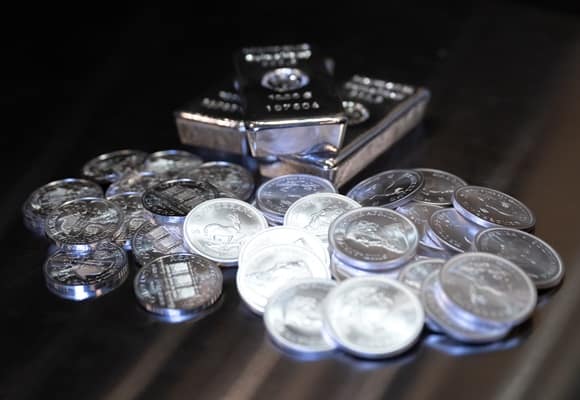
Silver is currently trading near $58.69, entering one of its most critical phases since the beginning of the year.
This is not because the metal has lost its underlying fundamentals, but because global market priorities have shifted.
Over the past several weeks, geopolitical tensions were the primary driver of precious metals. However, investors have now turned their attention back to U.S. economic data, which has become the dominant force shaping expectations for Federal Reserve monetary policy.
In my view, silver’s direction in the coming weeks will depend far more on the strength of the U.S. economy than on political developments, leaving investors increasingly cautious about building new long positions.
The latest U.S. ISM Manufacturing PMI reinforced the view that the American economy continues to outperform expectations.
The jump to 55.6 was more than just a positive reading—it signalled the fastest pace of manufacturing expansion in over four years. More importantly, the report showed improving employment conditions alongside persistent inflationary pressures, highlighting the resilience of the economy despite restrictive monetary policy.
In my opinion, these figures give the Federal Reserve greater flexibility to keep interest rates higher for longer and potentially delay any shift toward monetary easing if upcoming economic releases continue to surprise to the upside.
This is precisely where the main pressure on silver originates. Unlike equities, which often benefit from stronger economic growth, precious metals are directly affected by rising real yields and a stronger U.S. dollar. The more convinced investors become that the Federal Reserve will postpone rate cuts, the higher the opportunity cost of holding non-yielding assets such as silver and gold. For this reason, I believe silver’s recent pullback reflects a repricing of interest rate expectations rather than weakening physical demand. Investors are now treating every major U.S. economic release as a fresh vote on the future path of Federal Reserve policy.
At the same time, silver differs from gold in one crucial aspect—it is both a precious metal and a key industrial commodity. If global manufacturing activity continues to recover, industrial demand could provide an important layer of support, particularly as investment in renewable energy, electric vehicles, and semiconductor production continues to expand. Therefore, I do not believe strong U.S. economic performance is entirely bearish for silver. Over time, stronger industrial demand could offset part of the pressure created by higher interest rates. This dual nature makes silver fundamentally more complex than gold, with monetary headwinds competing against supportive industrial fundamentals.
Meanwhile, easing geopolitical tensions in the Middle East have reduced demand for safe-haven assets, contributing to recent weakness across precious metals. However, I view this as a temporary factor. Any unexpected escalation could quickly restore safe-haven flows into silver and gold. As a result, I do not expect investors to abandon silver altogether. Instead, many are likely to maintain strategic positions as protection against geopolitical uncertainty and potential disruptions in global energy markets.
Looking ahead, market attention is shifting toward a critical week of U.S. labor market data, including JOLTS job openings, ADP private employment, weekly jobless claims, and the Nonfarm Payrolls report. In my assessment, these releases will carry greater weight than comments from Federal Reserve officials because they will determine whether the current strength of the U.S. economy is temporary or sustainable. Another series of strong employment figures would likely reinforce expectations of prolonged monetary tightening, increasing downside pressure on silver. Conversely, signs of slowing labor market momentum could revive expectations for policy easing and provide the catalyst for a renewed rally.
Based on these macroeconomic developments, my short-term fundamental outlook for silver remains cautious rather than outright bearish. At present, there is little evidence suggesting the Federal Reserve is ready to soften its stance, while economic data continues to support confidence in maintaining restrictive monetary policy. Consequently, I expect any upside moves to remain limited as long as U.S. economic indicators stay resilient and the U.S. dollar remains firm. That said, I do not hold a negative long-term view. Silver continues to benefit from robust structural demand linked to global industrial growth while retaining its role as a defensive asset that can quickly regain momentum if interest rate expectations shift or geopolitical risks intensify.
Ultimately, I believe silver has reached a genuine inflection point where competing fundamental forces will determine its next major move. If U.S. economic data continues to outperform forecasts, downward pressure on prices is likely to persist in the near term. However, if economic momentum and labor market conditions begin to soften, market expectations could change rapidly, paving the way for a stronger recovery in silver prices. For investors, the key is no longer focusing solely on daily price fluctuations but closely monitoring every major U.S. economic release, as these indicators have become the primary drivers of silver’s outlook for the second half of the year.


Leave a Comment