
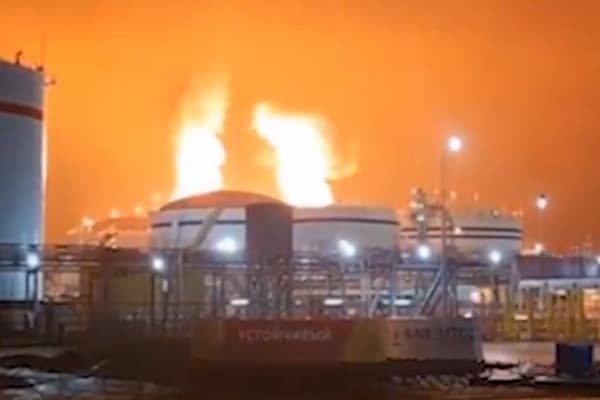
As Russia intensifies its campaign of strikes across Ukraine, with a marked increase in attacks on civilian areas and symbolic targets, a quieter, less visible shift is beginning to take shape inside Russia itself. It is not dramatic, and it is not unified, it’s definitely not an awakening, not yet, but cracks are forming.
From the ground in Ukraine, the escalation is clear. Strikes are becoming larger, more complex, and more deliberate in their messaging. Targets are not always purely military; historic centres and infrastructure hubs are increasingly part of the calculus, designed to resonate beyond Ukraine’s borders and compete for attention in a global news cycle now dominated by Iran and broader geopolitical instability.
This is a war that was meant to last three days, but is now deep into its fourth year with Russian losses estimated at over 1.2 million killed and wounded, a staggering cost for a campaign that has failed to achieve its original objectives. Meanwhile, Ukraine continues to absorb the humanitarian consequence, millions displaced, tens of thousands of children still missing or forcibly deported, and ongoing investigations following indictments by the International Criminal Court against Vladimir Putin and others linked to the war effort.
Read more related news:
Russia is set to shut a key oil pipeline in a fresh blow to Europe’s energy security
Alarm bells sound in Europe as spies warn Russia could escalate after Ukraine
Diplomacy goes off script as ‘Donnyland’ idea surfaces in Ukraine talks
Putin turns fuel boss as refineries keep catching fire amid Ukraine’s successful strikes
Russia’s oil network takes another hit as drones return for the night shift
Yet, despite the scale of the conflict, global attention is shifting. Humanitarian organisations struggle to maintain consistent visibility, while political narratives elsewhere absorb the oxygen, Iran and Trump dominating the news feeds, while signs in Russia, most certainly in a military sense, denote desperation and substantiated now by the actions we are witnessing inside Russia itself .
From the outside, the Kremlin’s control can appear absolute, but clearly that’s not the case. Since 2022, the Russian state has systematically dismantled the independent information space, blocking or restricting major Western platforms such as Instagram, Facebook, and Twitter, while applying sustained pressure on YouTube. Tens of millions of users have been effectively cut off from global platforms that once shaped public discourse and supported entire digital economies.
Telegram has since surged to become the dominant platform inside Russia, filling the vacuum left by blocked Western networks, but its role extends far beyond social media. In the absence of a resilient, widely accessible systems like Starlink inside Russia, Telegram has become a critical tool not only for communication, but for coordination. Both military personnel and pro-war channels have used it to share real-time updates, drone footage, targeting information, messages and battlefield narratives.
It’s a naive view to think Vladimir Putin isn’t getting information, or that he’s somehow insulated from reality. Authoritarian systems filter truth, yes, but they don’t operate blind. Decisions at that level are deliberate.
What’s happening in eastern Ukraine isn’t exaggerated,… https://t.co/HCIfoshspx
— Shaun Pinner (@ShaunPinnerUA) April 22, 2026
What began as a messaging app has evolved into a hybrid space, part information network, part operational tool, and part propaganda machine. This dual-use nature makes it uniquely powerful: a platform that can simultaneously support frontline coordination while amplifying Kremlin-aligned narratives to millions. In effect, Telegram hasn’t just filled the gap, it has become the battlefield itself.
But now, with restrictions and partial bans tightening, that advantage is beginning to fracture. The decision has drawn criticism even from within Russia’s own military circles, where Telegram has been relied upon for coordination and situational awareness. In many ways, it is a self-inflicted wound, disrupting a system they themselves came to depend on.
Ukraine, by contrast, has proven far more adaptive. Periods of Russian communication disruption have repeatedly been exploited on the battlefield, with Ukrainian forces capitalising on confusion and degraded coordination, contributing to gains of over 400 square kilometres in recent operations.
At the same time, legislation that criminalised criticism of the so-called “Special Military Operation,” with penalties of up to 15 years in prison. VPN usage, once a workaround, is now increasingly restricted, with thousands of services blocked or degraded. Even pro-war military bloggers are not immune. Figures such as former FSB colonel Igor Girkin, who criticised the Kremlin’s conduct of the invasion, have found themselves behind bars, despite not opposing the war itself, only how it was being fought.
“The 5th year of the war threatens economic catastrophe, and victory cannot be achieved simply through frontal assaults,” — Maxim Kalashnikov
The result is an information environment that is engineered, filtered, and tightly controlled, and yet, despite all of that, voices are still slipping through.
Not in the form of organised opposition, that has largely been dismantled or driven into exile, but in something more fragmented and, in many ways, more revealing. Questions are being asked, not ideological challenges to the war, but practical ones.
Is it worth it?
Is it worth dying in a trench in eastern Ukraine?
Is it worth sacrificing livelihoods and stability?
These are not the questions of activists, they are the questions of ordinary Russians, and increasingly, they are being echoed, carefully, by voices within the system itself.
That shift matters, because it is not being driven from outside, it is emerging from within the ecosystem the Kremlin has spent years constructing, controlling and one of the key drivers behind its economic.
When Russia moved to shut down or restrict Western social media platforms, it was not just a political decision, it carried immediate financial consequences. Influencers and content creators being one, who had built audiences and income streams on global platforms suddenly found themselves cut off from monetisation. Advertising revenues, brand partnerships, and international reach disappeared almost overnight. The pivot to domestic platforms has not compensated for those losses, audiences have fragmented, revenue streams have shrunk, and engagement has become harder to sustain as many live outside Russia like Victoria Bonya.
Even figures such as Pavel Durov, the founder of Telegram, have previously highlighted the tension between state control and digital freedom, warning that increasing restrictions are often less about security and more about maintaining influence over information flows. That tension is now visible in the behaviour of those operating within the system, stating these controls could be a prelude to mass mobilisation and additionally, the monitoring of descent.
Influencers face a narrowing path, too critical, and they risk prosecution, too compliant, and they risk losing what remains of their audience. The result is a careful balancing act, content that avoids direct criticism of the Kremlin or Vladimir Putin, but increasingly reflects the human cost of the war, the confusion surrounding its objectives, and the growing disconnect between official narratives and the lived reality.
It is not opposition, but it is not full compliance either, and to Putin, that’s incredibly scary.
In many cases, it manifests as justification, attempts to rationalize the war, to frame it as necessary or inevitable. Yet even these narratives often reveal underlying doubt, the need to justify, repeatedly and publicly, is itself an indication that belief is no longer absolute.
At the same time, it is important to recognise that a significant portion of the Russian population remains deeply isolated from the reality of the war. State media continues to dominate, casualties are obscured or reframed, and narratives are tightly controlled. From personal experience, including time spent in Russian captivity, it is clear that many individuals genuinely believe the war is justified, that it is defensive and that it is necessary.
That has not fundamentally changed.
What is changing is the environment around that belief, economic strain is increasing, mobilisation continues and losses accumulate. The impact on communities becomes harder to ignore, and now, increasingly, the tone of voices people trust is beginning to shift and reduce.
This does not signal imminent collapse, I must make that clear, because Kremlin’s control mechanisms remain strong, and repression remains effective, however, control is not the same as stability. Systems built on tightly managed narratives rely on consistency, and once those narratives begin to fracture, even subtly, they become harder to sustain.
What happens on the battlefield is now feeding directly into that dynamic, Ukrainian strikes on infrastructure tied to Russia’s war economy do not just have military implication, they create domestic consequences, disruption, uncertainty, and visible vulnerability that all feed into the same underlying questions, why is this happening, and how long can it continue?
So while many Russians remain silent on the bombing of children, attacks on passenger trains, or the “Kherson safari,” whether through fear of the law or belief in state propaganda, the loss of Telegram and wider social media has triggered a far more visible reaction.
For now, the Kremlin’s answer remains unchanged, maintain control, suppress dissent, and continue the war, but the narratives are becoming harder to manage and impossible to control. Not because they are just being challenged from the outside, but because they are beginning to shift from within.
Slowly.
But enough to matter.


Leave a Comment