
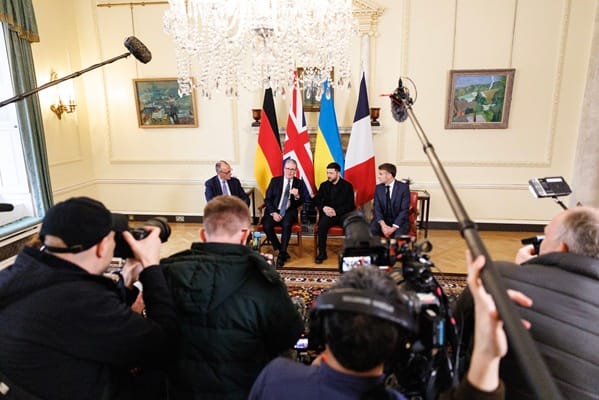
Yesterday’s meeting of the Coalition of the Willing was, on the surface, a show of resolve. Ukraine’s partners gathered to discuss the long tail of this war: how to sustain Kyiv, how to shape credible security guarantees, and how to prepare for a future that, on paper at least, includes peace.
The presence of Britain and France was central, not symbolic. Advanced concrete discussions with Ukraine on long-term defence cooperation, training, intelligence sharing, and the scaffolding of post-war security arrangements designed to deter another Russian invasion.
Germany’s role also loomed large. Under Chancellor Friedrich Merz, Berlin has moved decisively to anchor itself as a core European security actor rather than a reluctant partner.
Merz has been explicit about Germany’s position, stating that “there must be no dictated peace” for Ukraine and that Europe must be prepared to shoulder responsibility for its own security. That clarity matters and something I’ve been raising for several years. Europe, at last, appears to be getting its ducks in a row.
What raised eyebrows, however, was the attendance of Steve Witkoff and Jared Kushner. Their presence signals that parts of the U.S. political ecosystem are testing lanes beyond formal diplomacy, probing what leverage might exist, what incentives could be floated, and how messaging might land in Moscow.
Unfortunately, as seen repeatedly during the Trump era, commercial interests, reconstruction narratives, and deal-making have often risked taking precedence over human lives. Even the renewed discussion of firms such as BlackRock inevitably casts a shadow over proceedings, reinforcing concerns that money may once again come before people.
How many times have we fallen for the phrase “significant shift,” only to be kicked in the teeth, stabbed in the back, and then hear Trump repeat Kremlin rhetoric?
Putin isn’t going to sign any peace deal, he wants Kyiv.
That said, there is a power shift underway, and it’s… https://t.co/mByr9OtIxA
— Shaun Pinner (@olddog100ua) January 7, 2026
There were also reports that the Trump camp may be reassessing its tone following recent embarrassment caused by Vladimir Putin—who claimed his residence was attacked while simultaneously being photographed in camouflage and presiding over four years of systematic strikes on Ukrainian homes and government buildings.
Trump later appeared to rebuke those claims publicly, a rare moment of contradiction that underscored how detached Moscow’s narrative has become from reality, with propaganda now in overdrive.
That does not make the meeting unserious; it makes it revealing. When informal power brokers enter the room, it usually signals an attempt to shortcut a diplomatic maze that has resisted traditional approaches. Historically, however, particularly in the case of Witkoff, and given released transcripts of conversations with senior Kremlin figures, trust, which is essential for successful peace talks, is close to non-existent on the ground in Ukraine, especially where the Trump administration is concerned.
That said, Britain, France, and Ukraine reportedly aligned on the fundamentals: sustained military aid, accelerated industrial cooperation, and the principle that Ukraine’s sovereignty, not Russia’s preferences, must frame any settlement. That matters. It keeps the centre of gravity where it belongs: in Kyiv. Yet beneath the communiqués sits the unresolved, corrosive issue that has stalled every so-called peace conversation to date, Putin’s aims.
— Shaun Pinner (@olddog100ua) January 7, 2026
Those demands remain maximalist and unchanged: no NATO membership, no foreign troops on Ukrainian soil, and a de facto veto over Ukraine’s future security architecture. These are not negotiating positions; they are capitulation terms. They strip Ukraine of agency and ensure that any pause in fighting would simply reset the conditions for the next assault. That is why talk of imminent peace rings hollow for most people actually living in Ukraine and for those following the war and know Ukraine.
Last night in Dnipro, the war arrived again, sirens, impacts, and the familiar calculus of sheltering civilians. This is the reality that sits uncomfortably alongside conference tables and draft frameworks. While strategies are being sketched for 2026 and beyond, people are dying now. Families measure nights by explosions, not policy milestones.
To be clear, I welcome planning. Ukraine needs it. Deterrence needs it. Europe stepping up, Britain, France, and now a more assertive Germany are both necessary and overdue, however, we should be honest about the gap between planning and peace. As long as Moscow insists on denying Ukraine the right to choose its alliances and defend itself, there is no credible deal to sign.
So yes, plan for the future and build guarantees. Lock in European responsibility. But do not confuse preparation with progress, until Russia abandons its maximalist demands, for the war continues, and for those of us in cities like Dnipro, that is not theory.
It is tonight.




Leave a Comment