
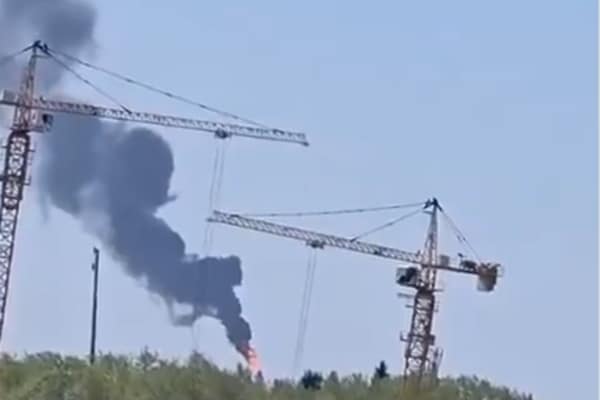
Ukraine has carried out one of its deepest long-range strikes of the war, hitting oil refineries in Russia’s Perm region, around 1,500 kilometres from the Ukrainian border, in an overnight drone attack that underscores Kyiv’s expanding strike capability.
Russian officials confirmed that industrial facilities in the Ural Mountains city were targeted, with regional governor Dmitry Makhonin saying an “enemy drone” struck a site in the area. He added that emergency services were deployed and that there were no reported casualties.
Local media and independent analysts said the Lukoil-operated Permnefteorgsintez refinery — one of Russia’s largest oil-processing facilities — was likely among the targets, with footage suggesting damage to the site’s infrastructure.
Analysts also reported damage near residential and administrative buildings, including a high-rise near a defence-related industrial plant. According to open-source analysis cited by Russian outlet Astra, a facility producing components for military aircraft engines was situated within several hundred metres of the blast area.
According to preliminary reports, Perm has once again come under attack from the Perm LPD
Against this backdrop, pressure is being rapidly relieved in the system at the refinery pic.twitter.com/7emUcaO1hs
— Exilenova+ (@Exilenova_plus) May 7, 2026
The Perm region, located deep in the Ural Mountains between Europe and Asia, is far beyond the range of most conventional battlefield activity, making the strike one of the more significant demonstrations of Ukraine’s long-range drone capability.
Ukraine later claimed responsibility for the operation. Robert “Magyar” Brovdi, commander of Ukraine’s Unmanned Systems Forces, said a unit carried out the strike on the refinery using long-range drones, in a post on social media.
Kyiv has increasingly targeted Russian energy infrastructure to disrupt fuel supplies and reduce Moscow’s oil revenues, which remain a critical source of funding for the war effort.
Ukrainian officials have argued that strikes on refineries and fuel infrastructure are intended to constrain Russia’s military logistics and economic resilience, particularly as global energy markets remain volatile amid wider geopolitical tensions.
President Volodymyr Zelensky has previously said such attacks have caused billions of dollars in damage to Russian energy infrastructure this year, though independent verification of overall losses remains limited.
Russia's refinery complex in the city of Perm has been attacked again, 1800km from Ukraine.
With all air defenses now protecting Moscow, the next few days are likely to be spectacular. pic.twitter.com/rC4zgsM854
— Jay in Kyiv (@JayinKyiv) May 7, 2026
Russian authorities have, in turn, acknowledged repeated strikes on oil facilities but have sought to downplay their strategic impact, citing continued revenues supported by elevated global oil prices and state subsidies to the sector.
The Institute for the Study of War has assessed that while Ukrainian strikes have put pressure on Russian refining capacity, Moscow has partially offset the losses through higher energy prices and financial support for domestic producers.
The latest attack highlights the continuing evolution of the conflict into a long-range war of attrition targeting industrial and energy infrastructure far from the front lines.


Leave a Comment