
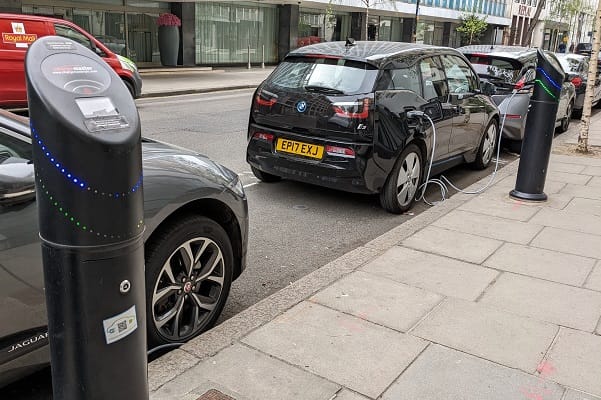
Local authorities based in London say constrained budgets and slow access to government funding are the biggest barriers to installing public electric vehicle (EV) charge points, according to a new national survey.
The research, based on responses from a total of 101* local authorities across England, Wales and Scotland, found that 60% of London councils cite pressure on council budgets as their main obstacle to expanding public EV charging.
Six in ten (60%) also say central government funding is a significant barrier, while 40% say lack of charge point location guidance is a major hurdle.
This compares to just 16% across the UK, highlighting the challenges in installing EV charging infrastructure in London’s densely populated local authorities.
Nearly a third (30%) say logistical and delivery challenges, including grid capacity and site constraints, are holding projects back, and the same proportion reference issues in navigating public sector procurement.
The findings come despite rapid growth in the UK’s charging network, with nearly 88,000 charge points installed across over 45,000 locations, and 27,895 chargers located in London**. But local authority-led deployment continues to play an essential role in this growth, and is crucial to ensuring coverage in residential areas, smaller towns and rural communities, and for drivers with no driveways or means to privately charge their vehicles. However, progress is being threatened by complex funding processes, administrative delays and infrastructure constraints.
The survey results are published in ‘Accelerating the UK’s EV future’, the latest Local Authority Insight Report produced by charge point operator (CPO) Believ.
London’s main barriers to EV charging point installation are:
=1. Budgetary issues (council budgets): 60%
=1. Budgetary issues (government funding): 60%
- Lack of siting guidance: 40%
- Logistical/delivery challenges: 30%
- Public sector procurement challenges: 30%
Resourcing was cited as a key reason causing local council budget pressures. Local authorities will, therefore, be greatly anticipating the rollout of the £200 million additional capability funding, announced in the Autumn 2025 Budget, that will fund more dedicated EV Councillors.
When asked to comment on the Local Electric Vehicle Infrastructure (LEVI) funding, most (80%) London councils stated a preference for more direct and targeted access to funds.
Guy Bartlett, Believ CEO, says the latest report shows that to accelerate the positive progress we have seen in local authorities’ EV charging infrastructure rollouts, we must address known barriers:
“The report is the only piece of research of its kind, talking to nearly a third of London’s local authorities, directly to the Councillors responsible for the EV charging rollout. And as such, we must act on the results,” he says.
“The clear and urgent priorities of unlocking funding, streamlining processes, expanding and signposting guidance must be addressed. The responsibility for this lies in tandem with the charging industry and government – with the right partnerships, the UK can build an EV charging network that works for everyone.”
Believ’s fully funded, end-to-end proposition empowers local authorities to accelerate charge point deployment, overcome financial and logistical barriers, and ensure no community is left behind in the UK’s drive for cleaner air for all.


Leave a Comment