
Ford has unveiled a sweeping overhaul of its European strategy, signalling a major shift in direction as the US carmaker moves to expand its line-up of electric, hybrid and commercial vehicles across the continent.
The Blue Oval will introduce seven new vehicles over the next three years, including two commercial models and five passenger cars, as part of its new “Ready Set Ford” campaign aimed at revitalising its position in a highly competitive European market.
The plans mark one of the company’s most significant product offensives in years and reflect a broader repositioning towards what Ford describes as “multi-energy” vehicles, combining internal combustion, hybrid and electric technologies.
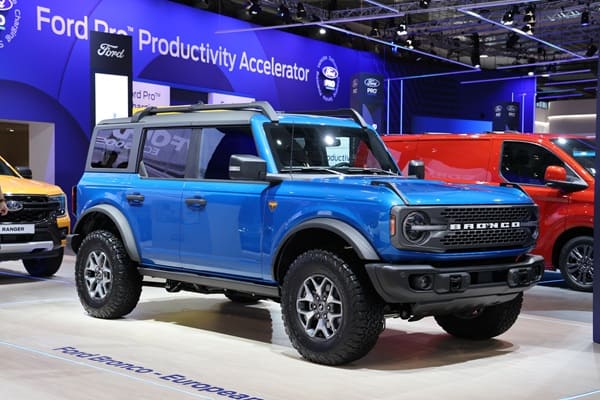
A key element of the strategy will be the expansion of Ford’s European manufacturing base, including production of a new compact Bronco model at the company’s Valencia plant from 2028.
The rugged SUV will form part of a wider global family of Bronco vehicles adapted for different markets, as Ford attempts to capitalise on growing demand for lifestyle off-road models in Europe.
The company also confirmed plans for a small electric hatchback, described as combining “distinct design with our signature driving dynamics”, as well as a new fully electric compact SUV with rally-inspired performance characteristics.
Two additional “rally-bred” crossover models are also planned, further expanding Ford’s presence in the fast-growing SUV segment.
In parallel, Ford will refresh its commercial vehicle range by introducing the Transit City and Ranger Super Duty models, designed to support businesses operating in urban low-emission zones.
The Transit City is expected to offer a range of up to 254km, with rapid charging enabling a full charge in just over half an hour, positioning it as a practical option for city-based fleet operators.
Jim Baumbick, president of Ford Motor Company in Europe, said the company remained committed to supporting customers through the transition to lower-emission transport.
He said Ford was “committed to supporting customers on the journey to a zero-emission future”, but warned that policy frameworks needed to reflect real-world demand.
He added that decoupling emissions targets from consumer behaviour would be “counterproductive”, calling for a more “customer-first approach” from policymakers.
Ford also urged governments to ensure that CO₂ regulations align with charging infrastructure rollout and supply chain realities, arguing that the transition must be achievable for mainstream buyers rather than dictated solely by regulatory timelines.
The company said it remained supportive of electrification but stressed the importance of continued investment in plug-in hybrids and extended-range electric vehicles, which it believes will play a key role in bridging the gap between petrol and full battery-electric adoption.
The strategy follows a period of recalibration for the manufacturer, which recently announced a $19.5 billion writedown linked to changes in its electric vehicle investment programme, including the cancellation or delay of several planned all-electric models.
A portion of the writedown also relates to the winding down of its joint battery venture with South Korea’s SK On, highlighting the scale of Ford’s strategic rethink in response to shifting market conditions.
Despite this, Ford said it still intends to launch a new affordable pickup truck priced under $30,000 next year, as it seeks to maintain competitiveness in the US market while repositioning its European operations.
The latest announcement underscores the growing tension facing global carmakers as they balance regulatory pressure, consumer demand and the high costs of electrification, with Ford now betting on a more flexible, mixed-energy future for its European business.


Leave a Comment