
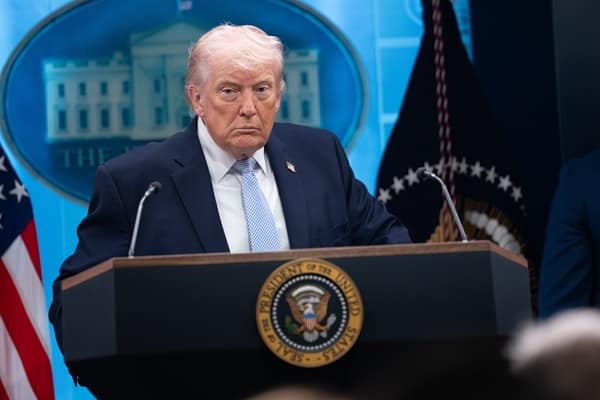
Despite Vladimir Putin launching the bloodiest war in Europe since World War II, as I wrote in an earlier article, it is Donald Trump who continues to dominate the headlines.
Strange, when you think about it, millions killed and injured, over 6 million internally displaced, an active terror campaign, and a Russian army pushing west, the very threat NATO was created to defend against.
Yet Trump continues to suck the oxygen out of the room on a daily basis, while Putin is shielded, handed lifelines, offered sanctions relief, and escalates his campaign in Ukraine with barely a fraction of the attention.
Following a difficult American-led campaign attacking Iranian targets, Trump has once again raised the prospect of withdrawing from NATO, yet another decision that ultimately benefits the Kremlin.
But this political theatre is darker. This is not just a misunderstanding; it is a deliberately projected misrepresentation of what NATO actually is, pushed across social media, amplified, and aimed squarely at a domestic audience and the MAGA core. NATO is a defensive alliance, built to protect its member states from attack, not to serve as a vehicle for ad hoc offensive military operations beyond its treaty obligations.
That distinction is critical, because the current escalation involving Iran was never, at any point, a NATO issue, which is exactly why Article 5 was never invoked, and now Trump wants to weaken Putin’s main adversary.
Trump is dominating the war conversation, this should concern us all
Article 5: Rare, serious and not for political use
Article 5 is NATO’s core principle: an attack on one member is considered an attack on all, but it is not automatic, and it is not symbolic. It is invoked only under specific conditions, namely, when a NATO member is directly attacked, and that has only been triggered once in history.
That moment came after the September 11 attacks, when allies rallied behind the United States in response to an unprecedented act of terrorism on its soil, something that now seems to be forgotten under the Trump administration, which has recently questioned allied involvement in countries like Afghanistan, creating backlash among the veteran community across Europe.
That precedent is critical because it shows how high the threshold is, and how seriously NATO treats collective defence. Iran is not attacking NATO territory, Israel is not a NATO member, and a U.S.-led strike in the Middle East, however complex, does not meet the criteria for collective defence. So when questions are raised about NATO’s role here, anybody claiming NATO “didn’t help” has either missed the point entirely, or is choosing to ignore it.
Trump’s pattern: Alliances as leverage
This is not the first time Donald Trump has threatened NATO. During his previous presidency, he repeatedly questioned the alliance’s value, framed it as a financial burden, and suggested the United States might not honour its commitments.
But the rhetoric has now evolved. It sits alongside broader, more aggressive statements about territorial ambition, including renewed discussion of acquiring Greenland and even references to action involving Canada. Whether intended as negotiating tactics or not, these statements signal a worldview where alliances are conditional and long-standing norms are negotiable.
That creates the kind of instability we are now seeing, not just diplomatically, but strategically. So who benefits from a weakened NATO?
Every time NATO unity is publicly undermined, one country benefits more than any other: Vladimir Putin. For years, Moscow has worked to fracture Western cohesion, politically, economically, and militarily. NATO remains the central obstacle to that objective, and having served under its command myself, I can say it is a formidable adversary. So when the alliance is questioned from within — particularly by the United States — it does not go unnoticed.
From Ukraine’s perspective, the implications are immediate. Weakened deterrence creates opportunity, mixed messaging from Washington creates space, and space, in this war, is something Russia has consistently exploited. It is the gap between peace and war where Moscow thrives, and now, increasingly, so does Trump’s White House.
Put simply: political division translates into battlefield risk.
Budapest: Where politics and strategy collide
This week, those dynamics were on full display in Hungary, and a trend is emerging. JD Vance travelled to Budapest and met with Viktor Orbán, a leader who has long positioned himself as neutral, but whose policies have repeatedly aligned with Moscow. Orbán has delayed EU sanctions, obstructed military aid to Ukraine, and consistently challenged Western consensus on Russia.
Hungary is also heading toward elections, and accusations of foreign interference are already surfacing. Orbán’s main challenger, Péter Magyar, has openly accused the United States of attempting to influence the outcome through the visit of JD Vance just days before Hungary goes to the polls.
That alone should raise concerns, but it doesn’t stop there.
New conversation transcripts released this week suggest ongoing coordination between Hungary’s foreign ministry and the Kremlin. At the centre of those reports is Péter Szijjártó, who has maintained close ties with Sergey Lavrov throughout the war. According to the emerging details, discussions included the real-time transfer of sensitive EU information, allowing Hungary to position itself to block or delay key funding decisions.
If accurate, this represents more than political alignment, it raises serious legal questions and points toward active interference in European processes, with direct consequences for Ukraine and broader EU cohesion, now seemingly endorsed by a visiting American Vice President.
JD Vance has aligned himself with what appears to be a Russian owned Hungarian Government.
Unbelievable 🤦♂️ https://t.co/NVOXXv6FK9 pic.twitter.com/0rc5MiPdHT
— Shaun Pinner (@ShaunPinnerUA) April 8, 2026
A government aligned or simply convenient?
Taken together, these developments raise a difficult question: is this coordination, or convergence? I think so. This is one of a number of decisions coming out of Washington that consistently make Putin’s Moscow the main beneficiary, including attacking Iran, while the U.S. administration now threatens to walk away from NATO over a conflict outside its remit.
Senior figures are now appearing to back political actors aligned with Moscow, like Orbán, while European partners are accused of sharing sensitive information with the Kremlin.
Individually, each can be explained. Collectively, they form a pattern that is deeply worrying, and repeatedly produces outcomes favourable to Russia.
The strategic reality
For Vladimir Putin, this is close to ideal. NATO cohesion under pressure, Western unity fragmented, political allies gaining ground within Europe, and Washington sending mixed signals at a time when clarity and support are critical.
Putin does not need a decisive military breakthrough if he can achieve political advantage instead, and in my view, the Trump administration is giving it to him in airdrop loads. But it’s not all plain sailing. Orbán is predicted to lose on April 12th, and Trump’s Iran debacle is expected to continue, adding to the disastrous midterm predictions. If that turns against him, it could see many of the doors begin to close for Putin.
NATO was never part of this fight with Iran. It was never supposed to be. But by threatening to walk away from the alliance over a conflict it was not designed to address, Trump isn’t just misrepresenting NATO’s role, he’s actively undermining the very structure that has kept the balance of power in Europe intact for decades.
And at a time when that balance is already under strain, that is not just reckless.
It is dangerous.


Leave a Comment