
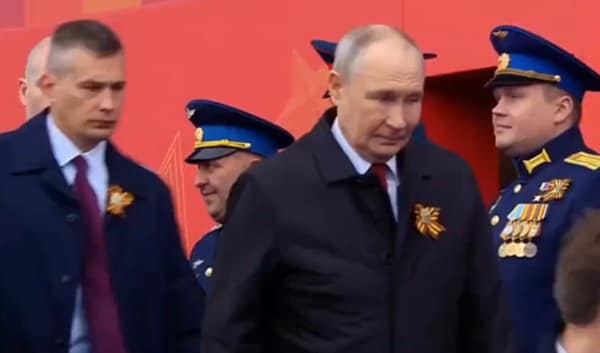
Vladimir Putin stated that the war in Ukraine is nearing its end, just hours after overseeing one of the smallest Victory Day parades in Moscow in decades.
“I think that the matter is coming to an end,” the Russian president told journalists on Saturday, while cautioning that the conflict remained “a serious matter”.
The remarks came against the backdrop of a heavily reduced Red Square commemoration that appeared to reflect both mounting battlefield pressures and heightened security concerns inside Russia.
Mr Putin used the occasion to renew attacks on Western governments for their military and financial support of Kyiv, accusing Nato powers of deliberately escalating confrontation with Moscow.
Read more related news:
Russia’s air travel has been ‘crippled’ as 13 airports are shutdown
Ukraine’s elite Azov Corps are back in Mariupol with drones out sightseeing
Russian frigate monitored by Royal Navy near UK wind farm for weeks
Fresh border tension as a reconnaissance drone discovered inside NATO
“They started ratcheting up the confrontation with Russia, which continues to this day,” he said, arguing that Western leaders had expected Russia’s statehood to collapse under sanctions and military pressure.
“They spent months waiting for Russia to suffer a crushing defeat,” he added. “It didn’t work out.”
Despite the defiant rhetoric, this year’s Victory Day celebrations were notably muted. For the first time in nearly two decades, heavy military equipment was absent from Red Square, with the parade consisting largely of marching formations under extraordinary security measures.
Attendance by foreign leaders was also sharply reduced. While allies, including Alexander Lukashenko, attended alongside delegations from Malaysia, Laos, Uzbekistan and Kazakhstan, several high-profile partners who appeared in previous years were absent.
The Kremlin’s increasingly defensive posture was further underscored by threats issued earlier in the week warning of possible strikes on central Kyiv, including diplomatic facilities, should Ukraine attempt to disrupt the commemorations.
At the same time, Moscow and Kyiv entered a temporary three-day ceasefire announced jointly alongside mediation efforts linked to Donald Trump. However, both sides quickly accused each other of violations as reports emerged of continuing drone strikes and civilian casualties.
The Kremlin has already indicated the truce will not be extended beyond the agreed period.
As part of the arrangement, Russia and Ukraine agreed in principle to exchange 1,000 prisoners each, though Mr Putin claimed Moscow had yet to receive formal proposals from Kyiv regarding the mechanism.
In remarks likely to provoke unease across Europe, Mr Putin also floated the prospect of discussing a future continental security framework, naming former German Chancellor Gerhard Schröder as his preferred interlocutor.
The suggestion drew inevitable scrutiny given Mr Schröder’s longstanding personal relationship with the Russian leader and his past involvement with Russian energy interests, including the Nord Stream projects.
Meanwhile, Ukrainian President Volodymyr Zelenskyy used Europe Day celebrations to emphasise Ukraine’s alignment with the continent, declaring the country “an inseparable part of the European family”.
The contrast between the two leaders’ appearances was striking: one presenting a scaled-back military spectacle under tight security in Moscow, the other framing Ukraine’s future firmly within Europe despite a war now entering its fifth year.


Leave a Comment