
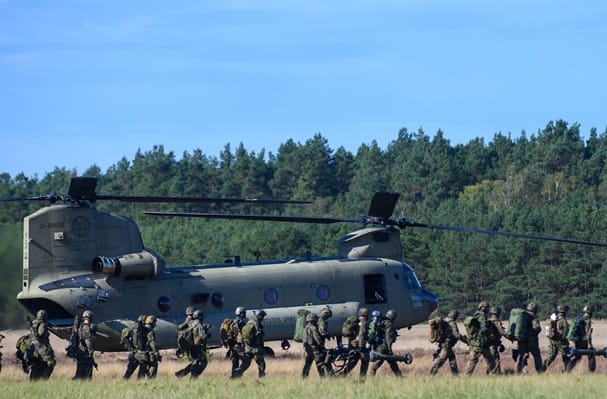
US troops are returning to Lithuania as the Baltic state strengthens its defences on NATO’s eastern flank amid continuing concerns over Russia’s military posture and the security of the region.
Lithuanian President Gitanas Nausėda said a new rotation of American forces was already on its way to the country, ending months of uncertainty over the future of the US military presence there.
“I have just received confirmation that the new rotation of US troops is already on its way to Lithuania,” Nausėda said.
He thanked US President Donald Trump and his administration, describing the deployment as important for Lithuania and the wider region.
“The US military presence in Lithuania is an indispensable part of our deterrence and collective defence,” Nausėda said.
Lithuanian Defence Minister Robertas Kaunas subsequently said two US battalions were expected to arrive towards the end of October.
Read more related news:
Europe braces for war as hospitals prepare for 1,000 wounded NATO troops a day
Commander warns Russia is testing NATO with ‘more dangerous’ covert attacks
Pentagon warns Russia ‘will use drones launched from the sea’ across the West hidden in cargo containers
Russian drones trigger alerts across NATO airspace scrambling fighter jets
One will be a heavy armoured battalion equipped with Abrams tanks and other heavy equipment, while the second will be an engineering battalion intended to support Lithuania’s developing national division and strengthen border defence.
The deployment is expected to involve about 1,000 US personnel and last for nine months, broadly continuing the rotational arrangement that has been in place since 2019.
Kaunas said the arrival of the American forces would “greatly contribute to the development of our national division, to the strengthening of our border defense and security”.
The Lithuanian minister also raised the possibility of establishing a permanent US military base in the country, although no decision has been taken on the proposal.
“This is a fresh new proposal, but considering the regional security situation and the cooperation between our countries, I think it is logical to consider such an idea,” Kaunas said.
The renewed deployment follows months of uncertainty over Washington’s military footprint in Lithuania. More than 1,000 US troops began leaving the country earlier this year after completing their previous rotation, while Lithuania waited for confirmation of the next contingent.
The uncertainty formed part of a wider US review of its military presence in Europe. Washington has been examining how American forces are deployed across the continent, with the Trump administration pressing European allies to assume greater responsibility for their own defence.
For Lithuania, which borders both Russia’s Kaliningrad exclave and Belarus, the continued US presence has particular strategic significance.
Lithuanian Foreign Minister Kęstutis Budrys said the American deployment represented a return to “large numbers” of US forces and described the presence as a key element of regional deterrence.
The decision also comes as Lithuania invests heavily in its own military capabilities. The country has significantly increased defence spending since Russia’s full-scale invasion of Ukraine and is developing a national division intended to strengthen its ability to defend its territory.
Estonia has also confirmed that the US will maintain its military presence there.
Estonian Foreign Minister Margus Tsahkna described the continued deployment as “a strong signal of Allied unity and important element of deterrence and defence on NATO’s eastern flank”.
The Baltic states have repeatedly warned that Russia represents a long-term security challenge, although there is no indication that a Russian invasion of Lithuania is imminent.
The renewed US deployment nevertheless comes against a backdrop of heightened concern about Russian military and hybrid activity across NATO’s eastern borders. NATO allies have faced repeated incidents involving drones, cyber operations, sabotage allegations and airspace violations since the war in Ukraine began.
The US troop rotation therefore carries significance beyond its headline numbers. For Lithuania, the presence of American troops provides a visible link between its national defence and NATO’s wider collective-defence structure.
For Washington, maintaining troops in the Baltic states demonstrates that the review of its European military posture does not necessarily mean an end to its forward presence in countries most exposed to Russia.
And for the region, the arrival of American armoured and engineering units is another indication that NATO allies are continuing to reinforce their eastern flank while Russia’s war in Ukraine remains unresolved.


Leave a Comment